A Fast From Buying Clothes

bokeh-173588_1280

It started out mostly from a whim, and then from the intrigue of a challenge.

I like to be pushed, and I like the idea of minimalism and less consumerism.Could I really do this? Could I stick it out for a whole year? I decided to try.

So at the end of February 2014 I agreed with myself that I wouldn’t buy any clothes until March 1, 2015.

It was a really good experience, a good year. I learned valuable things such as:

  • contrary to what I used to think, a woman really can have too many scarves.
  • you save great amounts of time and money walking past used clothing stores.
  • you save great amounts of regret if you don’t walk inside used clothing stores.
  • life goes on even after you walk away from something you really, really want
  • there’s always next year
  • if you don’t wear a jacket more than twice a year, you can get rid of it painlessly.

Some things that helped:

  • I told a couple friends what I was doing, so they could hold me to my word
  • I liked the clothes I had (most days)

Part of what took me to this kind of action is that I’m moving out of the country this summer. After living here 5 years, I’ll need to condense my stuff into probably no more than 2 suitcases. Every piece of clothing will need to be weighed (literally) and culled according to its value and serviceability.

It’s a great discipline for someone like me who idealizes doing with less and simplifying life. I’m not interested in being shabby and thread-bare, but I despise being bothered with stacks and shelves and boxes of Stuff to Wear.

Probably it’s harder for a Mennonite to maintain a good working philosophy of buying clothes when you/I can find them so cheaply. In our Polish backwater town, there are more used clothing stores on any given block than I’ve seen in any other town, and the siren call is out there every day. It appeals to our thrill of the chase, and the victory of getting more with less.

But sometimes, for whatever reason and whatever season, it’s good to say a hearty, clarifying NO. It’s surprisingly freeing. Part of discipline, I think, means carrying out a decision that you made well before the heat of the moment. It’s empowering to walk past something you really want and to know that it didn’t get the best of you.

And now that I can buy clothes again, I’m having fun, fun, fun!

Maybe it’s because I have a hard time moderating moderation and tend toward being all-or-nothing. Maybe it’s because I treasure the privilege I have now to buy some nice things.

Two anecdotes:

  • The day before March 1 was a Saturday and I had some free time, so I asked my friend to come with me to give me advice on buying a piece of fabric for a Simple Clothing Project that I’d been dreaming about for months. I bought it (it was more expensive than I’d expected) took it home, did what the recipe said, and it was a dismal failure.  I think there’s hope for it, but for now, it’s crumpled up on the floor, waiting for its redemption. I don’t think it’s a punishment for breaking the fast a day early but maybe it’s a lesson about not rushing into things and being humble enough to do a trial run first.
  • The one time I allowed myself to go into a used clothing store (to buy scarves for a project I was doing for friends) I saw this perfect, beautiful linen/cotton white top. It was really painful to walk away from it, but I managed. It haunted me for a long time. Would I ever find one so perfect again? Months later, I went to Jerusalem and was shopping in the old city and several times I walked past a white top that caught my eye. My friends said I should just ask about the price. I did, and about 15 minutes later, left the shop, wearing the piece! In the process, I learned how to bargain, which was hysterically fun. Do I miss that first linen top? Not for a skinny minute.

To wrap up: fasting isn’t fun. I haven’t girded up my courage yet to fast from second helpings or from chocolate. A year’s clothing fast was the thing I needed to do that was hard, but not impossible.

I don’t know what you’re grappling with, but you might need a fast from whatever it is that is getting the best of you. It could be music, work, entertainment, stuff, people–anything. For some do-able season, for some honorable reason, can you say NO? The discipline will make you stronger than you realized you could be and teach you surprising things.

Who knows? You might learn to bargain with a dramatic Middle Easterner.



Mixed Media

crayons-623067_640

I’d been breathing different air all day because of a lighter teaching load, and a field trip to the library for my babies’ class, my affectionate term for my six and eight year olds. We read Dr. Suess stories in honor of his birthday yesterday and ate marshmallows and, back at school again, colored green eggs and ham pictures for the wall.

A side-note: In this school, we LOVE Dr. Suess! He makes our job easier and more pleasant in many ways. I love the magic of the babies stumbling to sound out English and hearing words fall off their tongues and catching the hang of the rhythm even if they don’t understand all the words. I laugh with them at all the crazy creatures and the colorful feet. If you’re trying to elicit language, these stories help!

Then I had a no-show student, and another cancelled, so I could go home early. On the way, I walked past a gift and art supply shop, and stopped to see the new window display and gasped at the beautiful new mugs. Every day, this proprietor changes at least one of the three window displays and I get huge pleasure out of just looking at things as I walk past. They’re always closed when I pass in the evening, but now I was earlier than normal, and remembered I needed some paper for a project and couldn’t resist the siren call.

This shop is cram-jam full of porcelain and glass and canvases and frames and notebooks. The walls behind the counter are covered and double-stacked with paint tubes, brushes, pastels, and more pens and pencils. I always imagine the paint flying out of all the tubes to create fantastic bright swirling designs in the space above it. This place holds endless possibilities to plan and dream about but I knew I had to keep moving because it was minutes before the shop closed and I didn’t want to make them impatient.

The younger shop assistant helped me graciously with a mixture of English and Polish and found the paper and pen I needed. The older lady appeared in her fluffy, elegant, white chignon, looking the perfect part of an art patron. I paid, but couldn’t quite leave. I just stood a couple seconds and looked around and sighed and said smiling, “I want many things.”

A rollicking chuckle came out of the girl, and she said, “Me too!”

Laughing with a stranger who speaks a different language from me is simply wondrous.

Even in Australia

A couple Sundays ago, I was bogged down in terrible language fatigue. I was lost most of the morning in the general assembly, and also later when (trying to) talk Polish with friends. It was like my tongue was thick with fur and my brain was frozen, gooey molasses, and I don’t want to admit it, but I was so disheartened I went to bed and cried.

The next day, I spent several hours at my friend’s house. She fed me and made me tea and her children were angelically happy and quiet and friendly. She and I talked of life and questions with no answers and miracles, and it was most relaxing and soul-nourishing.

While I was driving home, it came to me: those hours were Polish submersion and I hadn’t even thought of it. My friend knows enough English that I could switch to that when I got stuck, but language was no barrier that day. I was amazed.

I told this story to my Polish-friend-who-lives-in-Ireland, and she nodded with a simple explanation: “Good days, bad days.” She knows what she’s talking about it, and she’s right.

Saturday I trotted over to the market to buy my fix of pickles. The sun was trying to shine, it was a weekend, there was a dusting of snow around–it was a nice morning. But all the adults I passed were scowling. They met my eye with such misery and coldness that it made me shiver and want to cry and keep my eyes to the ground.

But the little girls in the line behind me were enjoying the snow, throwing little snow balls at each other, and one snowball nearly flew into the pickle barrel. The twinkly-eyed lady who fishes out the pickles for customers looked up and SMILED! She didn’t scold the girls for disturbing her, and I wanted to hug her. She and the little girls were the only bright spots in the market.

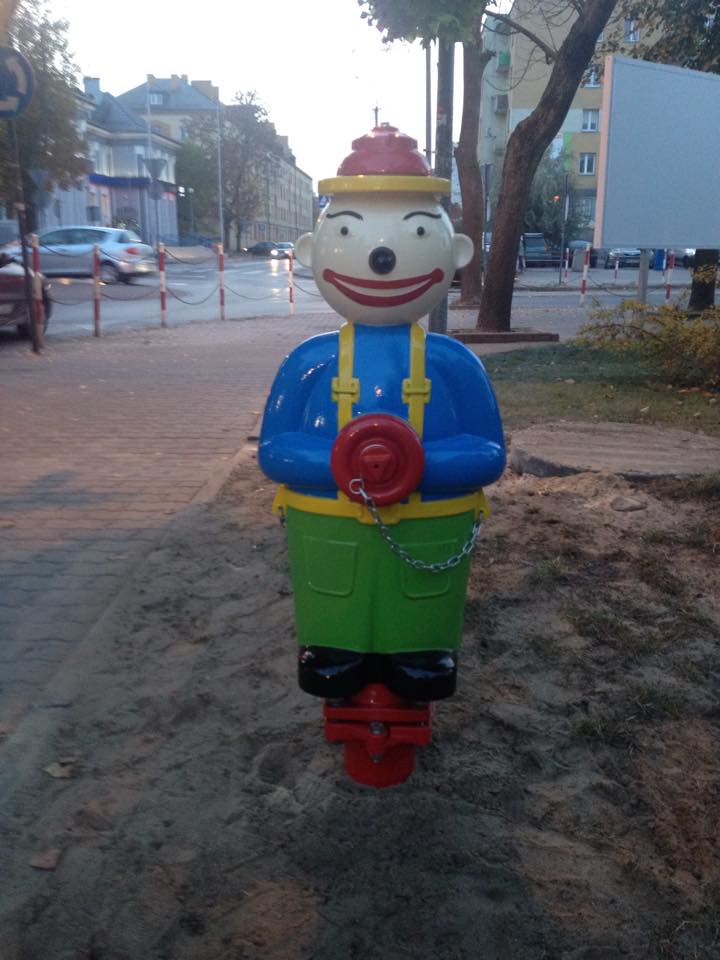
Then I walked down another street, past more Very Grumpy People, and my heart was breaking for their bleakness and joy-less expressions. I walked past this fire hydrant, a colorful character who is slowly reclaiming this town from its former grim communist grey.

Here he is in the summer:

10711059_808386075851615_5789464786393362353_n

but Saturday, in the cold wind and snow, someone had carefully put a stocking cap on his head. I chuckled aloud, and felt better the whole day.

Good days, bad days. Bad minutes, good minutes.

I tend to be all-or-nothing, so when it’s a bad day, it’s a Really Horrible Terrible Day and nothing will ever be right again. When I grow up, I hope I can remember to keep calm and not panic because the good minutes always come again.

Even in the winter, even in Poland.

*Photo credit: Ola Kierska


Beyond Money

We completely wore out the fun Grinch story. I’m happy not to hear it for another year. So I chose to read Tolstoy’s “Papa Panov’s Christmas” to one student on Saturday. The story about the shoemaker expecting to see Jesus has many versions and translations, and this one was abbreviated, but even so there were some phrases and words that challenged my high intermediate level student.

To help her be able to take it in more easily, I read slowly, deliberately. When the cobbler kept watching the window for Jesus, I suddenly felt my throat constricting and slowed my words even more so I could control my shaking voice. Maybe he had missed his visitor? I felt his ache of disappointment. When the cold girl came with her hungry baby, my student’s eyes brightened and she interrupted: “I think she is Jesus!”

When we finished the story, she said she’s going to find it in Polish so she can read it to her children. No one ever said that about the Grinch story, even though we got lots of class mileage out of it.  In his simple story, Tolstoy encapsulates the deepest longings and satisfaction of the human experience, and I felt honored to share it with my student and see her understanding.

Outside our apartment block is an outdoor market. At any time, I love shopping there, but these days leading up to the holiday season, it’s an Experience. I stood in line at the little old lady’s stand with the big blue barrels of sour kraut and pickles (the best in the town, everyone agrees). Beside us was another stand with three enormous square tubs that held maybe a foot of water crowded with dozens of fat, gasping carp. I tried to watch discreetly and not be too slack-jawed but all I wanted to do was stare and shake my head.

Older people stood in line at the tubs (my observation is that no one younger than 40 is willing to buy live carp and kill them) and carefully pointed to the fish they’d chosen. The beefy men selling them would scoop out the carp, weigh them, and pop them into trash bags. It was serious business. I couldn’t decide if the men were so serious because they were opportunists taking advantage of the tradition and the old people, or if this is simply the way things are done. I’ve been told that carp is the high point of the Christmas eve meal, so clearly buying, killing, or selling it is not a joking matter.

In other parts of the market, people were laughing and talking and exchanging wishes. I bought half a meter of beautiful lace for some presents sometime, and the ladies were so relaxed and positive and pleasant and wished me a merry Christmas as I left. Celebrating this season in a Polish town is so rich that I think everyone should be jealous of me.

This morning I had my last session of the year. My student is 71 or so, a retired Russian language teacher, and she had asked that this lesson would be Christmas carols. So I prepared music and lyrics for my favorites, “Lo How a Rose” and “O Holy Night.” She came with an elegant centerpiece she’d made with greenery from her garden, plus a box of butter cookies she’d made, plus 2 CD’s so we could listen to her favorite Polish carols. I made green tea for us, and we listened to the songs and sang along as we wanted, and drank tea and I munched her cookies and chatted in Polish because, well, it’s easier for her than English.

At the end of the hour, she was preparing to pay for the lesson, and I put my hand on hers to refuse it, saying today wasn’t a lesson, only pleasure, and I can’t take money for it. It wasn’t an English lesson, any way you look at it. “No, Anita, I beg you” she said, “You’re young and you need things. Please take this to buy what you need–maybe carp, or some meat?” She was dead serious.

The weather outside is frightful –driving rain coming horizontally in strong wind. No snow in sight. I hang onto my hood, walking home, and I’m sooooooooo glad vacation has started, and there are a million things I’m happy about, but something more than rain is making my cheeks wet.

The things I need are beyond money. What I have is more than I can hold.

Battery Recharging

Yesterday our American group of 14 adults and children had a glorious time of celebrating Thanksgiving. Never mind that Thursday was a normal work day in Poland and none of our friends and neighbors know what the holiday is like. We still wanted to hang onto it, so we set aside Saturday afternoon and evening for that purpose.

As a mid-dinner activity, our hosts passed around a big brown bag. We were all to reach in without looking and pick out the first thing our fingers touched. Among the items was a candle, screwdriver, spool of twine, and mine was a battery. Then we all took turns saying something we’re thankful for, connected to the object in our hand.

I said that I’ve been thinking a lot of a year ago, and how sick I was, and after the surgery, my battery was completely out of power, but now it’s pretty much like new, and I’m so grateful.

I don’t do well with improv so of course afterward I thought of lots more I could have said.

Like how grateful I am for the previous day that recharged my batteries. Can I tell you about it?

First, I tidied up the house and laundry, and started preparing the stuffing I was making for the next day’s Thanksgiving dinner. Then Jewel and I went to a friend’s place in the country to find greenery. There were so many beautiful colors and textures of pine that we could hardly stop, and loaded arm loads of it into the car. Then we went to another friend’s place to pick up pine cones from the forest floor. The husband and wife came out to the car to welcome us, and I showed my bag I’d brought to put the pine cones in. The mom said something to the young boy who ran down the hill and came back up with a feed sack full of pine cones. So all I had to do was put them by handfuls into my bag.

“Come in and have tea with us, please? You haven’t been here for two months!”

We couldn’t say no. The youngest girl put out cups and saucers on the coffee table and the mom brewed her winter tea: Lipton with cinnamon, cloves, and lemon slices. As we drank, we chatted (all in Polish) and found out they were doing homework for their foster care classes.

“I wrote a story for my assignment. Can I read it to you?”

We said yes please, but please explain it to us in simpler Polish. “Oh, it will be simple, because it was written for three year olds.”

And it was, and it was a magical moment huge battery recharge, sipping sweet, spicy tea, listening to a new darling story about a little rabbit. Its burrow was broken and its mom was sick so the mice took it to their house, and wrapped it in cozy blankets and fed it hot soup. They gave the rabbit a mirror so that he could see someone who looked like himself.  awwww!

Back home again, we finalized supper plans for 4 guests, and I put together Greek marinated chicken which I’d never done before and finished the stuffing preps and brought in the armloads of greenery.

With Messiah coming from the speakers, I arranged greenery and candles and stars on the coffee table and window sill. I couldn’t believe how the time flew as I deliberated colors and arrangements.

Our friends came at 6:30, the meal was a success, and we played games and talked and laughed til late. The dancing candlelight in the background gave me so much joy on top of everything else.

At the end, I was tired, but my battery was completely recharged. It had been a hard week. I’d had a stomach bug all week and couldn’t eat much and lost considerable sleep because I was fretting about things I couldn’t control. I’d cleared this day’s plans so I could stay home and do as little as possible. But despite those changed plans, in one day, so much energy came surging back.

Recharged batteries takes a certain level of self-awareness because it takes place when we don’t consciously make it happen. What are you doing when time is immaterial to you? When do you feel yourself relaxing and breathing deeper and slower? What happens to make you start laughing or humming to yourself?

For me, it happens when I

  • try new things, experiment, explore (it was Greek marinated chicken that day)
  • step out of routine
  • work with my hands
  • socialize
  • eat chocolate
  • handle color and texture
  • work with words

God made us so intricately, with so many layers, and I don’t know how it works that one layer affects so many others. I only know that He is very, very good to me in giving me so many ways that help recharge my battery and power up for the new week.

9754012931_b19806b32c_m

Photo Credit:

<a href=”https://www.flickr.com/photos/46151146@N04/9754012931/”>Takashi(aes256)</a&gt; via <a href=”http://compfight.com”>Compfight</a&gt; <a href=”https://creativecommons.org/licenses/by-sa/2.0/”>cc</a&gt;

We Have Only to Look

the winds of skagit.

Recently I read the book The Glass Castle by Jeannette Walls. It’s the riveting story of her childhood, raised by her artist/hippy/rebel/paranoid parents who were always on the run. She writes with great candor and grace, never bitter about how she got dangerously burned while boiling hotdogs at age 3, or how she was forced to root in the garbage cans for food in high school because she was starving.

(It’s a really rough story in spots, and I don’t recommend it for young readers or to anyone who takes offense at honesty.)

I listened to several interviews with Jeannette, and something she said keeps coming back to me: the worst thing that happens to us is actually the best thing that happens to us.

So she was starving during much of her childhood, but it means that now she appreciates how she can go to a grocery story and buy ANYthing she wants. Their poverty limited them terribly, but it didn’t keep her dad from taking her out on the porch and giving her the planet of her choice for Christmas. He’d said she could have any star she wanted, but when she asked for Venus, he said “It’s Christmas. You can have a planet if you want.” What other child ever got Venus for Christmas?!

It keeps coming back to me–the idea that the things that are ‘bad’ can become something good. I say it carefully here, because I’ve not walked through the deep, devastating losses that many people have. But I want it to be true, that pain doesn’t have the last word, and that the yucky can be changed into good.

In my days and hours and minutes, it looks something like this:

  • When I repeatedly bruise myself in our poorly-designed kitchen, it means we have food to cook and dishes to wash.
  • I don’t like living on the first floor of our apartment building, but just outside my bedroom window yesterday I got to watch an older man carry a wooden cabbage slicer the size of Texas. It was wide enough to take a whole head of cabbage. Only in Poland!
  • A student who drains me is the reminder that I have energy to work and I have a job where I can be creative and be challenged every day, keeping boredom far away.
  • Housemates who have different priorities than I, resulting in potential frustrations, means I don’t live alone. Thus, I’m rarely lonely, and hopefully I won’t become stiff and unbending. (For an excellent read on this phenomenon, please treat yourself here.)
  • Being single when most women my age are mothers of teenagers means I am free to plan trips with my friends at a moment’s notice. Or pile books on the empty half of the bed.
  • Having undergone a harrowing surgery and long recovery gives me sensitivity to others’ physical pain and limitations.

Part of me doesn’t like listing these things, in fear that it feels chirpy. No one who is walking through a dark time wants to hear glib, pat words like “Look–you have dishes to wash which is more than some people have!” Or “Hey, be thankful for your freedom to travel!”

I think the transformation of good coming out of bad is a process of perspective that is hardly possible in the middle of the mess. There is value in being honest and saying “This really stinks, and I hate this.” But to walk out of that and look back on it from a safe distance is redemptive and healing.

Which is what God is all about. The change of perspective is way more than positive thinking and pulling yourself up by your own shoe strings. The picture of peace and joy and glory shining out of negative situations has God’s fingerprints all over it. Because His character is light, and the darkness will never, ever, ever over-power it.

This is what I hang my heart on.

Read The Glass Castle if you want to read a story told by a masterful writer. But more importantly, maybe today you can try to step back from your story and find the streaks of light piercing your clouds.

The beauty might surprise you.

There is glory and beauty in the darkness, could we but see!

And to see, we have only to look. –Fra Giovanni, in 1513

Caramels and Apple

goggles

They should make weather protection for eyes–something apart from aviation goggles.

Every morning, the wind is colder than the day before, and it makes my eyes water.  Scarf. Gloves. Boots. Heavy coat. I’m well-supplied, but on my walk to school, I always think about Lewis Carroll’s “The Walrus and the Carpenter” as I wipe my streaming eyes.

I’m always afraid people think I’m crying on my way to work. I could cry about many things, but my job isn’t one of them.

I like the challenge of finding the balance of pushing a student and helping them relax and talk. I have a student who just about won’t talk, and I haven’t figured out if it’s a speech issue or learning problem. It makes me revisit Torrey Hayden’s accounts of her electively mute children, and how she got them to talk. I love the challenge even though it exhausts me. Her smile tells me she enjoys the class even though she doesn’t tell me so.

In different classes, I like doing things with our hands while we learn. Push pieces of papers around to form phrases or sentences. Make a hedgehog out of fruit. It’s not as tidy as a neat stack of books or papers, but it makes me happy.

I love the kiddo whose family has lived in different countries, so he’s used to hearing other languages, and he never tries to talk Polish to me. He’s only 8, and he wrinkles up his face to try to think of how he can tell me something, and when he laughs he closes his eyes. Our lessons always have plenty of merriment.

A student, new to the class of women, brought a bag of caramels to share. She asked if it’s ok to give them out at the beginning of class. She wanted to be careful not to interrupt a formal class time. I said of course it’s ok because I LIKE candy. The lady beside me explained to her, “Anita isn’t professor. She is friend.” That was high praise, in a culture that is super careful with their definition of ‘friend.’ So we all chomped caramels during the whole lesson.

The best part was when the new-comer didn’t want to say her sentences when it was her turn. “Nie dam rady.” (“I can’t do it.”) But the four women around her urged and coaxed and pushed her to try, as only women can do, and she did it superbly. I cheered for all of them.

It’s important to me that my students feel comfortable and equipped to do what I ask of them. Sometimes I miscalculate and a worksheet is too easy or too hard. This week one of them had fun constructing this sentence: “You don’t know what I know” when I’d given her work that was too easy. Her pleasure at using the right pronouns made her eyes sparkle.  This is the student who is so energetic that she fairly buzzes, and after an hour with her, I feel energized instead of tired.

This week there was the teen who is crazy about Apple, and talks endlessly about Steve Jobs trivia. And the other teen who talked to me for 45 min about her taekwondo competition in Budapest.

Yup, I’ve got the best job in town. Cold walk notwithstanding.


Photo Credit: <a href=”https://www.flickr.com/photos/48262246@N06/4998700820/”>Tangentical</a&gt; via <a href=”http://compfight.com”>Compfight</a&gt; <a href=”https://creativecommons.org/licenses/by-nc-nd/2.0/”>cc</a&gt;


Vignettes of the Week

This week’s days were filled with lesson plans and laughter and music. Conversation and music ricochets around the hard walls and stair well of the school and makes me think that the place is a kind of an alive, breathing organism where we do life and English lessons and love.  There were curved, earnest, little fingers flipping memory cards.  A high five for me from a student who also is  proud of being 40. Endless chatter–and birthday cake– in a class of women who are all buddies.

And best of all, the little crescent moons on a little boy’s face when he closed his eyes to laugh when I asked if he has a snake for a pet. I completely lost my heart to him and his twinkly eyes and can’t wait for a whole year of classes with him and the two other 8 year olds. While teaching children is not my strength, my inner child is really happy with glitter and glue and paint on my fingers. Doing little craft projects while listening to English children’s songs is what I call low-stress language learning, which suits me down to the ground.

Oh yes, and the honesty of the lady who said “I’m not good at anything–this is my complex.” But then she told me how she makes her own almond milk and nutella and she inspired me to try it. And another student, in a lesson about friendship, couldn’t believe how I have a friend I’ve never met, and have Skyped with her only one time. She was so incredulous she dropped her head onto the table. “It’s your personality. You have 1,000 close friends because you’re such an open person.”

I tramped home thinking, I’m so rich, I’m so, so, rich. I have so, so, so many friends that color my world and help make me who I am.

And the week isn’t even finished yet.


A Wonderful Nightmare

I‘m living in a dream.

I say this to myself many times, probably every day. I live in a non-descript eastern Polish town, just east of Warsaw. I walk to school every day and down the street are bakeries and ice cream kiosks and used clothing stores. Our apartment has hot water and wifi. My English students are charming and vivacious and intelligent and beautiful. There are friends in town whom I can always call or visit and who give me way more than I deserve or could return to them. All around me is tangible, rich culture and history.

Sounds rosy.

It is!

And it isn’t.

The hardest thing in this place is the language. It’s the primary reason I’m leaving at the end of this school year. By then it will have been 5 years of speaking fractured, childish Polish and constantly doubting my understanding anyone. Like last week when I asked the landlord if he remembers about the broken oven part, and he said Lavern will take care of it. But I’d misunderstood him 10 days earlier to say that he’d take care of it himself and we’d been waiting all this time for him. I get things screwed up even in English, and don’t hear what people say,  and it’s 200 times worse in Polish.

It puts me in a cage, and I can function, but not fly. It is a bitter thing.

I keep thinking about the bitter water turning sweet in the old prophet’s day and how the miracle is still true.

How what is rosy and sweet isn’t only that.

And what is bitter isn’t only that.

I’m usually an all-or-nothing person, but I’m learning that most of life is not about either/or, but more both/and.

So this monster of a language has shown me grace like nothing else in my life. It has been both brutal and gentle, like when I croaked out my requests at the village store and  the sweet shop keeper said I say ‘butter’ very nicely. The Polish word for butter is one of the easiest words ever and I chuckled all the way home at how eager he’d been to compliment me.

This bitter cage is sweet because it lets me look deeply into my students eyes and say I know exactly how they feel. I know how scary it is to expose how little I know. I know how it is to understand way more words than I can produce. I know how it is to know a word but not be able to access it in all the folds of my brain. (Who was it who said the greatest sermon is “Me too”?) So I can give them understanding on several levels, and it is sweet, the way they like me and keep coming back.

My anguish becomes something good? It’s hard to admit it–indeed, the admission comes through clenched teeth–but I have to believe it because it’s so obvious. The bitter does become sweet.

This bitterness repeatedly hands me sweetness. In four years, I have never had someone shout or get angry at me for not being able to say what I want in their language. They just wait, or suggest another word, or show by gestures. hmmm, I take that back. There were several women at train ticket desks who obviously think the whole world should be able to speak Polish.

This bitter cage shows me that saying “I don’t know” when asked for a word, or to say a completely wrong word doesn’t stop the universe in its orbit . Nothing–especially failure–is usually as bad as it feels at the moment. But it’s painful. Especially to someone who has been called a walking thesaurus. It’s living with clipped wings instead of soaring.

DSC02727

I took this photo on the train from Warsaw to Berlin, Germany. The hysterical English translation is not unlike some of my mangled Polish sentences.

But this isn’t wasted time, I know. I can’t express myself with words above a child’s level, but I today bumped into an acquaintance on the street and listened to her telling me that she finished her masters degree and is going on Monday for an interview for her doctorate. I congratulated her and said simple, positive, affirmative words and smiled and nodded a lot. She feels heard and cared for, and that’s something sweet, and what most everyone wants most of the time anyhow.

Communication and presence and soul transcend words. This is what helps me survive and even thrive in this town where the average adult can’t speak English. This is what sustains relationships in which I can’t talk above a 6 year old’s level but do experience an ocean of love and the silent language of kinship.

I will always be grateful for living in this place of dreams and nightmares–unutterably grateful. Which proves that sometimes there aren’t adequate words.

Even in an English thesaurus.

A Simple Saturday

Once upon a time, a little while ago, about last Saturday, a very tired, happy girl sat on her tiny balcony to drink her coffee. She was tired because she’d been on a glorious, intense, bountiful choir tour all over Poland for the last 3 weeks, and she was happy because she’d made new friends she’d never dreamed existed, she could putter around her little flat again and water her brave, parched houseplants and drink coffee–plus she still had her voice that hadn’t succumbed to vocal fatigue as it had in other tours.

At noon, the happy, tired girl took herself to the school to clean the place and get it ready for church the next day. But she ended up not cleaning very much because of all the lovely help that also showed up, so she went out to buy cleaning supplies that had run low over the summer. Then, because she had time/money/energy and because she always wants a reason to buy flowers, she trotted off again to buy flowers for some friends. The florist lady, speaking English, helped her expertly and asked when English classes will start again because of course she’s coming for lessons.

Back home again, the girl had every intention to sweep and mop the floor, but was too tired, and laid on the couch for a long time. She read a borrowed copy of Fahrenheit 451 and wished for her own copy to write in and then she had a nap.

The tired, happy girl was invited to a friend’s bonfire for dinner. They were six friends around the fire, with lemonade, glorified ramen noodles over the fire, kielbasa, and apple crisp and tea. All of this was spread out over hours while the sun dipped low and golden and the stars came out. At one point during the laughs and stories of family lore, the girl tipped her head way back and saw the stars sparkling between the tall trees over her. It looked like glitter and diamonds and all the tired went out of her.

It had been a Very Good Day.