Hope Opens Every Door

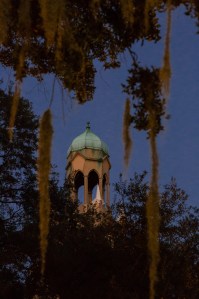
Photo by Jan Tinneberg on Unsplash

This is the time of year when all the Christian writers come out of the woodwork to offer their Advent devotionals. Every year, I get tired of all the serious, sober one-liners we should reflect on for the whole season. They’re all wise and thoughtful, but it gets to be too much to take in.

So if you can’t absorb one more pithy statement or rumination about how a Christian can approach Christmas, please scroll on, with no hard feelings.

These days, I keep thinking about hope and its agony, how warming hope’s promise is, but how devastating its wait is. I used to think Emily Dickinson’s lines were so sweet:

“Hope” is the thing with feathers –
That perches in the soul –
And sings the tune without the words –
And never stops – at all –
And sweetest – in the Gale – is heard –
And sore must be the storm –
That could abash the little Bird
That kept so many warm –
I’ve heard it in the chillest land –
And on the strangest Sea –
Yet – never – in Extremity,
It asked a crumb – of me.

But I know better now. I don’t know a hope that doesn’t ask for even a crumb. That sounds like limp-noodle passivity, shut-down apathy, which is not a healthy way to live.

I find that vibrant, throbbing hope asks for a lot, lot, LOT of surrender, trust, agony–words I prefer to forget about.

I’d love a conversation with Miss Dickinson and ask what she meant by saying that hope doesn’t ask a crumb of me. She’s a brilliant writer, and she must have had some good reason for the line. I like these of hers better:

Not knowing when the Dawn will come,
I open every Door.

I think it’s hope that motivates a person to “open every Door.” And to be clear: I’m not talking about hoping it rains tomorrow, or hoping your cold will go away soon, or wanting to get pregnant and holding your newborn ten months later. I don’t mean to dismiss that kind of hopefulness, but let’s be honest: praying the same agonized prayer for years or decades is another kind of hope.

The kind of hope that opens every door is a hope that’s been waiting a long, long time–years and years and years with no sign of anything ever changing. This hope longs for dawn, aches for light and relief from murkiness and questions and waiting. This hope is a tenacious push, a desire that never goes away, eyes that ache for night to end.

In the Christmas story, hope is what the Jews held close to their hearts every time a woman was pregnant because they were so desperate for Messiah, their rescuer. They were living under an oppressive regime, and they believed the prophets’ words that had never yet come true, not even after thousands of years. They still hoped for Jesse’s rod to bloom into justice. They hoped for the Prince of Peace to reign on David’s throne. They didn’t know what shape their hope would take, but the ones who were attuned to their hearts’ desire opened every door, looking for their Dawn.

Did you ever notice how often the familiar prophecies use will?

The LORD will indeed give what is good, our land will yield its harvest.

The desert and the parched land will be glad, the wilderness will rejoice and blossom.

They will enter Zion with singing; everlasting joy will crown their heads. Gladness and joy will overtake them, and sorrow and sighing will flee away.

Today, far removed from Jewish women’s hopeful waiting, we carry our own stories of night and longing–at least all those attuned to their inner pulse. Single women like me hope for true love and meaningful work and a place to belong. But we don’t have a monopoly on longing and hope. Hope for dawn, for change, for the night to end, is the common thread that connects all people who carry hope for years.

But here’s the kicker: hope is slippery.

Hope is shaped by and linked to desire.

And desire is closely akin to demand, which is where hope turns ugly.

We know how those demanding faces look. We’ve heard the bossy, impatient voices in our living rooms or in front of us at Starbucks. Next time, let’s listen with compassion to that brassy, harsh woman. Maybe her hope went awry. Maybe her hope was sweet at first, but that was ten years ago, then her hope spiraled into demand, and the woman’s crustiness has nothing to do with the poor barista and everything to do with heartache.

When the Jews didn’t get their promised Messiah for thousands of years, their hope wept and moaned, “How long, O Lord?” What I love about this is that God never told them to stop groaning and asking.

Lament is a form of hope because it looks outside itself for the dawn. Lament acknowledges the deep holes of the soul; lament names what is dark. And with tenacious, stunning courage, lament lifts its eyes beyond the closed door to the eastern horizon.

Hope requires immense courage and staggering risk, holding throbbing possibility that sometimes makes me feel I’ll bleed out. With all respect to Emily Dickinson, hope asks me for far, far more than crumbs.

The Psalms model for me hope’s posture: name what is unbearably dark and unfair, weep and howl over it, and open my door to God who brings the dawn.

The purest form of hope is worship. Hope doesn’t kick open the door nor slam it shut and go silent. Hope turns the knob, risks the click of the latch and mourns the devastating darkness and speaks to the Man of Sorrows who’s acquainted with grief. Lament is worship because it trusts the only one who can do anything about the dark, and it declares Him endlessly loving and mighty and wonderful.

Hope is not a chirpy Pollyanna. Hope is nurtured in silence and secrecy, but its softness and expectancy leak out in winsome, delightful ways of living. In contrast, crushed hope-turned-bitter festers in invisible places of the personhood, but reveals itself in caustic words and ugly negativity. The old saying is true: what’s in the heart comes out.

Luke records that Zechariah, finally able to speak after his son John was born, crafted a prophetic poem of worship. His people’s long wait was nearly over, and he worshiped:

…the tender mercy of our God, by which the rising sun will come to us from heaven.

Zechariah had opened every door, didn’t stop hoping for Dawn, and named what He loved about God: His tender mercy.

Maybe hope involves more than the thing hoped for, more than the dawn waited for. Maybe the best part about hope is that it’s the place we experience, sweetly and piercingly, God’s tender mercy even in–especially in–the dark.

I wrote a book one time about living well in a place I hadn’t planned to be. It also talks about how to dream, which is akin to hope. You can order your copy here!
Our Trip to Savannah

Back in May, I flew to Georgia to visit Lolita for a weekend. In the first hour, I knew she and Michelle and I needed to spend a weekend together. They had both been through traumatic years: caring for Ukranian refugees in Poland, re-entry to the US after 20+ years, a teen son with recurring osteosarcoma. They were still living in the ragged stages of recovery and survival and I knew in my soul we needed time to talk, breathe slow, and be present with each other. “We three should get together in—Savannah,” I said rashly, because I felt it deeply but didn’t have a plan.

They didn’t dismiss the idea, even though it felt impossible. How could it be possible, two homeschooling moms leaving for a weekend? We kept hinting at the dream throughout the summer, waited for  CT scan results, and when they were (miraculously!) clear, we started planning in earnest.

We would stay on Tybee Island. Michelle would drive 9 hours from VA. I would fly in late after teaching that day at Ministry Training Center. Lolita would have the shortest drive and would bring the essential food items: coffee, cream, and scone ingredients for me to bake.

They settled into our un-luxurious but clean condo and had the evening together on the beach and picked me up at the airport after 10:00. Each night was so funny. We had all these things we wanted to do and talk about, (including a blind date they’re thinking about for me) but after about 10:30, we discovered we weren’t teenagers anymore, and we’d struggle on until we hit a wall at midnight and call it a day. I spent the next week trying to catch up on the lost sleep. I wonder if this proves my age more than anything else about me.

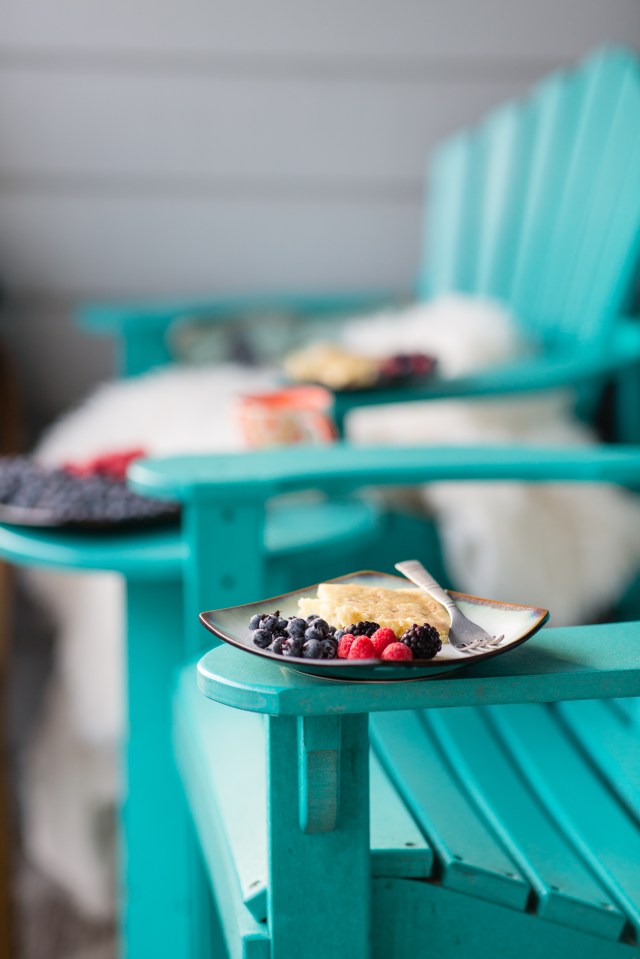
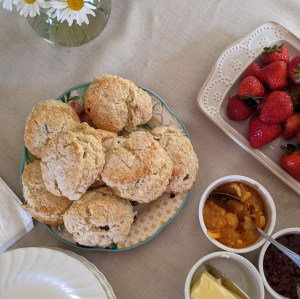
We didn’t sleep late, and sipped our coffee on the balcony in the glorious sunshine. I mixed up the scones and made a mistake and they became a fluffy cakey thing that we nibbled the rest of the day. We wanted to name this new creation but couldn’t settle on a name that suited us.

The beach wasn’t hot, but it was sand and water and scattered sunshine. And it was space to talk and talk and listen and listen and laugh and cry. We found our way to the city and the river front, and got carried away with the elegant, weathered, old-world vibe.


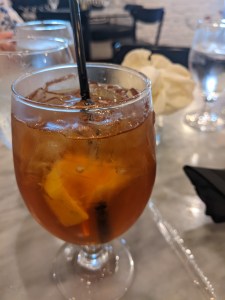
Vic’s on the River was a elegant place that served food flavored to perfection. We moaned and swooned over my shrimp and grits and Lolita’s she-crab soup. I was going to be good and order water, but how could I not enjoy sweet tea while in the south? The sweet tea was perfection. The wait staff were elegant and personable and we felt like princesses.

At the end of our meal, the lady beside us asked if we’d recommend the shrimp and grits. We got into a conversation when she asked where we’re from. We explained that we’ve been close friends for years at a distance, and have never been together with just the three of us. “This is a story,” our new friend said. “You could write a book about how you all got together!”

It’s true. Way back in our Voxer days, I created our chat group so that we could stay connected over all our drama. These were the friends who knew me the longest and we’ve stayed connected by that bond that comes from years of shared history. A book would make a good story about strong, enduring friendship across many miles and years. And the wonder is that it’s not a story, but a beautiful friendship of three.

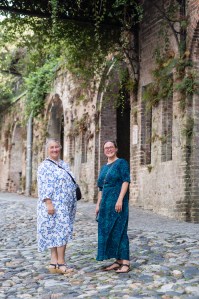
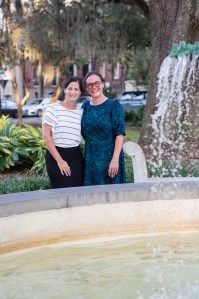
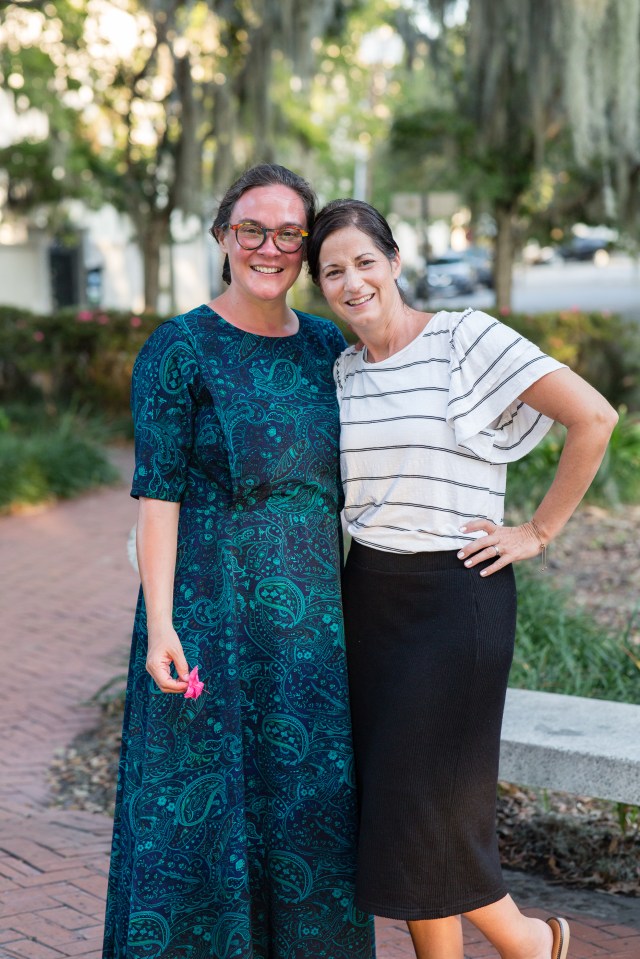
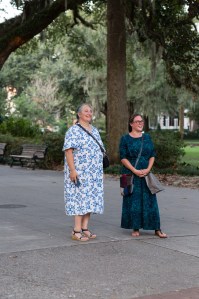
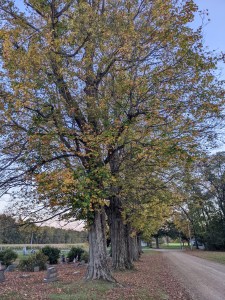
For the rest of the glorious afternoon, we ambled the beautiful old streets marked by restful squares filled with giant live oaks, benches, and paths. We moved slow, took lots of pictures, oohed and ahhhed over anything and everything, and laughed often, because there were always big feelings.


In one deserted square, it was golden hour and Michelle was taking lots of pictures and the fountain was calling my name. I sat on its edge, swung my feet into the water, and asked Michelle to take a picture of me splashing. But on the second kick, my sandal strap broke. This is maybe one reason  moms don’t let their children splash in public fountains, but I say when you’re nearly 50, the rules change. Even so, I knew as I was kicking that the sandals weren’t made for this kind of fun, and I should’ve taken them off first. We laughed and wailed at my thoughtlessness, and I walked for hours with one sandal. Eventually, we passed a CVS where I found cheap flip flops to wear back to the house. I still don’t regret splashing in the fountain. I’ll splash barefoot next time.

.    

We watched art students sketch and sat long at Forsyth Square. We kept thinking we were back in Europe and it felt surreal. We got snacks and headed back to the condo and couldn’t manage to stay awake and coherent past midnight.


The next morning, we savored coffee on the balcony again and packed up. The beach was  cool and windy, so we headed to the city. The drive in, across green swamps, was like moving through a painting. We found Savannah Coffee Roasters, a place that ticks all the boxes for a coffee shop you could stay at for a long time or keep coming back to. One of the owners is Australian, which may account for that flair of menu choice and extraordinary service.


We took our coffee and pastries to a shaded square and sat on a park bench and talked for a long, long time. We had to watch the clock because we had miles to go that day, but we didn’t move fast. We found a Churchill pub with she-crab soup and sweet tea and it was wonderful. Then we had to say goodbye. Michelle hit the road and Lolita dropped me off at the airport.

I had a very long, lonely, late trip home and fell into bed in the wee hours of Monday morning with no regrets.

This tells what we did, in broad strokes. Michelle was the unofficial professional photographer and all the stellar shots here are hers. Photos are wonderful to document the sights. But what we heard, felt, said, saw, stays with us beyond what photos convey. All we can say is we’re much better  for this sweet, beautiful break in an old southern city.

Look For a Lovely Thing

I took a walk this evening. I was sleepy after supper and didn’t feel like walking, but I told myself, “If you don’t take a walk, you’ll die.” It’s not that dire, of course, but I was feeling melodramatic, and when the sky is clear and the next half hour is free, a walk is always the best idea.

When I crossed the road in front of my house, I saw this leaf in the grass and it gave me an idea:

Dr. Elissa Weichbrodt, on Instagram, does what she calls “color walking.” I heard her speak earlier this year, and was so moved with the way she sees the world and the Christian’s place in it that I’ve never been quite the same since. I read her new book, Redeeming Vision, and love how she unpacks art and its back stories. When I saw how she does color walks, I felt cynical because in my neighborhood, there’s never anything as exciting or dramatic as the vibrant colors she finds. So I never tried color walking, even in the summer.

But this evening, this faded leaf pushed me into trying something new. I decided to call it contemplative walking, like Dr. Weichbrodt does sometimes, and took pictures of all the yellow I could see.

It pushed me to walk faster, toward the next yellow thing because I didn’t know what it would be.

I saw shades that tended toward tan and orange, and the sun was setting in glorious clouds, but I was focused.

Look for a (yellow) thing and you will find it.

I kept thinking of Sara Teasdale’s lines,

“Look for a lovely thing and you will find it,
It is not far——
It never will be far.”

Lucky I was looking for yellow. Pink or purple is going to be a harder search.


What We Make Much Of

Women often tell me, “I don’t have anyone experienced I can talk to about this.” Or “I’d like to have a mentor, someone I can ask questions of and learn from, but I don’t know how to find one.”

I make at least two deductions from this common theme:

  1. Younger women need older women in their lives.
  2. Older women rarely advertise their willingness to walk beside younger women.

There are a million influencers out there and some of them contribute to some women’s anxiety, FOMO (fear of missing out), feeling inadequate about their house or their children or décor or skin care routine. (Notice the qualifier “some.” Influencers are good if they’re good influences. Obviously.)

But there’s little substitute for real-time, life-on-life connection that teaches, shapes, influences, mentors, shows a way through. You hear inflections in the voice. You see a flash fall over a face. You see a shrug in a throw-away comment. You feel a fingertip on your arm or shoulder. And it all adds up: the influence of an older person’s loves and driving motivation, which informs the younger’s definition of what is good and true and beautiful.

Not many women are going to walk up to someone younger and say “I really like you and I’d love to be your mentor.” That puts it on the younger ones to ask someone to be a mentor.

It also means that the older woman shouldn’t overthink it and feel she’s not a good enough influencer to be a mentor. Unless she has some glaring unrepentant sin, or she fritters her hours away on cat videos or women’s fashions, she’s able to mentor someone in some way.

A mentor, loosely defined, is someone who has more experience in some area of life than someone else and is able to communicate that experience. Mentoring isn’t a new idea. It’s been around for as long as people have wanted to learn informally from others who knew more about weaving or investing or baking or laying stone. The Biblical term for women mentors is simple: “the older teaching the younger.” I tell women to look for someone with gray hair because they’re usually the ones who have the stories to learn from. I can’t tell you how much I benefit from the gray haired ladies I talk to.

But let’s not get hung up on years or age. Let’s think about it more in terms of having more or less experience and more or less time given to a particular interest or cause or love. I know many ladies younger than me who teach me about relationships and life skills, and it’s a wonderful thing. I’m a better person because of what I learn from them. I’m healthiest when I’m in the middle of a spectrum: receiving from the more experienced, and giving to the less experienced.

I wonder how younger women can tap into the wealth of experience and observations of older women. For starters, it means connection, communication, an exchange of stories, ideas, and questions. Most of all, teaching the younger requires engaging the whole person, not just a slice of information that is inserted at choice times.

So how does one become a whole person, equipped to be a mentor and have a voice that deserves to be heard?

I’m privileged to work on a team where a two-year mentoring program is baked into the rhythms of our weeks. It’s a beautiful plan, and I love putting energy into it. But it’s only a program. Mentoring as a program is only as good as the individuals who facilitate it. And even so, it’s not a guarantee that mentees will become the people we or God dream for them to be, because none of us are robots, and all of us make more or less wise or foolish choices.

I’ve heard my pastor John say many times that helping people in matters of the soul is not conditional on having letters behind our names or reading certain books, but on how well we know Jesus. I think he’s absolutely right.

My pastor is writing a book on discipleship (the biblical term for mentoring or following Jesus) but before the book is published, he’s teaching a Sunday school class on the content, and it’s gold.

He began the study by saying “We don’t make enough of Jesus.” And I’m not that old or experienced, but I totally agree.

So it seems the best way to become the kind of woman who can influence wisely is to become a woman who loves Jesus more than she loves anything else. More than managing a designer house. More than curating a large Instagram following. More than pulling off a cute outfit. More than making a stunning loaf of sourdough–though all of those are valid in their place. Especially the sourdough!

I dream of women’s conversations that discuss what they love most. It might be a challenge to turn a conversation there after church or after a meal, but it could be a life-changing, life-giving conversation.

Mentoring and knowing Jesus is not about being noisy or profound. The woman who never says anything in Sunday school may be the woman who could tell you how she’s able to love her difficult husband well. The girl who makes fantastic sourdough may be the one who shares that bread with her neighbors and you never hear about it except to see the shine in her eyes.

To love Jesus supremely, He has to become part of the air we breath, not just time we spend sitting with him and coffee and a candle, though that’s important. Another way of thinking about this is: whatever we make much of will influence others.

Some ideas for starters:

  1. How about staying in only Matthew, Mark, Luke, and John for a month’s Bible reading? For a year? Reading them over and over, observing Jesus’ interactions with people, mulling over His words?
  2. How about praying aloud the Lord’s prayer every day? Every day for a month? Every day for a year? How might His words become our words? His goals become our goals?

I wonder. It would be a way to walk toward making much of Jesus.

These are not quick fixes or over-night changes, but ways we can open ourselves to grace, to God’s powerful, beautiful presence that restores, teaches, grows us. Time doesn’t heal all, and learning doesn’t change us. It’s God who heals and changes and grows us, and we, no matter our age, get to choose to join/cooperate/align with Him and His goals for us and for those we love.

That’s true, enduring influence, and we all need more of it.

Join me?

Blood, Red

My pastor says

If we could hear the stories

Of what happened last night

In every house

Within

A two-mile radius from us, it would

Break

Our

Hearts.


My pastor’s breaking voice and

The tears of Jesus

Keep me from crumpling

At the chaos, wails, shards

In humanity,

In me.


In the garden of agony

He knew last night’s stories.

The olive press, gnarled trunks,

Cracked earthen paths gave

Witness to His writhing.


Bankers, bakers, henchmen,

Sharp-ribbed orphans,

Traffickers—all

Mewl, not knowing

They were made for a garden

Of scents, luscious, and

Colors, wondrous,

Brimming with golden shalom

Light years away.


I draw a circle on the map—

Its stories shatter me.


He holds the circle of the earth

And weeps.


The man above time,

Whose pulse beats justice,

Carries without despair

The weight of the world

And the tears of tykes

While

Grief,

Blood red,

Stabs him

Too.


I wrote a book one time about living well in a place I didn’t plan to be. You can order your copy here!
Summer Pieces

Well. It’s been summer of staying local, not buzzing away to see far-flung people. It’s been good, even though I’m feeling antsy. My summer priorities were to plug in where my feet are, and I have no regrets. But yes, I’m ready to go somewhere. Meanwhile, I’ll recommend bits and pieces that have fed me and kept me from getting bored and stagnant.

In the spring, I was telling a friend that I’m not going anywhere because I don’t have international travel plans this year. “Yeah, you’re not going anywhere. You’re just going to New York,” she joked. She had a point. “Going somewhere” is fairly subjective.

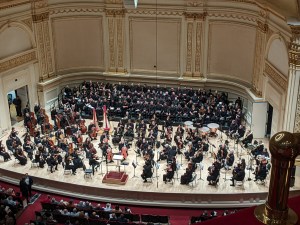
I went to Brooklyn for my summer break in June. Before I went, I was scared I’d be lonely, but in some mysterious alchemy, that didn’t happen until the very last day. The break in the city was everything I needed it to be: books, socializing, solitude, exploring, favorite haunts, new friends, a few ESL lessons. Next year year, I’ll turn 50, and I intend to celebrate all year, starting now, and I felt that a concert would be a good way to start. I dithered for days. Was it too much money? And who goes to a concert alone? But I got a ticket to listen to the Met Orchestra and Choir sing Brahm’s Ein deutsches Requiem at Carnegie Hall, and in the first 30 seconds, I knew this was the right decision. The music was exquisite and glorious, and I’ll always be glad I went. And it turns out lots of people go to concerts alone. Here is the recording that I listen to often, which is wonderful, but nothing like hearing it live.

Earlier in the year, I had the opportunity to be present for a talk that moved me so deeply that I’ve listened to the recording multiple times. Charles Cotherman spoke on Becoming Human. He suggested that efficiency doesn’t help us be more human, but close community does. And he said we can only serve God in the place where our feet are, a truism that hit me hard. He’s researched the story of Christian study centers such as L’Abri, where Christians formed communities centered around education, and he wrote about them in Thinking Christianly. After his talk, I told him how much I admired the Schaeffers’ work at L’Abri, but he reminded me that they had a work at a particular time and place, and our work in this time and place is going to look different.

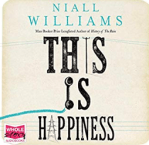
I listened to an audio book on Hoopla that had me grinning often and I still live in its aura. This is Happiness is set in Ireland in the 1950’s when the villages were “getting the electricity.” I’ve never enjoyed descriptions of rain so much. The narrator was Irish, which added to the nostalgia, and I was sorry when the story ended. However, the title and its meaning stays with me, and I hope it always will.

In a round-about, God-led way, I came across a podcast that was so gripping and beautiful, I gave it as a listening assignment to the women’s Sunday school class I’m teaching. We’re studying John, and this sermon, “I Am The Bread” by Tyler Stanton, fed me profoundly. It’s on Spotify here and on his church’s website here. I usually listen to books and podcasts at 1.3 or 1.4 times the normal speed, which helps keep me focused. But not this speaker! I also loved his sermon on Theology of the Body. And I’m reading his book Praying Like Monks, Living Like Fools, which is solid and convicting.
Another book I just finished is Holy Unhappiness by Amanda Held Opelt. I really agree with her premise: that the prosperity gospel has seeped into our theology and made us feel more entitled than we realize. Her insights about satisfaction in marriage and work seem sound and realistic, which was refreshing, and made me wish I’d read this a long time ago. However, I felt very disturbed at her personal story of medical crisis and how God miraculously healed her after four days. I don’t want to minimize her trauma and suffering, but really? Four days? It felt dismissive of anyone who has wept and suffered and begged God for healing for months and years. I struggled to take her seriously after that, and I need to discuss the book’s message with someone else who’s read it.

This summer, besides good things to listen to and read, there have also been guests hosted and mini celebrations, simple and happy and not overwhelming to plan and carry out.

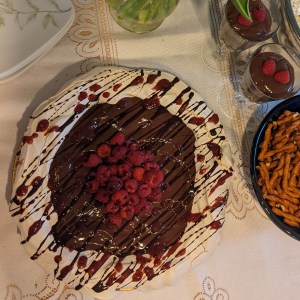
I hosted a small party to celebrate my healed wrist, and it included pavolova with chocolate and raspberries, which always makes the angels sing.

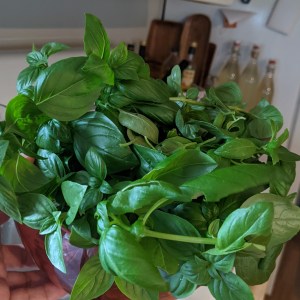
There was fresh basil to make pesto for a tomato salad at our book club’s picnic.

There were scones to celebrate one friend’s birthday,

and Strawberry Brita cake for another friend’s birthday.

There has been Bible study at jail to prep and lead, and exquisite moments with those strong, brave women in hard places. There have been beautiful choirs that made me cry and worship. There have been meaningful lunch conversations and prayers and Literature Camp with more beautiful conversations and friends. There was an evening of solitude by Lake Erie where I made a piece of art with stones and sand as an act of slowing down and talking with God.

I’m still glad that Guys Mills has roads leading out of it. My feet are still itchy and probably always will be, but it’s been a good summer of serving where my feet are.

Practicing Prayer

Last Saturday, one friend prayed for me over a Whatsapp call, and another sent me these gorgeous flowers. I am moved to consider how I can follow the Spirit in turn. This weekend, we celebrate Pentecost. I love to think about the feminine qualities of the Holy Spirit, how He broods, hovers, nurtures–and infuses with incredible power. I wonder how living with the Spirit’s flame resting on us could be seen in us, in me.

I’d only talked with her once, last fall, over breakfast,

Between catching bites falling off her little girls’ spoons.

On Saturday, over the phone,

Our second conversation,

She was as vivacious as I’d remembered,

As thoughtful and generous

As we planned how we’ll plan

Our time together next month.

At the end of our 22 minutes,

She asked if she could pray for me now.

She’s the missionary, the busy mom,

She’s the one who needs care and support

But she prayed for me, and my day was better by her words.

That was Saturday.

Today is Tuesday, and twice

Since then, in conversations, I felt a nudge

To pray right then for the friend beside me.

Shoulder to shoulder,

Weakness beside weakness,

I got to talk to God on a dear one’s behalf,

To beg for His strength in fragility,

Wisdom in questions,

And declare my handing them into

His great care.

I love them dearly but can never save

Or give what they need most.

But I can hold them and remind them

Of what is truest and best in this

Awful, wondrous universe.

Prayer is a surprise at the end of a Whatsapp call,

An innervating string of words,

An example to follow,

A gift to speak at the Spirit’s nudge.

He hovers over us

With white wings that shade and comfort

As prayer gives wings to words

For each to fly.

Pain and Goodness

On the second night of February, I’d been working late and was walking home in the dark at 8:30. I was excited about having wrapped up a writing class, and was oblivious to how the temperature had dropped drastically after the day’s rain. That meant there was smooth ice on our gravel path and before I knew what was happening, my feet shot out from under me.

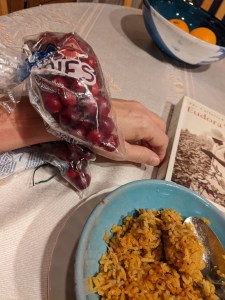
On my back on the ice, I thought to myself that usually when one falls, it hurts their knee or shoulder or head. But nothing hurt except my wrist, with a blinding pain I’d never felt before. I howled and rolled around in pain on the snow beside the path and found a way to get back on my feet. My housemate was gone for the weekend. The house was dark and when I walked in, my wrist had an egg-bump. I cried and googled what to do for a sprain and found frozen cranberries to put on it. Surely it was just badly sprained.

I wanted to call my neighbor friend to come help me but she was gone for the weekend too, so I cried more, not sure if the tears were from pain or from being alone. I knew I needed to sleep more than I needed to spend the night in the ER. So I managed the shower, pain pills, a pillow to elevate my arm while I sleep. (Managed became the operative word for the next months.) I slept decently, which seems like a miracle.

The next morning, I managed to walk to work in a winter wonderland. My coworkers said I need to get the wrist checked out. My doctor said she’d call the x-ray order in to the medical center because she doesn’t want to ask me to drive to see her first. It was one of the blowiest, snowiest mornings of the year and my friend took me in her car and we crept into town on bad, hilly, snow-covered roads. It was a nightmare. But we were kept safe.

In the waiting room, I bumped into sweet Omani friends, which was a lovely distraction. Waiting for the results, I asked the receptionist where I could get a drink of water, and she brought me this tall glass of cold water–well beyond her line of duty, I’m sure. And my coworker friend went beyond her duty to stay with me the whole morning, plus hand me a package of salted dark chocolate on the way home.

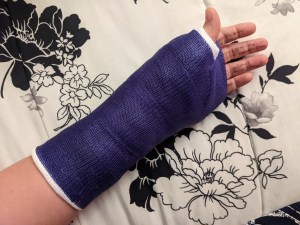
In the waiting room. I deeply feel the irony of the book title in this context!When the x-rays and CT scans were read, I learned there were two diagonal breaks at the tip of the radius. Maybe that explained the terrible pain. Maybe it was double the pain of one break. It was too late to go to ortho for a cast, and because it was Friday, I had to come back Monday for that. I spent Saturday chasing the sun in my house, studying to lead prison Bible study, and playing big, sweeping Christopher Tin music from the next room so I wouldn’t feel so alone. I cried because I had to cancel the next months of piano lessons and was excited to pack an overnight bag to celebrate a cousin’s 30th birthday party. The harrowing weekend was the beginning of months of paradox: managing so much pain AND being given so much goodness on every side.


At ortho, the specialist didn’t seem super confident or competent. I need my wrist and I was terrified he’d miss something and I’d have to live with a damaged wrist. He said I’m not out of the woods for possibly needing surgery, which terrified me more. The first day with my cast, I wrote Bible study notes on my fingers to take into jail. The notes didn’t work great but the motherly Jehovah Witness lady who always goes in with us helped drape my coat around my shoulder because my arm didn’t fit into my sleeve.

The rest of February blurs into memories of pain pills, a cold arm, voice-dictated emails and Word documents or typing with one hand, working extra hard all day to get less done than normal. I couldn’t even do Ctl+C or any other shortcuts with my left hand so I got used to doing them with my right.  I didn’t do anything for Lent because my cast was enough suffering. I’d collapse on the couch in the evening and manage to get back to work every morning. And I drank lots and lots of tea. And I was very thankful that I’m right-handed, even though that hand got so, so tired doing all the things. Sweet cards from friends came in the mail, wishing me quick healing. One friend sent a box with all kinds of treasures squished into it. My housemate tied my shoes for me until I learned how, and did all the house chores that required two strong hands.

Also.

After two weeks, the specialist I was dubious about said I didn’t need surgery, which seems like an enormous miracle, the way the breaks slanted.

Also.

There were sweet moments of beautiful reprieve sprinkled throughout the month. Two nights a week, I joined a writing class on Zoom with a teacher in Thailand. We crossed 12 time zones and bonded over beautiful words and still stay in touch. The classes helped to keep putting words on paper instead of spiraling down into pain and boredom. At the end, our teacher wrote verses about each of us, and mine seems to say more than she knew.


Also.

I  got to go to Lancaster to a writers and artists’ conference and met one of my favorite poets. I don’t have words for how special it was to love Malcolm Guite’s poetry, and then to hear him recite his own poems and give some of their backstory. He was uncommonly gracious and accommodating. “And you hurt your arm,” he commented after we posed. I’m proud of this picture, except for the plastic bag. Hearing him speak about the way he respects words and lets them do their work was a concept I want to keep. The warm experiences of my old and new friends sharing that rich weekend still gives me deep joy.

After three weeks in a cast, my wrist swelled and my fingers got tingly, and I was terrified about nerve damage. Orthopedics assessed it and after a technician sawed off the cast, she motioned to a sink and told me I could wash my hand, and then she left the room. I washed and washed, and wiped and wiped the weak, wrinkled hand and arm for a long, long time. It felt like something rubbery that could maybe come alive again. They sent me to an occupational therapist who fitted me carefully with a removable brace. The therapist was the most delightful, positive, helpful person I’d met in that department. She made my whole month better.

I had the brace for five weeks with instructions for no weight-bearing. The tingling went away, and the daily exercises went better every day. I’d sit on Zoom or in classes practicing my stretches and fists. And I could type with two hands! I could get so much work done with so little effort! I kept the arm elevated as much as possible every day and every night. It made for many praise sessions in the car as I drove. If your hand is raised anyhow, it’s a good time to pray and praise.

But the body remembers, and many times as I walked home on the gravel path and across the little dip where the ice had been, my gut felt shivery and shaky, remembering the spot where the trauma happened.

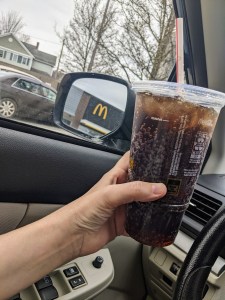
The day the specialist signed off on me and said I’m good to go, I got a large Coke to celebrate. I wanted to cheer for my brave little wrist that was able to hold a whole full glass all by itself. The golden arches in the mirror was a happy accident.

Gradually, I wore the brace less and less. My wrist still catches me by surprise: my left hand can open a whole heavy door all by itself! I can carry a laundry basket in one hand and a laundry rack in the other. This is a remarkably efficient way to do laundry. I can wash dishes and sweep the floor again, and my hand does what I ask it to even though it’s stiff and aches every day.

One of the first weeks free from the brace, I was washing dishes at a friend’s house and broke THREE cups with my uncoordinated left hand that crashed things. I still feel awful about it. I kept thinking about stroke victims and others who have to build a life around a dysfunctional limb. I had learned ways to manage my handicap, but it took enormous energy, focus, and creativity to compensate. Plus, after that first terrible weekend alone, I had willing people around me to help with anything I couldn’t manage.

I hesitated putting this story out there because it could seem too much like a great-aunt’s organ recital. But the nice thing about a blog is that no one has to read it and no one is watching you delete it from your inbox. But for those still reading: I haven’t come to profound conclusions and life lessons about this story. For now, I’m acknowledging the crazy mix of hard and good, loss and gifts poured out, privilege and disappointment.

Apparently, life is never all one or the other.

Comfort and Forgive

Recently I’ve been lingering in Psalm 25, particularly verse 18: “Look upon my affliction and my distress [I need comfort.] and take away all my sins [I need forgiveness.]” This pairs with the gospel song with line “He took my sins and my sorrows.”

At the cross, we find both comfort for what’s been done to us and forgiveness for the wrong we’ve done. Beyond that, there’s more at the empty tomb, which I’m still exploring.

Last week one morning, this acrostic poem seeped out of my pen. And yes, I’m reading The Hobbit right now, so that found its way onto some lines as well.

Come closer, friend and savior Jesus
Or I will
Move off the path to where
Foul goblins lurk to
Overwhelm my heart. I want to walk with You to
Rivendell where
Time slows and music lingers in the leaves

And cake and wine heap up but
Not too much to long for more.
Desire and dust

Fill my mouth and still holy water
Offerings will never ever wash or
Rinse the dust and
Grime and wrinkled skin of
Inconvenient, stubborn
Vices
Except you hold my hand and clean and caress each crevice.

After Saturday Night

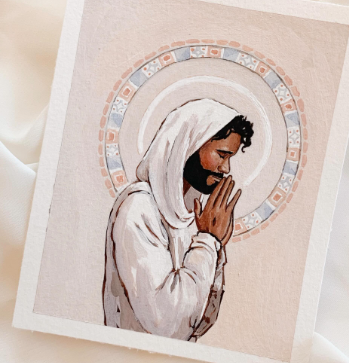
Photo by Łukasz Łada on Unsplash

He saw me first.

I saw a garden hand

With grass-pressed tunic,

Soil on toes,

Eyes at ease with a job well done.

He saw my tears yet didn’t flinch—

No garden hand had ever asked me

About that water swelling

In stormy cataracts on cheeks.

They’d taken my Love—He’s

Broken, stabbed, now stolen.

My love is gone, is gone, and

I would wail and run

Five thousand furlongs if only this garden man

Confides to me the hiding place that

Holds my love, my broken love.

He said my name, my truest word:

Mary, once bitter, now sweet.

He was a garden man, but

More—the one I’d lost. I knew

Him by that voice and by

Those eyes, new, knowing.

They caught the morning light and

Calmed my own frantic, swollen ones.

Where had He been? What ablutions

Rinsed crusted blood and water from olive skin and linen?

What had He seen and how did this morning’s Father

Turn toward yesterday’s forsaken Son?

What words had made my sad untrue?

Quiet mystery surrounded, hovered, haloed Him—this

Garden-loving, light-bearing frame of holed and holy clay.

He didn’t tell me where He’d been. (He never tells me everything.)

The rose-gold sky back-lit His frame.

My Love

Had found me first

Again.