A Poem-Long Sentence

I wrote this poem some time ago, but it works now too, except for the line about summer! I took this snowy picture two days ago and the snow is still falling and it’s beautiful beyond words.

I could write a poem about stopping by the woods on a snowy evening, but
Someone much wiser and more profound than I has already written a poem beginning with
that line and
After I read that I feel that I can never write so sparse and rich so why should I try,
But I have words in me that Frost never did, so that gives me permission to try to push out
Words, pat them into line, riffle through, discard or choose the precise ones to show, not tell,
The mood and texture of the vignette I have in mind
And even though it’s not about horse or downy flake (I drive a car, it’s high summer, and I don’t Collect Currier & Ives prints) my soul holds
Pictures of thin spaces, moments, sparkles, glistenings, that would be fun to take
out of storage, unfold,
Hold up to the light, adjust, unwrinkle, because, even though out of sight, they shape me,
and maybe
They could nudge someone and set the compass for a friend’s reference point of what is
Good and beautiful and true since stable compasses are scarce these days and we need them
Even though we don’t say it, however insightful we are and however experienced
because we are all
Mostly shuffling our way toward home, knowing we’re not there yet and it might be
Awhile—probably miles to go before we sleep—but we’ll get there someday and meanwhile
we hold
Each other’s hands to find the path and share the light we see because beauty must be shared, not Hoarded, which has to be why Frost gave us his snapshot of his woods and horse.

My book talks about another kind of walk. It’s a voice to remind you that you’re never actually alone, wherever you’re walking. You can buy it here!

I Bring

This poem came out of a prompt in the writers’ circle I’m part of, led by Rachel Devenish Ford.

I bring whimsy and laughter and hugs—

Here, have one!

Today’s too beautiful for dour, dry words and

We are delighting in spring’s light shining in eyes and

Music sparkling from fingers,

Colors spilling from dresses that drape and swoosh

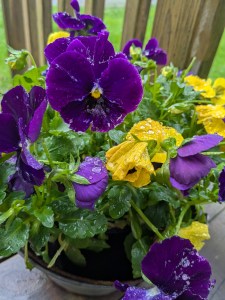
Like pansy petals.

I bring cake and songs and glitter pens for everyone.


I bring questions and ache—

Here, take it—it’s heavy.

Today’s too sad for songs and

Questions rumble over trite answers and

Scattered bits of blue eggs dry in their yolks on the ground and

A storm blows disarray over the whole globe,

Smashing like feral bulls seeing red, pawing after power.

What I asked for didn’t come. What I hoped became impossible.


Celebration and sorrow.

I bring both today.


I wrote a book about living well in a place I hadn’t planned to be. It explores the curious mix of holding both joy and sorrow at the same time. You can order your copy here!

Charity Concert

This is an old, out-dated poem, but it doesn’t go away. This is not a statement about politics but tears for the forgotten women and children suffering because of others’ arguments.

April 2, 2022

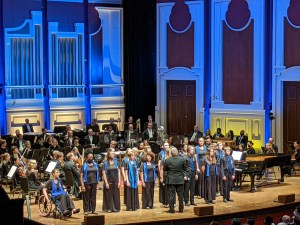
Orchestra musicians and choirs

Donated a free concert in aid of

Ukraine.

Guests waved blue and yellow flags,

Wore blue and yellow clothes

Or gorgeous flowy Ukrainian blouses.

No one clapped the whole evening

Until

Every song and every poem and the grand

Ukrainian national anthem

Faded into silence.

And then

The appropriate applause lasted for a long, loud time.


Surrounded with plush red velvet, dim lighting,

Glittering chandeliers,

We called this solidarity.

We called it respect. And it was.

And the music had been beyond beautiful.


But how does velvet sit in

Harmony with missiles and battered bags,

Fractured families, mass graves?

The irony, the audacity

Sits heavy on my chest.


And

Where were the charity concerts

For starving Afghanis hiding from their government?

Why is no one singing

The Sudanese national anthem

And remembering their child soldiers?


Ukraine is close enough and

White enough

For America to do something—anything—even

Host a luscious night of music and call it

Care.


Beneath my confused anger

Weeps grief.

Above the globe

Weeps Jesus

Over the wreckage of the world.

Hope Opens Every Door

Photo by Jan Tinneberg on Unsplash

This is the time of year when all the Christian writers come out of the woodwork to offer their Advent devotionals. Every year, I get tired of all the serious, sober one-liners we should reflect on for the whole season. They’re all wise and thoughtful, but it gets to be too much to take in.

So if you can’t absorb one more pithy statement or rumination about how a Christian can approach Christmas, please scroll on, with no hard feelings.

These days, I keep thinking about hope and its agony, how warming hope’s promise is, but how devastating its wait is. I used to think Emily Dickinson’s lines were so sweet:

“Hope” is the thing with feathers –
That perches in the soul –
And sings the tune without the words –
And never stops – at all –
And sweetest – in the Gale – is heard –
And sore must be the storm –
That could abash the little Bird
That kept so many warm –
I’ve heard it in the chillest land –
And on the strangest Sea –
Yet – never – in Extremity,
It asked a crumb – of me.

But I know better now. I don’t know a hope that doesn’t ask for even a crumb. That sounds like limp-noodle passivity, shut-down apathy, which is not a healthy way to live.

I find that vibrant, throbbing hope asks for a lot, lot, LOT of surrender, trust, agony–words I prefer to forget about.

I’d love a conversation with Miss Dickinson and ask what she meant by saying that hope doesn’t ask a crumb of me. She’s a brilliant writer, and she must have had some good reason for the line. I like these of hers better:

Not knowing when the Dawn will come,
I open every Door.

I think it’s hope that motivates a person to “open every Door.” And to be clear: I’m not talking about hoping it rains tomorrow, or hoping your cold will go away soon, or wanting to get pregnant and holding your newborn ten months later. I don’t mean to dismiss that kind of hopefulness, but let’s be honest: praying the same agonized prayer for years or decades is another kind of hope.

The kind of hope that opens every door is a hope that’s been waiting a long, long time–years and years and years with no sign of anything ever changing. This hope longs for dawn, aches for light and relief from murkiness and questions and waiting. This hope is a tenacious push, a desire that never goes away, eyes that ache for night to end.

In the Christmas story, hope is what the Jews held close to their hearts every time a woman was pregnant because they were so desperate for Messiah, their rescuer. They were living under an oppressive regime, and they believed the prophets’ words that had never yet come true, not even after thousands of years. They still hoped for Jesse’s rod to bloom into justice. They hoped for the Prince of Peace to reign on David’s throne. They didn’t know what shape their hope would take, but the ones who were attuned to their hearts’ desire opened every door, looking for their Dawn.

Did you ever notice how often the familiar prophecies use will?

The LORD will indeed give what is good, our land will yield its harvest.

The desert and the parched land will be glad, the wilderness will rejoice and blossom.

They will enter Zion with singing; everlasting joy will crown their heads. Gladness and joy will overtake them, and sorrow and sighing will flee away.

Today, far removed from Jewish women’s hopeful waiting, we carry our own stories of night and longing–at least all those attuned to their inner pulse. Single women like me hope for true love and meaningful work and a place to belong. But we don’t have a monopoly on longing and hope. Hope for dawn, for change, for the night to end, is the common thread that connects all people who carry hope for years.

But here’s the kicker: hope is slippery.

Hope is shaped by and linked to desire.

And desire is closely akin to demand, which is where hope turns ugly.

We know how those demanding faces look. We’ve heard the bossy, impatient voices in our living rooms or in front of us at Starbucks. Next time, let’s listen with compassion to that brassy, harsh woman. Maybe her hope went awry. Maybe her hope was sweet at first, but that was ten years ago, then her hope spiraled into demand, and the woman’s crustiness has nothing to do with the poor barista and everything to do with heartache.

When the Jews didn’t get their promised Messiah for thousands of years, their hope wept and moaned, “How long, O Lord?” What I love about this is that God never told them to stop groaning and asking.

Lament is a form of hope because it looks outside itself for the dawn. Lament acknowledges the deep holes of the soul; lament names what is dark. And with tenacious, stunning courage, lament lifts its eyes beyond the closed door to the eastern horizon.

Hope requires immense courage and staggering risk, holding throbbing possibility that sometimes makes me feel I’ll bleed out. With all respect to Emily Dickinson, hope asks me for far, far more than crumbs.

The Psalms model for me hope’s posture: name what is unbearably dark and unfair, weep and howl over it, and open my door to God who brings the dawn.

The purest form of hope is worship. Hope doesn’t kick open the door nor slam it shut and go silent. Hope turns the knob, risks the click of the latch and mourns the devastating darkness and speaks to the Man of Sorrows who’s acquainted with grief. Lament is worship because it trusts the only one who can do anything about the dark, and it declares Him endlessly loving and mighty and wonderful.

Hope is not a chirpy Pollyanna. Hope is nurtured in silence and secrecy, but its softness and expectancy leak out in winsome, delightful ways of living. In contrast, crushed hope-turned-bitter festers in invisible places of the personhood, but reveals itself in caustic words and ugly negativity. The old saying is true: what’s in the heart comes out.

Luke records that Zechariah, finally able to speak after his son John was born, crafted a prophetic poem of worship. His people’s long wait was nearly over, and he worshiped:

…the tender mercy of our God, by which the rising sun will come to us from heaven.

Zechariah had opened every door, didn’t stop hoping for Dawn, and named what He loved about God: His tender mercy.

Maybe hope involves more than the thing hoped for, more than the dawn waited for. Maybe the best part about hope is that it’s the place we experience, sweetly and piercingly, God’s tender mercy even in–especially in–the dark.

I wrote a book one time about living well in a place I hadn’t planned to be. It also talks about how to dream, which is akin to hope. You can order your copy here!
Blood, Red

My pastor says

If we could hear the stories

Of what happened last night

In every house

Within

A two-mile radius from us, it would

Break

Our

Hearts.


My pastor’s breaking voice and

The tears of Jesus

Keep me from crumpling

At the chaos, wails, shards

In humanity,

In me.


In the garden of agony

He knew last night’s stories.

The olive press, gnarled trunks,

Cracked earthen paths gave

Witness to His writhing.


Bankers, bakers, henchmen,

Sharp-ribbed orphans,

Traffickers—all

Mewl, not knowing

They were made for a garden

Of scents, luscious, and

Colors, wondrous,

Brimming with golden shalom

Light years away.


I draw a circle on the map—

Its stories shatter me.


He holds the circle of the earth

And weeps.


The man above time,

Whose pulse beats justice,

Carries without despair

The weight of the world

And the tears of tykes

While

Grief,

Blood red,

Stabs him

Too.


I wrote a book one time about living well in a place I didn’t plan to be. You can order your copy here!

Practicing Prayer

Last Saturday, one friend prayed for me over a Whatsapp call, and another sent me these gorgeous flowers. I am moved to consider how I can follow the Spirit in turn. This weekend, we celebrate Pentecost. I love to think about the feminine qualities of the Holy Spirit, how He broods, hovers, nurtures–and infuses with incredible power. I wonder how living with the Spirit’s flame resting on us could be seen in us, in me.

I’d only talked with her once, last fall, over breakfast,

Between catching bites falling off her little girls’ spoons.

On Saturday, over the phone,

Our second conversation,

She was as vivacious as I’d remembered,

As thoughtful and generous

As we planned how we’ll plan

Our time together next month.

At the end of our 22 minutes,

She asked if she could pray for me now.

She’s the missionary, the busy mom,

She’s the one who needs care and support

But she prayed for me, and my day was better by her words.

That was Saturday.

Today is Tuesday, and twice

Since then, in conversations, I felt a nudge

To pray right then for the friend beside me.

Shoulder to shoulder,

Weakness beside weakness,

I got to talk to God on a dear one’s behalf,

To beg for His strength in fragility,

Wisdom in questions,

And declare my handing them into

His great care.

I love them dearly but can never save

Or give what they need most.

But I can hold them and remind them

Of what is truest and best in this

Awful, wondrous universe.

Prayer is a surprise at the end of a Whatsapp call,

An innervating string of words,

An example to follow,

A gift to speak at the Spirit’s nudge.

He hovers over us

With white wings that shade and comfort

As prayer gives wings to words

For each to fly.

Pain and Goodness

On the second night of February, I’d been working late and was walking home in the dark at 8:30. I was excited about having wrapped up a writing class, and was oblivious to how the temperature had dropped drastically after the day’s rain. That meant there was smooth ice on our gravel path and before I knew what was happening, my feet shot out from under me.

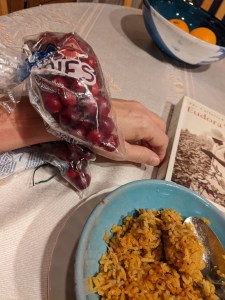
On my back on the ice, I thought to myself that usually when one falls, it hurts their knee or shoulder or head. But nothing hurt except my wrist, with a blinding pain I’d never felt before. I howled and rolled around in pain on the snow beside the path and found a way to get back on my feet. My housemate was gone for the weekend. The house was dark and when I walked in, my wrist had an egg-bump. I cried and googled what to do for a sprain and found frozen cranberries to put on it. Surely it was just badly sprained.

I wanted to call my neighbor friend to come help me but she was gone for the weekend too, so I cried more, not sure if the tears were from pain or from being alone. I knew I needed to sleep more than I needed to spend the night in the ER. So I managed the shower, pain pills, a pillow to elevate my arm while I sleep. (Managed became the operative word for the next months.) I slept decently, which seems like a miracle.

The next morning, I managed to walk to work in a winter wonderland. My coworkers said I need to get the wrist checked out. My doctor said she’d call the x-ray order in to the medical center because she doesn’t want to ask me to drive to see her first. It was one of the blowiest, snowiest mornings of the year and my friend took me in her car and we crept into town on bad, hilly, snow-covered roads. It was a nightmare. But we were kept safe.

In the waiting room, I bumped into sweet Omani friends, which was a lovely distraction. Waiting for the results, I asked the receptionist where I could get a drink of water, and she brought me this tall glass of cold water–well beyond her line of duty, I’m sure. And my coworker friend went beyond her duty to stay with me the whole morning, plus hand me a package of salted dark chocolate on the way home.

In the waiting room. I deeply feel the irony of the book title in this context!When the x-rays and CT scans were read, I learned there were two diagonal breaks at the tip of the radius. Maybe that explained the terrible pain. Maybe it was double the pain of one break. It was too late to go to ortho for a cast, and because it was Friday, I had to come back Monday for that. I spent Saturday chasing the sun in my house, studying to lead prison Bible study, and playing big, sweeping Christopher Tin music from the next room so I wouldn’t feel so alone. I cried because I had to cancel the next months of piano lessons and was excited to pack an overnight bag to celebrate a cousin’s 30th birthday party. The harrowing weekend was the beginning of months of paradox: managing so much pain AND being given so much goodness on every side.


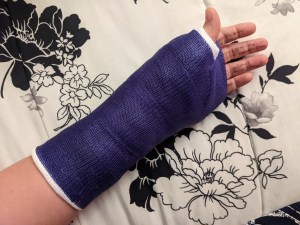
At ortho, the specialist didn’t seem super confident or competent. I need my wrist and I was terrified he’d miss something and I’d have to live with a damaged wrist. He said I’m not out of the woods for possibly needing surgery, which terrified me more. The first day with my cast, I wrote Bible study notes on my fingers to take into jail. The notes didn’t work great but the motherly Jehovah Witness lady who always goes in with us helped drape my coat around my shoulder because my arm didn’t fit into my sleeve.

The rest of February blurs into memories of pain pills, a cold arm, voice-dictated emails and Word documents or typing with one hand, working extra hard all day to get less done than normal. I couldn’t even do Ctl+C or any other shortcuts with my left hand so I got used to doing them with my right.  I didn’t do anything for Lent because my cast was enough suffering. I’d collapse on the couch in the evening and manage to get back to work every morning. And I drank lots and lots of tea. And I was very thankful that I’m right-handed, even though that hand got so, so tired doing all the things. Sweet cards from friends came in the mail, wishing me quick healing. One friend sent a box with all kinds of treasures squished into it. My housemate tied my shoes for me until I learned how, and did all the house chores that required two strong hands.

Also.

After two weeks, the specialist I was dubious about said I didn’t need surgery, which seems like an enormous miracle, the way the breaks slanted.

Also.

There were sweet moments of beautiful reprieve sprinkled throughout the month. Two nights a week, I joined a writing class on Zoom with a teacher in Thailand. We crossed 12 time zones and bonded over beautiful words and still stay in touch. The classes helped to keep putting words on paper instead of spiraling down into pain and boredom. At the end, our teacher wrote verses about each of us, and mine seems to say more than she knew.


Also.

I  got to go to Lancaster to a writers and artists’ conference and met one of my favorite poets. I don’t have words for how special it was to love Malcolm Guite’s poetry, and then to hear him recite his own poems and give some of their backstory. He was uncommonly gracious and accommodating. “And you hurt your arm,” he commented after we posed. I’m proud of this picture, except for the plastic bag. Hearing him speak about the way he respects words and lets them do their work was a concept I want to keep. The warm experiences of my old and new friends sharing that rich weekend still gives me deep joy.

After three weeks in a cast, my wrist swelled and my fingers got tingly, and I was terrified about nerve damage. Orthopedics assessed it and after a technician sawed off the cast, she motioned to a sink and told me I could wash my hand, and then she left the room. I washed and washed, and wiped and wiped the weak, wrinkled hand and arm for a long, long time. It felt like something rubbery that could maybe come alive again. They sent me to an occupational therapist who fitted me carefully with a removable brace. The therapist was the most delightful, positive, helpful person I’d met in that department. She made my whole month better.

I had the brace for five weeks with instructions for no weight-bearing. The tingling went away, and the daily exercises went better every day. I’d sit on Zoom or in classes practicing my stretches and fists. And I could type with two hands! I could get so much work done with so little effort! I kept the arm elevated as much as possible every day and every night. It made for many praise sessions in the car as I drove. If your hand is raised anyhow, it’s a good time to pray and praise.

But the body remembers, and many times as I walked home on the gravel path and across the little dip where the ice had been, my gut felt shivery and shaky, remembering the spot where the trauma happened.

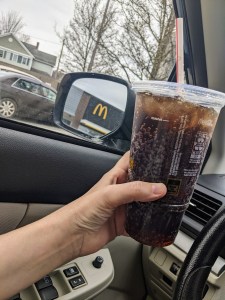
The day the specialist signed off on me and said I’m good to go, I got a large Coke to celebrate. I wanted to cheer for my brave little wrist that was able to hold a whole full glass all by itself. The golden arches in the mirror was a happy accident.

Gradually, I wore the brace less and less. My wrist still catches me by surprise: my left hand can open a whole heavy door all by itself! I can carry a laundry basket in one hand and a laundry rack in the other. This is a remarkably efficient way to do laundry. I can wash dishes and sweep the floor again, and my hand does what I ask it to even though it’s stiff and aches every day.

One of the first weeks free from the brace, I was washing dishes at a friend’s house and broke THREE cups with my uncoordinated left hand that crashed things. I still feel awful about it. I kept thinking about stroke victims and others who have to build a life around a dysfunctional limb. I had learned ways to manage my handicap, but it took enormous energy, focus, and creativity to compensate. Plus, after that first terrible weekend alone, I had willing people around me to help with anything I couldn’t manage.

I hesitated putting this story out there because it could seem too much like a great-aunt’s organ recital. But the nice thing about a blog is that no one has to read it and no one is watching you delete it from your inbox. But for those still reading: I haven’t come to profound conclusions and life lessons about this story. For now, I’m acknowledging the crazy mix of hard and good, loss and gifts poured out, privilege and disappointment.

Apparently, life is never all one or the other.

Comfort and Forgive

Recently I’ve been lingering in Psalm 25, particularly verse 18: “Look upon my affliction and my distress [I need comfort.] and take away all my sins [I need forgiveness.]” This pairs with the gospel song with line “He took my sins and my sorrows.”

At the cross, we find both comfort for what’s been done to us and forgiveness for the wrong we’ve done. Beyond that, there’s more at the empty tomb, which I’m still exploring.

Last week one morning, this acrostic poem seeped out of my pen. And yes, I’m reading The Hobbit right now, so that found its way onto some lines as well.

Come closer, friend and savior Jesus
Or I will
Move off the path to where
Foul goblins lurk to
Overwhelm my heart. I want to walk with You to
Rivendell where
Time slows and music lingers in the leaves

And cake and wine heap up but
Not too much to long for more.
Desire and dust

Fill my mouth and still holy water
Offerings will never ever wash or
Rinse the dust and
Grime and wrinkled skin of
Inconvenient, stubborn
Vices
Except you hold my hand and clean and caress each crevice.

After Saturday Night

Photo by Łukasz Łada on Unsplash

He saw me first.

I saw a garden hand

With grass-pressed tunic,

Soil on toes,

Eyes at ease with a job well done.

He saw my tears yet didn’t flinch—

No garden hand had ever asked me

About that water swelling

In stormy cataracts on cheeks.

They’d taken my Love—He’s

Broken, stabbed, now stolen.

My love is gone, is gone, and

I would wail and run

Five thousand furlongs if only this garden man

Confides to me the hiding place that

Holds my love, my broken love.

He said my name, my truest word:

Mary, once bitter, now sweet.

He was a garden man, but

More—the one I’d lost. I knew

Him by that voice and by

Those eyes, new, knowing.

They caught the morning light and

Calmed my own frantic, swollen ones.

Where had He been? What ablutions

Rinsed crusted blood and water from olive skin and linen?

What had He seen and how did this morning’s Father

Turn toward yesterday’s forsaken Son?

What words had made my sad untrue?

Quiet mystery surrounded, hovered, haloed Him—this

Garden-loving, light-bearing frame of holed and holy clay.

He didn’t tell me where He’d been. (He never tells me everything.)

The rose-gold sky back-lit His frame.

My Love

Had found me first

Again.

The Awl

Photo by Victoriano Izquierdo on Unsplash

Some months ago, I was in a battle of wills with the Almighty. One Sunday in share time, a brother reflected on the ceremony of the awl and the pierced ear. He said, “That slave must have really trusted his master to be willing to stay with him the rest of his life.” I knew then it was mine to trust, not fight for my will to be done, and I went home and wrote this poem.

Then his master shall bring him to God, then he shall bring him to the door or the doorpost. And his master shall pierce his ear with an awl; and he shall serve him permanently. Exodus 21:6

He stands at my shoulder,

Awl in hand.

His eyes speak what His words

Have always said and what

I know is truer than true.


I voice my yes, so I can hear tomorrow

When my heart wanders:

“My Master, yes.

Yes to never owning but always having enough.

Yes to living under Your roof over Your furniture.

Yes.

Yes to safety You’ve proven these seven tenuous years.

Yes to plenty and to peace, to eating like a child at home.

Yes to Your care and not another’s, to a home not my own.

Yes.”


My eyes sweep over His turbaned head and out past tiled rooftops,

Mountain Hermon, the Jordan, and towns beyond.

But it’s here He invites me to stay and I say

Yes.

In His weathered doorway I lean

After the awl,

Hole held in His fingers that

Drip blood.