The Value of Your Story

The Daughters of Promise team asked me to contribute an article for each of their magazine issues this year. The themes they assigned were too beautiful and exciting for me to refuse to write about even though I didn’t actually need three new projects with deadlines. This blog post is the article I wrote for their Storyseekers and Storytellers issue.
The stories in this photo are some of my favorites. I’ve read all of them at least twice.

I was returning from a missionary conference where Elisabeth Elliot had spoken. Riding a big, lumbering bus through green Irish scenery, I read as miles disappeared behind us. I was reading Mrs. Elliot’s latest book, Quest for Love, which she had autographed for me. It had been a hard year for me, adjusting to a new life in a new country. But even more difficult, I was holding heartbreak, a romantic hope deferred.

In the book, Elisabeth Elliot wrote of her own broken heart when she said goodbye to Jim, the man she loved, and didn’t know when she’d ever see him again. She had been so distressed that she threw herself on her bed, crying so loudly that her landlady rushed in to ask what was wrong.

In that bus, surrounded by silent strangers, I read her story for the first time and wept. Tears dripped off my nose because I felt so relieved and comforted. I saw that my hero, the extraordinary Elisabeth Elliot, had also cried. She, too, had felt deep distress about her romantic hopes and big questions with no answers, and she had sobbed, too. I suddenly didn’t feel so alone, and a significant increment of healing happened deep inside me on that long bus ride.

Women—like Elisabeth Elliot—are good at telling stories.      Our stories hold immense value when we share them. Women are the life-bearers and      nurturers, and telling stories is a way we offer life to each other.  Elisabeth’s story did for me what all good stories do:

  1. Stories show us what is good, beautiful, and true.
  2. Stories give us hope because they show we’re not alone.

Remember that time you heard about someone’s experience, and it helped you feel new energy to keep walking? It was only a little snapshot, a short testimony, a tiny snippet from their life that they shared with you, but it gave you enough light that you still remember it and make decisions accordingly.

Each life has many, many mini-stories in it. Think about your own story—not the long arc of your life, but that little scenario from yesterday or a prevailing memory from last year. Any time you want something and go through conflict to find it, you have the beginning of a story. In your best stories, a hero arrives on the scene and helps you receive the object you wanted at the beginning of the story.[1] This is the illustration or snapshot from your life that you can offer to your world at the appropriate time to demonstrate what is good, beautiful, and true. This is your story.

Let’s unpack this definition of story so that you can identify yours.

You want something.

Our hearts are always moving in a specific direction. We lie if we say we don’t want anything. But desire is risky and potentially overwhelming. Hence, it can feel easier to shelve desire rather than to hold it, or     cover it up with a thick blanket of love for interior design or books—safer, more kosher desires to live with.

But for just a minute here, sit still and ask yourself what Jesus asked many people: What do you want? Probe the longings under those longings. Don’t be afraid to explore and sit in those caverns for five minutes. What emerges from that silence reveals an extremely important part of your story.

Cinderella wanted to go to the ball. Winnie the Pooh wanted a jar of honey. Anne wanted puffed sleeves. But under those dreams were deeper longings. Cinderella wanted to belong. Winnie the Pooh wanted the taste of honey on his tongue. Anne wanted to be beautiful. Your desires are the signs of an alive, beating, beautiful heart, not something to be ashamed of.

The minute you stop desiring, your story stops. If the blind men hadn’t wanted to see, Jesus wouldn’t have healed them. If the bleeding woman hadn’t been desperate for healing, she would never have touched Jesus’ hem and been healed, and she’d have had no story.

So, what do you want? What will you want today when you go shopping? What did you want on Sunday when you walked into church? What did you want when you picked up your phone just now? It’s important to name your desire because it gives you a clue about what you value most and what kind of story you will live.

You must go through conflict to find what you want.

Conflict, like desire, is wildly uncomfortable. So it makes sense that we hush conflict as much as possible. Conflict in our stories can look like disappointment, illness, questions with no answers, or difficult relationships. Name a disruption in your life or your day. You could make your own list of curve balls and disagreements just from yesterday, because all our stories hold some kind of difficulty where we conflict with ourselves, others, nature, or God.

Conflict is the place where your story turns, and good comes from it (eventually). Without conflict, your story flatlines. Without the conflict with Joseph’s brothers, Joseph’s story would just have been about Joseph in the field. Without conflict between His will and the Father’s will, Jesus would only have been sitting in the dark in the garden of Gethsemane.

Because of the significant disruption of my experience of fibroids, years of pain, and resulting hysterectomy at age 39, I became more sensitive to people’s pain than I would have otherwise, and I’m thankful. Janette Walls’ story in The Glass Castle shows that without her dysfunctional parents and their hurtful choices, she’d never have decided to pursue a better life.

The points of conflict in a story are the precise points where the story improves. In literature, we call these “inciting incidents.” Sometimes, the situation worsens before it turns positive, but the plotline turns on these points and makes the conflict enrich the story, deepening its impact. The impact comes from how clearly it shows us what is good, beautiful, and true.

Your true hero is Jesus.

Out of conflict, heroes emerge. To be clear: you’re an important character in your story, but not the hero. Your pain, your disappointment, or your demanding situation is not your hero or the most important part of your story. I don’t mean to sound like your predictable Sunday school teacher, but Jesus is the hero of your story.

Without conflict, we don’t know that we need Jesus. Jesus the hero does not exist to make all our dreams come true or take away all the conflict we live with, but to bring us to a deep connection with Him. He is who makes our stories ultimately true, good, and beautiful.

You dream and talk and shop and eat differently depending on who your hero is, the person you admire, the one you want to be like. So, who is your hero? How does your story make Jesus look good?

Your story matters!

 Women are good at telling stories, but they’re also good at comparing their story with others’ stories, and this takes them to sad places.

Your story matters, even if it feels ordinary and insignificant. When Anabaptists in Switzerland were hunted like criminals, the boundary line of one canton ran through one Anabaptist family’s house. This meant hunted people were safe on one side of the house but not the other. Can you imagine the drama and actual “cops and robbers” scenarios inside those walls? Meanwhile, we can assume that the lady of the house was baking bread and sweeping crumbs from the floor and mending holes in aprons. Her ordinary, mundane days made it possible for people to find shelter in her house.

Do your days feel dull? Does your ordinary story give hope and safety to your world? Your story—your ordinary, daily, mundane story matters!

Maybe you feel that your story doesn’t fit well with the stories around you. It’s odd, misshaped, and feels out of place.

Queen Esther was an orphan raised by a cousin and placed in a harem, which sounds like a dysfunctional, disastrous story on every level. Esther’s story didn’t develop like other Jewish girls, but hers was an utterly vital story.

If your story feels too normal or too odd to contribute to your world, take another look at what you long for, the conflict you’ve encountered in pursuing it, and the hero you’ve chosen. When you tell your neighbor or sister or best friend your ordinary story of what happened last week, or that wild, nonsensical occurrence from last year, you might give a bigger gift than you see now.

Your ordinary story can demonstrate how to live well without you preaching how to live well. Your strange story can help someone feel hope because they know they’re not alone. Your story is more valuable than you know!

It’s been thirty years since that bus ride home when Elisabeth Elliot’s story comforted me so deeply. What is your story? How could it help someone else feel less alone?

You should usually wait to share your story until someone asks for it. You should offer it humbly, not mapping your story on theirs as if you have all the answers. But your story—your plain, puzzling, aching story—when it demonstrates what is good, true, and beautiful, is a way you offer hope and goodness to your world.


[1] I’m indebted to Donald Miller, his Storyline conference, and his multiple books for this simplistic definition of story. It does not fit all the definitions of literary stories, but it fits the contours of living a good story.


I wrote a book once, and it’s not a story, though it has one piece of fiction in it, written in first person. The fiction is so colorful that a friend thought it had happened to me, which pleased me enormously. The book is about living well when you find yourself in a story you hadn’t planned. You can buy it here!
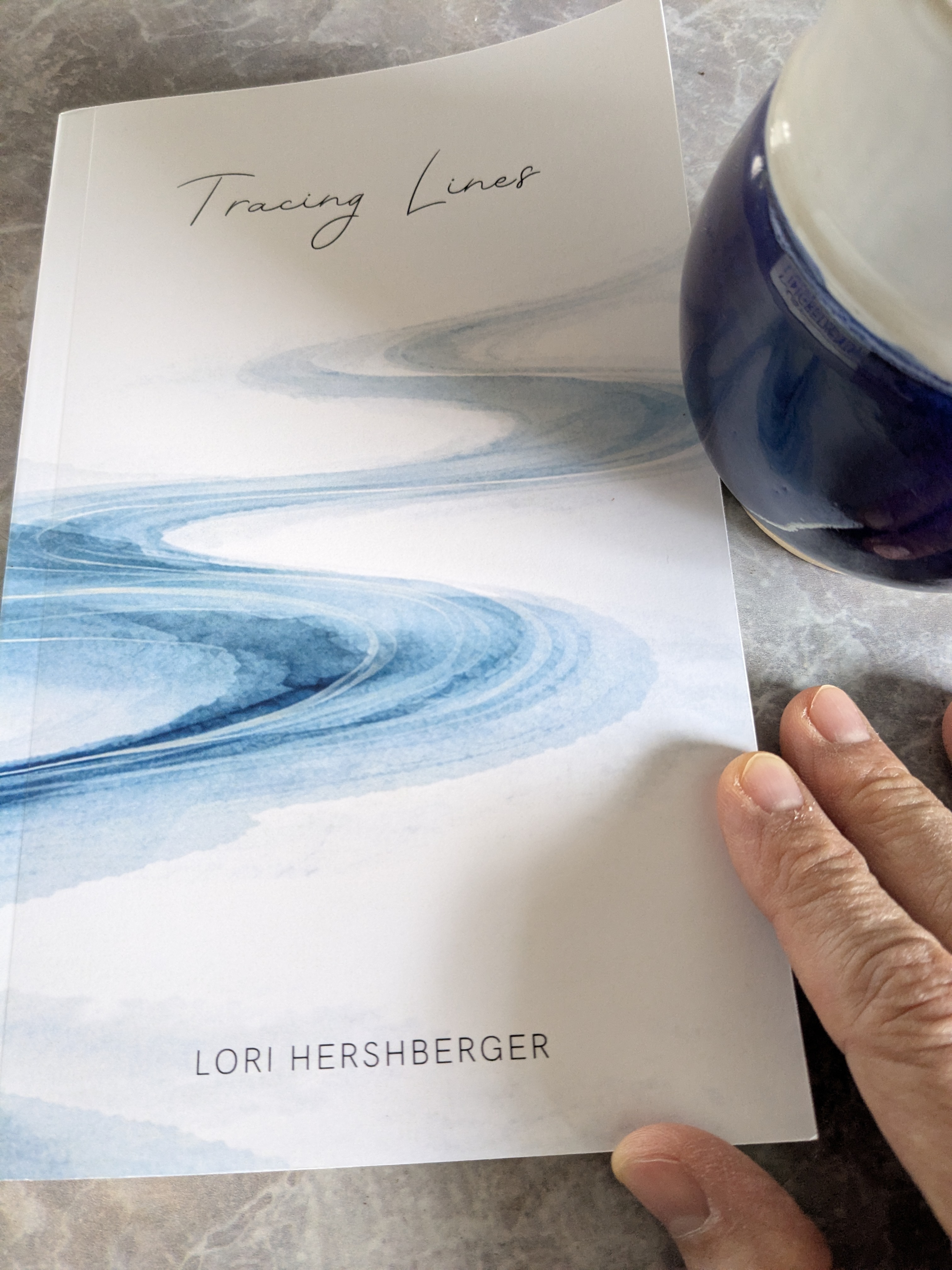
Tracing Lines, by Lori Hershberger

One of my favorite memories of last year is the serendipitous breakfast I had with Lori in Pittsburgh. A group of us were gearing up for our second day at REACH and we needed coffee and the line was too long at the hotel. So we found a coffee shop around the corner from the venue and inside the door was Lori!

I crashed her solitary breakfast, joined by another friend who is unnamed because she’s currently in a closed country. We were three friends who are never ever together: Lori from Thailand, our friend headed to the far east, and me, and we talked as fast as we could around our coffees and shared breakfast sandwiches. Lori was so brave in her cloud of jetlag, and very gracious because she had come to be alone, and we didn’t give her a chance to stay alone. We talked about words and travel and introverts and time zones and I needed to leave way too soon.

Now, a year later, I get to hold and read and announce Lori’s new book of poetry! It has been fun to watch it evolve from a distance. I’ve seen some of the poems before via her blog, but reading them on paper is a far better experience.

Most poets have recurring themes they visit. My themes often circle around light and darkness. Lori’s themes are often about specific places, geography, and distance between places. But the places are fully embodied, never only about dust or wind or water or airports, but also the deep wells of memories, hopes, loves, and griefs connected to those places.

And I love the way she uses repetition to give weight to her lines. When I finish reading a poem, I feel a little thud of recognition and wistfulness because I understand without knowing fully, and I wish I could write like that.

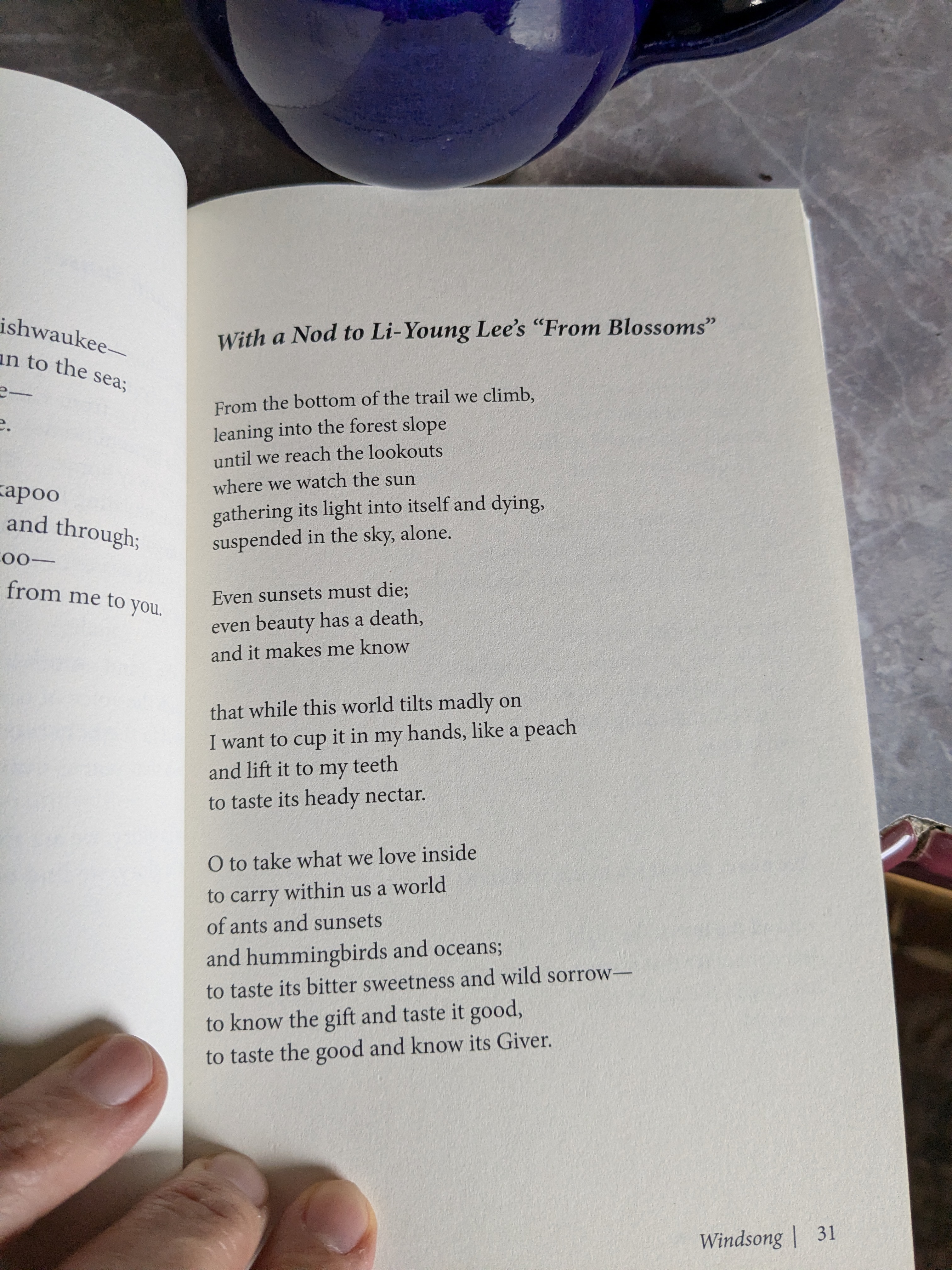
I also love how Lori’s poems give a nod to or enter conversation with other poems and their writers. Like this one:

Lori loves widely and deeply across the time zones and cultures. Her daily life of teaching English and living in a foreign country both enrich her and cost her deeply. I especially love how she pours out her life for her students. She makes it look easy and happy but I know there’s much I can’t see.

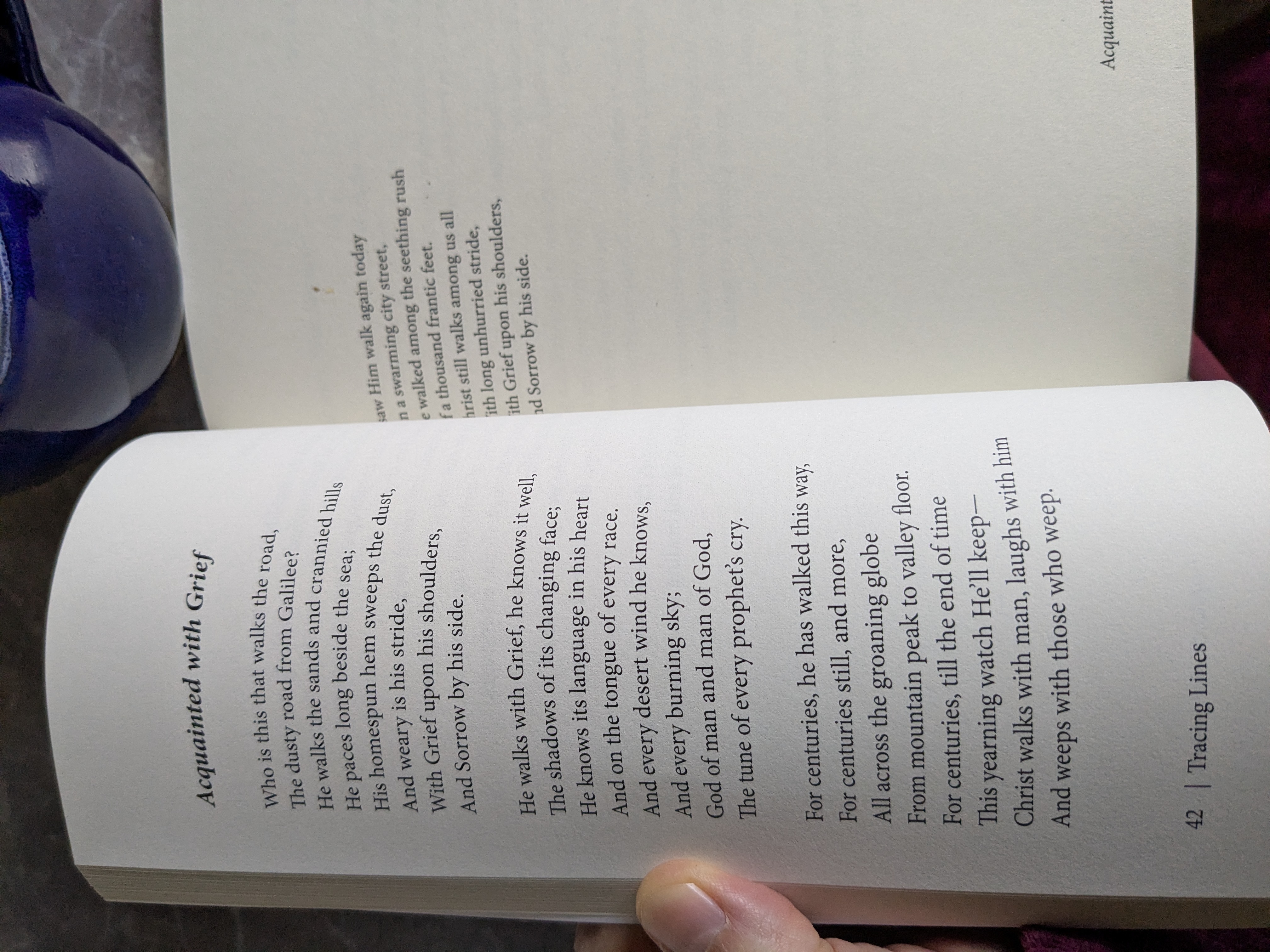
One of her talented students illustrated this book and did a fantastic job. I’m paging through the book now, trying to choose the best poem and illustration to share here, but I can’t choose. You will have to get your own copy, and quickly!

Ordering details from Lori’s blog:

If you’re in the US, you can order a copy for $10 on Amazon here: US Amazon link

You can also order it on Kindle for $6.99 if you prefer to read on Kindle: US Kindle

If you’re in Canada, you can find for $13.66 it at this link: Canada Amazon Link

If you prefer to order directly, you can send me an email at georgeinthailand620@gmail.com, or call me at 620-878-0733, or wherever else you already have my contact information. Allow 7-14 days for your order to arrive. For the US, expect shipping to be around 3 dollars with 50 cents added on for each book. For Canada, shipping is $4.25 with 75 cents added on for each extra book. For direct orders from Canada, I can only accept Paypal, no checks.

Are you wondering if you should order on Amazon or order directly? If you’re not in a hurry, and it’s before April 20, feel free to order directly. I’ll be around to send out the orders (I’m home in Kansas until April 26) and I make a little more money through direct orders, and Amazon gets less. This is always a good thing, no?

Knowing & Being Known: a book review

Last week I was walking in the snow with a friend and we were talking about the books we’ll read during Christmas break.

“Remind me of the title of the book you said everyone should read,” she said.

“Well, right now I have two books that I’m saying everyone should read,” I said. “Are you thinking of Relational Spirituality  or The Body Teaches the Soul?”

“No—there was one before those.”

I doubled over laughing.

I can’t help that I’m the enthusiast who is sure that of course everyone will love whatever I love. And that means that I make superlative statements sometimes. But yes. I read a lot and because reading time is limited, I work hard to read the best. Which of course means others will want to read them too.  

Then I remembered that before the last two books I really loved and enthused about, there was one a month earlier: Knowing and Being Known by Erin Moniz.

About once a year, I hear about a freshly-published book, and I know I need to read it right away and shouldn’t wait until I can buy it cheaply used, which is usually how I buy books. Last year, it was How To Know a Person by David Brooks. This spring Tyler Staton’s A Familiar Stranger was another one that I knew I couldn’t wait until I could buy a used copy. 

This makes two new books this year. No—there was also A Teachable Spirit by A. J. Swoboda that also everyone should read, but I digress. Another digression: I sometimes also read old books. On the Incarnation is perfect and lovely for this time of year.

Knowing and Being Known answered the sometimes-whispered, but often-silent questions about loneliness and ache for companionship. Erin speaks from the perspective of working with college students who are navigating relationships and find themselves floundering between their ideals and their gritty, disappointing reality.

She found that behavior modification wasn’t changing students’ lives in the ways they were longing for. She could tell them “Stop dating losers.” But while she could give solid advice, it didn’t address the deeper hunger driving the behavior. So she went on a search to explore the theology of intimacy: what is in the good news of Jesus that meets the universal hunger for intimacy? 

Other researchers have identified three essential building blocks for healthy, sustainable relationships: 

  • Self-giving love: reciprocity
  • Attention/curiosity: orientation toward and seeking the other
  • Commitment: choosing each other repeatedly; mutuality

Erin expands on these, and then broadens the points and finds them modeled perfectly in the Trinity. 

“…the revelation of mutuality and freedom in the Trinity challenges individual, entitled autonomy. The Trinity’s mutual love of Father, Son, and Holy Spirit defines for us the balance of interconnected love and freedom. 

That we are hardwired for intimacy harkens back to an origin story of intimacy that yields the eternal goodness, beauty, and abundance that existed before the dawn of time.”

This is the good news of the Gospel: that the magnet of our desire is pulled inexorably toward  the north star of God’s love, the model and perfection of intimacy.

And don’t just think we’re talking only about sexual intimacy, although that’s a valid hunger. This north star is much, much wider and deeper than that one level of intimacy, and it is accessible to everyone everywhere. That’s good news!

I love how Erin addresses loneliness. She acknowledges the hard realities of extended singleness but goes on to name a deeper reality: loneliness is part of the human experience. Further, she says, “I do not believe it is loneliness we fear. What we actually fear is the things loneliness reveals….There are other things driving the pain we describe as loneliness.” 

I think she’s 200% right. I live alone and I love it most of the time. I’m not usually lonely, but when it does descend at odd times, I subconsciously get very creative at avoiding the discomfort. But even a healthy, life-giving marriage wouldn’t fix that. My married friends tell me this and I believe them.

It takes a ton of courage to sit with the questions that lie beneath loneliness. But when we find that courage and that silence, we discover what is under that angst and what we really believe about ourselves, our future, God, and those we love. If we can learn to steer our magnets toward our true north, many of our questions and longings will order themselves under that star, like iron filings tracing the path between strong magnets. 

I’m not saying it as well as Erin does, so get yourself a copy and read it and underline it and discuss it with your friends. I’m not getting paid to promote this. I just want others to  discover the richness of a message that has the potential to comfort and coach toward deeper peace and understanding of each other and of God. So go ahead and order a copy for yourself and a friend as a gift to both of you. It could be a great way to start a new year!

My book talks about loneliness too, and has suggestions for when you’re feeling left behind. You can buy it here.

A Poem-Long Sentence

I wrote this poem some time ago, but it works now too, except for the line about summer! I took this snowy picture two days ago and the snow is still falling and it’s beautiful beyond words.

I could write a poem about stopping by the woods on a snowy evening, but
Someone much wiser and more profound than I has already written a poem beginning with
that line and
After I read that I feel that I can never write so sparse and rich so why should I try,
But I have words in me that Frost never did, so that gives me permission to try to push out
Words, pat them into line, riffle through, discard or choose the precise ones to show, not tell,
The mood and texture of the vignette I have in mind
And even though it’s not about horse or downy flake (I drive a car, it’s high summer, and I don’t Collect Currier & Ives prints) my soul holds
Pictures of thin spaces, moments, sparkles, glistenings, that would be fun to take
out of storage, unfold,
Hold up to the light, adjust, unwrinkle, because, even though out of sight, they shape me,
and maybe
They could nudge someone and set the compass for a friend’s reference point of what is
Good and beautiful and true since stable compasses are scarce these days and we need them
Even though we don’t say it, however insightful we are and however experienced
because we are all
Mostly shuffling our way toward home, knowing we’re not there yet and it might be
Awhile—probably miles to go before we sleep—but we’ll get there someday and meanwhile
we hold
Each other’s hands to find the path and share the light we see because beauty must be shared, not Hoarded, which has to be why Frost gave us his snapshot of his woods and horse.

My book talks about another kind of walk. It’s a voice to remind you that you’re never actually alone, wherever you’re walking. You can buy it here!

This Week’s Reads

Because of always having several books on the go simultaneously, I finished 3 this week and they’re phenomenal enough to recommend them here.

The Dean’s Watch by Elisabeth Goudge is stuffy and passionate and achingly beautiful. I’d read it a long time ago, and it felt especially fitting to be re-reading it this week, since its setting is Advent. The characters are vivid and alive, even if sad and scruffy. They’re real. I’ve heard that it’s to be an allegory, but I haven’t seen through it all yet. There’s something in this quote though, that means more than the words say:

“It does not matter, Job,” said the Dean at last.  “I mean it does not matter that the clock was broken. What matters is that the clock was made.”

For years, I shied away from Henri Nouwen’s The Wounded Healer because I thought it was too deep and wordy. But when I actually opened it I found it very readable and accessible. The depth and wisdom was amazing. The thoughtfulness and careful words are to be read slowly and digested. He talks alot about loneliness and how it’s not something to run away from, but can become a source of life for others.

This is the announcement of the wounded healer: ‘The master is coming–not tomorrow, but today, not next year, but this year, not after all our misery is passed, but in the middle of it, not in another place but right here where we are standing.’

This morning over coffee, I finished The Shack, the book that took the evangelical world by storm some years back. I’d read it before, after an operation when I was in a daze of painkillers, so not everything registered very well, but my impression then was the same as this time: that its message is valuable and powerful, but the writing style was very distracting. I wanted to mark out all the fluffy adverbs. Even so, I really like the picture of the fellowship and love among the Trinity, and the way they shower love and are ‘especially fond’ of people. The story was both convicting and comforting.

Mack, if anything matters then everything matters. Because you are important, everything changes; every time you reach out and touch a heart or a life, the world changes; with every kindness and service, seen or unseen, my purposes are accomplished and nothing will ever be the same again.

I never wanted an e-reader before, but today I do. Next week I plan to go to the US for 2 months. I’m teaching a Bible school class for girls for 3 wks, and have  no room to take any books for resources. Living with one checked-in bag for 2 months means only essentials go. In theory and in practice, I like travelling light. But I hate to be book-less. I don’t know yet how my ideal will match my practice.

Related post: Heavy Books

To Have and To Hold–A New Book!

I’m delighted to tell everyone who will listen about a new book that my friend and mentor, Sharon, wrote. It’s out now! To Have and To Hold is written for women who find themselves alone and wondering how to think about themselves and life and God.

Sharon is a gifted teacher and mentor, and writes out of her own experiences and questions. I was privileged to read the manuscript, and what I liked best is how she is brave to ask and wrestle with questions that have no quick, pat answers. It’s a must-read if you are wondering why there are singles in the world, and what is God up to in your aloneness?

You can order the book now from Christian Learning Resource for only $10.99.

Call  800-222-4769       or email clr@fbep.org for your own copy.

And in your spare time, visit her lovely blog at www.tohaveandtoholdbook.com

To Explain

The link for Westminster Seminary Bookstore is there because I’ve just finished taking a course from there, under CCEF, Christian Counseling and Education Foundation. The course was “Dynamics of Biblical Change” and was 12 wks, by correspondance. Dr. David Powlison was the lecturer. It was a grueling but wonderful time. I would highly recommend the course to anyone who was looking for Biblical ways to search out their heart motives and pursue God’s wisdom in all of life.

The next course is “Methods of Biblical Change” which I’m considering taking later this year. Paul Tripp is the lecturer for that one, I understand.

It’s actually sort of sad to break the tradition that Mondays became for me: listening to 3 hrs of lectures every Mon. morning. Then throughout the week, there was assigned reading of chapters and articles, and response papers. During the 12 wks we worked on a self-counselling project, and at the end wrote a report on that, as well as a report on a ministry project. Because the end of self-examination and pursuit of wisdom is to reach out and bless and minister to others, and not always stay navel-gazing.

I loved how the course was very practical, realistic, and always tied into Scripture. I have a new appreciation, knowing that the Bible actually speaks into real situations of the real world. There’s a lot of security and freedom in that.

So check out the Westminster bookstore. They have some good stuff. I recommend the book Come Back Barbara by C. John Miller and his daughter Barbara. It’s the incredible, beautiful story of a prodigal daughter, written by the father and daughter. John has passed on now, but Barbara is one of the instructors in the counselling course.