Several years ago, I took six poetry workshops on Zoom with Danusha Laméris, a beautiful, gifted poet who lives in California.
Danusha was making a point that I’ve forgotten, but her story remains with me and I think of it almost every day. She told us that she had a young son who was hospitalized multiple times with a chromosome deficiency that no one could diagnose. He died before he became a teen. (I can’t remember all the details and I wish Danusha would find this blog post to correct it.)
The stress of having her son deathly ill for years with no answers was agony, and the medical staff tried to be helpful by promising her that some day there would be resolution.
But there was one tall, wise doctor who carefully and lovingly explained to her that there might never be an explanation. “You will have to find a way to bear up while not knowing what is wrong with your son.”
Danusha said he said it gently and kindly and full of love, and his words helped her shift into a way of living that, though still hard, made it possible to go on.
I often think of that wise doctor and how his words apply to all of us in some way.
Life is beastly hard in many ways and places, and there are often no good ways out of the hard pieces.
Singleness is hard and marriage is hard.
Raising children is hard and being childless is hard.
Forgiving and budgeting and exercising and being sick and hosting and grieving and waiting and deciding and repairing is hard, hard, hard.
Difficulty doesn’t necessarily mean that we’re doing something wrong and need to correct it. Difficulty means that there might be no quick resolution to this, so our next goal has to be to learn how to carry this weight well. We need to find a way to bear up under the hard.
Sometimes I think that’s a key part of being an adult: finding what strengthens me and then doing that regularly.
Finding a way to do hard things doesn’t mean that we should grit our teeth and muscle through the next big task. I think living well in difficult seasons requires nurturing a heart that is both soft and strong.
That’s what Danusha did. Over the years marked by griefs, she has kept her eyes open to the light and the beauty around her and puts it into poetry. The sting of multiple losses pierces her lines, and grief is a pervasive theme for her, but it doesn’t have the last word in her story.
You don’t have to write poems to deal with hard things, although I bet you can write a better poem than you think you can.
To stay soft and strong, some people pray breath prayers.
Or take daily silent walks.
Or cry when they need to.
Or set the timer for ten minutes and read or nap.
Or laugh with children.
Notice how these physical responses can help to build the muscles that help carry emotional or spiritual weight.
Those tears when you see the morning star before dawn? That’s your soft heart, sensitive to beauty and wonder.
That grin and deep sigh before you walk into the next big assignment? That’s your strong heart keeping you vertical and resilient.
The world doesn’t need more harsh, strident, strong women. We need sensitive, impressionable women with strong, resolved, steady, thoughtful hearts that keep doing the next right thing without crumpling. And when they crumple, they cry awhile then get back up.
Soft, not flabby.
Strong, not strident.
Being soft and strong is a way to bear up in the hard places that might never be resolved until the new creation.
The way Jesus lived and loved models a way for us to be soft and strong, able to bear up under heaviness as He did. And the Spirit that raised Jesus from the dead is in you and ahead of you and over you. He is very strong on your behalf. And His heart is soft toward all that is beautiful and all that is broken.
My book is about living well when you find yourself in a story you hadn’t planned. You can buy it here!
The Daughters of Promise team asked me to contribute an article for each of their magazine issues this year. The themes they assigned were too beautiful and exciting for me to refuse to write about even though I didn’t actually need three new projects with deadlines. This blog post is the article I wrote for their Storyseekers and Storytellers issue. The stories in this photo are some of my favorites. I’ve read all of them at least twice.
I was returning from a missionary conference where Elisabeth Elliot had spoken. Riding a big, lumbering bus through green Irish scenery, I read as miles disappeared behind us. I was reading Mrs. Elliot’s latest book, Quest for Love, which she had autographed for me. It had been a hard year for me, adjusting to a new life in a new country. But even more difficult, I was holding heartbreak, a romantic hope deferred.
In the book, Elisabeth Elliot wrote of her own broken heart when she said goodbye to Jim, the man she loved, and didn’t know when she’d ever see him again. She had been so distressed that she threw herself on her bed, crying so loudly that her landlady rushed in to ask what was wrong.
In that bus, surrounded by silent strangers, I read her story for the first time and wept. Tears dripped off my nose because I felt so relieved and comforted. I saw that my hero, the extraordinary Elisabeth Elliot, had also cried. She, too, had felt deep distress about her romantic hopes and big questions with no answers, and she had sobbed, too. I suddenly didn’t feel so alone, and a significant increment of healing happened deep inside me on that long bus ride.
Women—like Elisabeth Elliot—are good at telling stories. Our stories hold immense value when we share them. Women are the life-bearers and nurturers, and telling stories is a way we offer life to each other. Elisabeth’s story did for me what all good stories do:
Stories show us what is good, beautiful, and true.
Stories give us hope because they show we’re not alone.
Remember that time you heard about someone’s experience, and it helped you feel new energy to keep walking? It was only a little snapshot, a short testimony, a tiny snippet from their life that they shared with you, but it gave you enough light that you still remember it and make decisions accordingly.
Each life has many, many mini-stories in it. Think about your own story—not the long arc of your life, but that little scenario from yesterday or a prevailing memory from last year. Any time you want something and go through conflict to find it, you have the beginning of a story. In your best stories, a hero arrives on the scene and helps you receive the object you wanted at the beginning of the story.[1] This is the illustration or snapshot from your life that you can offer to your world at the appropriate time to demonstrate what is good, beautiful, and true. This is your story.
Let’s unpack this definition of story so that you can identify yours.
You want something.
Our hearts are always moving in a specific direction. We lie if we say we don’t want anything. But desire is risky and potentially overwhelming. Hence, it can feel easier to shelve desire rather than to hold it, or cover it up with a thick blanket of love for interior design or books—safer, more kosher desires to live with.
But for just a minute here, sit still and ask yourself what Jesus asked many people: What do you want? Probe the longings under those longings. Don’t be afraid to explore and sit in those caverns for five minutes. What emerges from that silence reveals an extremely important part of your story.
Cinderella wanted to go to the ball. Winnie the Pooh wanted a jar of honey. Anne wanted puffed sleeves. But under those dreams were deeper longings. Cinderella wanted to belong. Winnie the Pooh wanted the taste of honey on his tongue. Anne wanted to be beautiful. Your desires are the signs of an alive, beating, beautiful heart, not something to be ashamed of.
The minute you stop desiring, your story stops. If the blind men hadn’t wanted to see, Jesus wouldn’t have healed them. If the bleeding woman hadn’t been desperate for healing, she would never have touched Jesus’ hem and been healed, and she’d have had no story.
So, what do you want? What will you want today when you go shopping? What did you want on Sunday when you walked into church? What did you want when you picked up your phone just now? It’s important to name your desire because it gives you a clue about what you value most and what kind of story you will live.
You must go through conflict to find what you want.
Conflict, like desire, is wildly uncomfortable. So it makes sense that we hush conflict as much as possible. Conflict in our stories can look like disappointment, illness, questions with no answers, or difficult relationships. Name a disruption in your life or your day. You could make your own list of curve balls and disagreements just from yesterday, because all our stories hold some kind of difficulty where we conflict with ourselves, others, nature, or God.
Conflict is the place where your story turns, and good comes from it (eventually). Without conflict, your story flatlines. Without the conflict with Joseph’s brothers, Joseph’s story would just have been about Joseph in the field. Without conflict between His will and the Father’s will, Jesus would only have been sitting in the dark in the garden of Gethsemane.
Because of the significant disruption of my experience of fibroids, years of pain, and resulting hysterectomy at age 39, I became more sensitive to people’s pain than I would have otherwise, and I’m thankful. Janette Walls’ story in The Glass Castle shows that without her dysfunctional parents and their hurtful choices, she’d never have decided to pursue a better life.
The points of conflict in a story are the precise points where the story improves. In literature, we call these “inciting incidents.” Sometimes, the situation worsens before it turns positive, but the plotline turns on these points and makes the conflict enrich the story, deepening its impact. The impact comes from how clearly it shows us what is good, beautiful, and true.
Your true hero is Jesus.
Out of conflict, heroes emerge. To be clear: you’re an important character in your story, but not the hero. Your pain, your disappointment, or your demanding situation is not your hero or the most important part of your story. I don’t mean to sound like your predictable Sunday school teacher, but Jesus is the hero of your story.
Without conflict, we don’t know that we need Jesus. Jesus the hero does not exist to make all our dreams come true or take away all the conflict we live with, but to bring us to a deep connection with Him. He is who makes our stories ultimately true, good, and beautiful.
You dream and talk and shop and eat differently depending on who your hero is, the person you admire, the one you want to be like. So, who is your hero? How does your story make Jesus look good?
Your story matters!
Women are good at telling stories, but they’re also good at comparing their story with others’ stories, and this takes them to sad places.
Your story matters, even if it feels ordinary and insignificant. When Anabaptists in Switzerland were hunted like criminals, the boundary line of one canton ran through one Anabaptist family’s house. This meant hunted people were safe on one side of the house but not the other. Can you imagine the drama and actual “cops and robbers” scenarios inside those walls? Meanwhile, we can assume that the lady of the house was baking bread and sweeping crumbs from the floor and mending holes in aprons. Her ordinary, mundane days made it possible for people to find shelter in her house.
Do your days feel dull? Does your ordinary story give hope and safety to your world? Your story—your ordinary, daily, mundane story matters!
Maybe you feel that your story doesn’t fit well with the stories around you. It’s odd, misshaped, and feels out of place.
Queen Esther was an orphan raised by a cousin and placed in a harem, which sounds like a dysfunctional, disastrous story on every level. Esther’s story didn’t develop like other Jewish girls, but hers was an utterly vital story.
If your story feels too normal or too odd to contribute to your world, take another look at what you long for, the conflict you’ve encountered in pursuing it, and the hero you’ve chosen. When you tell your neighbor or sister or best friend your ordinary story of what happened last week, or that wild, nonsensical occurrence from last year, you might give a bigger gift than you see now.
Your ordinary story can demonstrate how to live well without you preaching how to live well. Your strange story can help someone feel hope because they know they’re not alone. Your story is more valuable than you know!
It’s been thirty years since that bus ride home when Elisabeth Elliot’s story comforted me so deeply. What is your story? How could it help someone else feel less alone?
You should usually wait to share your story until someone asks for it. You should offer it humbly, not mapping your story on theirs as if you have all the answers. But your story—your plain, puzzling, aching story—when it demonstrates what is good, true, and beautiful, is a way you offer hope and goodness to your world.
[1] I’m indebted to Donald Miller, his Storyline conference, and his multiple books for this simplistic definition of story. It does not fit all the definitions of literary stories, but it fits the contours of living a good story.
I wrote a book once, and it’s not a story, though it has one piece of fiction in it, written in first person. The fiction is so colorful that a friend thought it had happened to me, which pleased me enormously. The book is about living well when you find yourself in a story you hadn’t planned. You can buy it here!
One of my favorite memories of last year is the serendipitous breakfast I had with Lori in Pittsburgh. A group of us were gearing up for our second day at REACH and we needed coffee and the line was too long at the hotel. So we found a coffee shop around the corner from the venue and inside the door was Lori!
I crashed her solitary breakfast, joined by another friend who is unnamed because she’s currently in a closed country. We were three friends who are never ever together: Lori from Thailand, our friend headed to the far east, and me, and we talked as fast as we could around our coffees and shared breakfast sandwiches. Lori was so brave in her cloud of jetlag, and very gracious because she had come to be alone, and we didn’t give her a chance to stay alone. We talked about words and travel and introverts and time zones and I needed to leave way too soon.
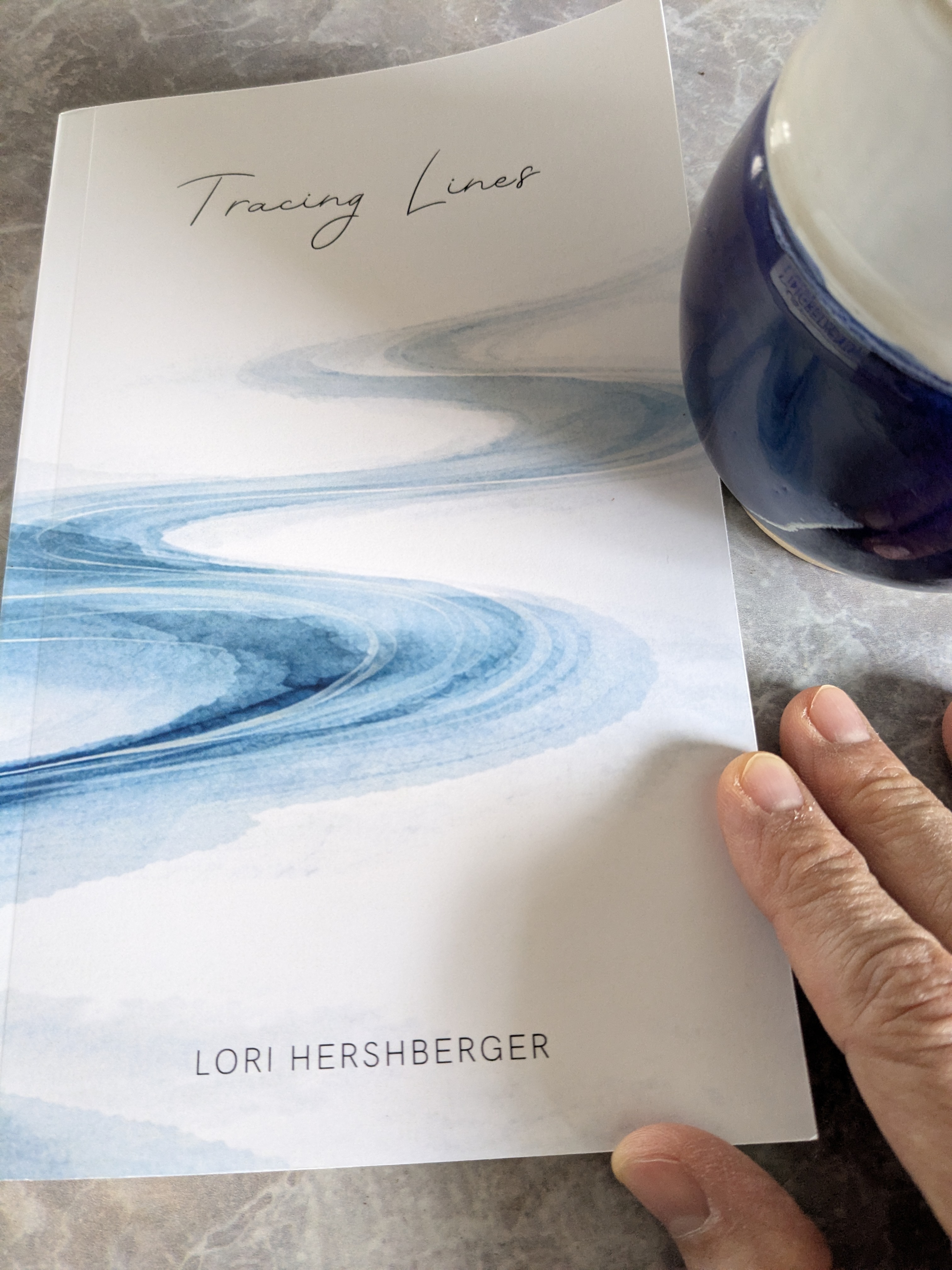
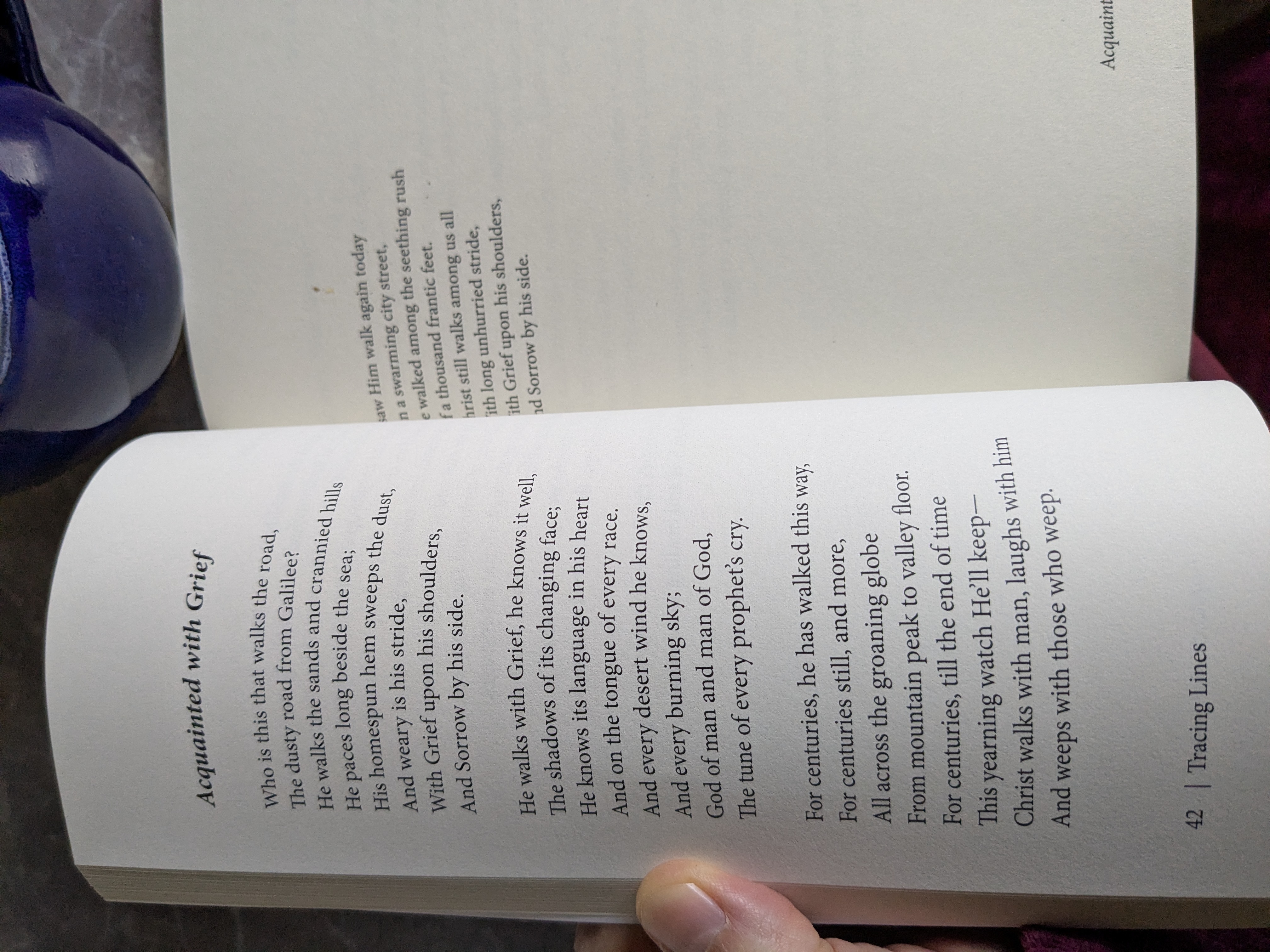
Now, a year later, I get to hold and read and announce Lori’s new book of poetry! It has been fun to watch it evolve from a distance. I’ve seen some of the poems before via her blog, but reading them on paper is a far better experience.
Most poets have recurring themes they visit. My themes often circle around light and darkness. Lori’s themes are often about specific places, geography, and distance between places. But the places are fully embodied, never only about dust or wind or water or airports, but also the deep wells of memories, hopes, loves, and griefs connected to those places.
And I love the way she uses repetition to give weight to her lines. When I finish reading a poem, I feel a little thud of recognition and wistfulness because I understand without knowing fully, and I wish I could write like that.
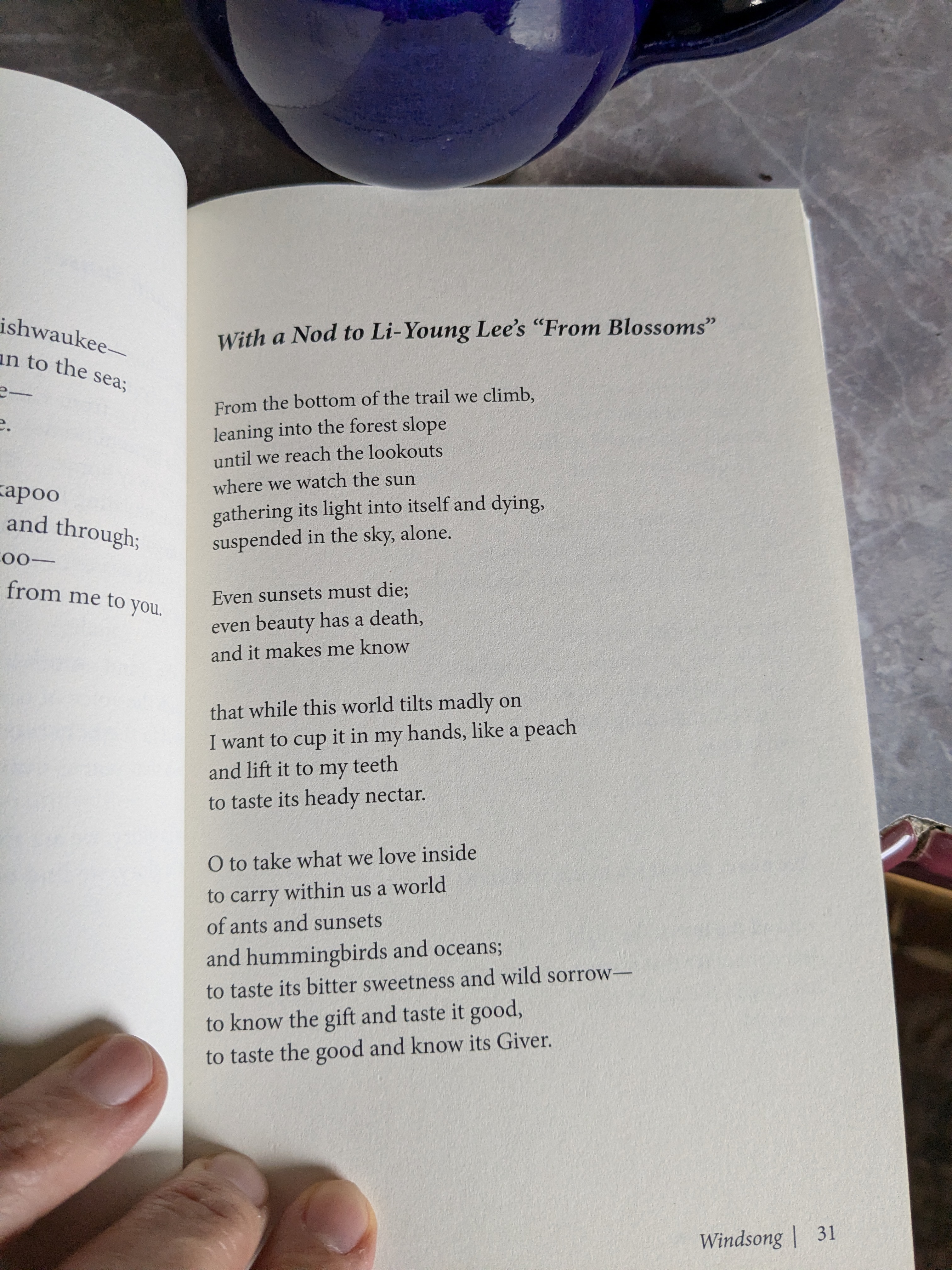
I also love how Lori’s poems give a nod to or enter conversation with other poems and their writers. Like this one:
Lori loves widely and deeply across the time zones and cultures. Her daily life of teaching English and living in a foreign country both enrich her and cost her deeply. I especially love how she pours out her life for her students. She makes it look easy and happy but I know there’s much I can’t see.
One of her talented students illustrated this book and did a fantastic job. I’m paging through the book now, trying to choose the best poem and illustration to share here, but I can’t choose. You will have to get your own copy, and quickly!
Ordering details from Lori’s blog:
If you’re in the US, you can order a copy for $10 on Amazon here: US Amazon link
You can also order it on Kindle for $6.99 if you prefer to read on Kindle: US Kindle
If you’re in Canada, you can find for $13.66 it at this link: Canada Amazon Link
If you prefer to order directly, you can send me an email at georgeinthailand620@gmail.com, or call me at 620-878-0733, or wherever else you already have my contact information. Allow 7-14 days for your order to arrive. For the US, expect shipping to be around 3 dollars with 50 cents added on for each book. For Canada, shipping is $4.25 with 75 cents added on for each extra book. For direct orders from Canada, I can only accept Paypal, no checks.
Are you wondering if you should order on Amazon or order directly? If you’re not in a hurry, and it’s before April 20, feel free to order directly. I’ll be around to send out the orders (I’m home in Kansas until April 26) and I make a little more money through direct orders, and Amazon gets less. This is always a good thing, no?
I wrote this poem some time ago, but it works now too, except for the line about summer! I took this snowy picture two days ago and the snow is still falling and it’s beautiful beyond words.
I could write a poem about stopping by the woods on a snowy evening, but Someone much wiser and more profound than I has already written a poem beginning with that line and After I read that I feel that I can never write so sparse and rich so why should I try, But I have words in me that Frost never did, so that gives me permission to try to push out Words, pat them into line, riffle through, discard or choose the precise ones to show, not tell, The mood and texture of the vignette I have in mind And even though it’s not about horse or downy flake (I drive a car, it’s high summer, and I don’t Collect Currier & Ives prints) my soul holds Pictures of thin spaces, moments, sparkles, glistenings, that would be fun to take out of storage, unfold, Hold up to the light, adjust, unwrinkle, because, even though out of sight, they shape me, and maybe They could nudge someone and set the compass for a friend’s reference point of what is Good and beautiful and true since stable compasses are scarce these days and we need them Even though we don’t say it, however insightful we are and however experienced because we are all Mostly shuffling our way toward home, knowing we’re not there yet and it might be Awhile—probably miles to go before we sleep—but we’ll get there someday and meanwhile we hold Each other’s hands to find the path and share the light we see because beauty must be shared, not Hoarded, which has to be why Frost gave us his snapshot of his woods and horse.
My book talks about another kind of walk. It’s a voice to remind you that you’re never actually alone, wherever you’re walking. You can buy it here!
I identify with Elisabeth when she wrote: “As a writer, I have to fight the feeling that each article I write must be pretty much the very last word I’ll ever have to say on that topic.”
Writers are strange, often- misunderstood people. They write authoritatively even though they don’t know everything about the subject. They doubt themselves, but at some point they put their soul on the line and let others see their words. They give the faceless public the chance to riffle through the paragraphs, pounce on a point or two, take issue with nonessentials, and remember what suits them.
Then the writer thinks about how she could have said it differently, how she could have fleshed out that idea, taken the other one out, and she hopes that the discerning reader will see what she didn’t explain, and understand that no one will write flawlessly.
Elisabeth wrote the excellent article “What’s a Guy to Do?” and followed it up more recently on her own blog by explaining what she could’ve written, explained, and discussed, but didn’t. Good stuff, especially for women. Breeze on over there and see.
Let’s be clear about this: I don’t do chain stuff or forwards. For various reasons. Two recipes or 50 questions about yourself to forward to 51 of your friends or email poems that have 152 emoticons in them that you MUST forward unless you want to be attacked by a billy goat? I don’t do it. Life is too short. But Dorcas tagged me in a meme, which is (or can be) a different thing, and I answered her questions because they were about things I care about, and I had time to answer them.
(A meme is an idea or theme that spreads like a virus in the blogging world, and this one is about writing and I’m breaking the bendable rules by not preparing a list of more questions or bloggers.)
1. How long have you been blogging, and how often do you post?
I started the blog in ’08 when my book came out. Before that, I had a xanga site, which was more social to me than serious writing. There is no rhyme or reason as to how I often I post. I refuse to write just so that I get more hits on my site, or because it’s been awhile since I last posted. I only write when I feel there’s something inside that needs to get out. This is my 201st post here.
2. Have you had anything published, and if so, what and when?
Some devotional/inspirational articles in CLP’s “Companions” some years ago. I published my own book, written especially for single women, in ’08.
3. Who is the author who best speaks your language and who you would most like to be like, in style and message?
Philip Yancey speaks my language because of his honesty. I admire the way he explains his conclusions with words that are carefully chosen but still carry a cadence, a kind of rhythm. I admire CS Lewis for the way he connects the spiritual and the tangible world. I’m relishing Les Miserables but would NOT want to mimic Victor Hugo’s style.
4. What do you see as the unique message God has given you to share with the world ?
It has something to do with exposing beauty and truth. Also, I want to be a voice for those who have none, and an ear for those who those who have found none. In other words, be a facilitator, which may not necessarily mean writing.
5. Who or what has made you believe in yourself as a writer?
A teacher at school (Rosalind McGrath Byler) and a Calvary Bible school teacher (Ervin Hershberger).
6. Who or what has done the opposite?
Men who refused to market my book, were opposed to it because it didn’t fit their theology and disapproved of my using quotes from writers in other denominations.
7. Besides blogging, what types of writing have you done?
Journaling. Letters. Dabbled in verse and music composition but wasn’t willing to stick to it. In my head, I’ve written travel articles about my local area in Ireland.
8. Where would you like to be, writing-wise, in five years?
Working on my 2nd book.
9. What would need to happen to move you from here to there?
A lot of things that God and I keep discussing.
10. Any advice for beginning bloggers/writers?
Don’t write if you can help it. But if you can’t help but write, do! Read all the time, always have several books on the go, and don’t read rubbish.
11. Just for fun: what’s a skill you have that almost no one knows about? (example: I know how to develop black and white film in a darkroom.)
I can read and write words upside-down, across the table from my English students.