Several years ago, I took six poetry workshops on Zoom with Danusha Laméris, a beautiful, gifted poet who lives in California.
Danusha was making a point that I’ve forgotten, but her story remains with me and I think of it almost every day. She told us that she had a young son who was hospitalized multiple times with a chromosome deficiency that no one could diagnose. He died before he became a teen. (I can’t remember all the details and I wish Danusha would find this blog post to correct it.)
The stress of having her son deathly ill for years with no answers was agony, and the medical staff tried to be helpful by promising her that some day there would be resolution.
But there was one tall, wise doctor who carefully and lovingly explained to her that there might never be an explanation. “You will have to find a way to bear up while not knowing what is wrong with your son.”
Danusha said he said it gently and kindly and full of love, and his words helped her shift into a way of living that, though still hard, made it possible to go on.
I often think of that wise doctor and how his words apply to all of us in some way.
Life is beastly hard in many ways and places, and there are often no good ways out of the hard pieces.
Singleness is hard and marriage is hard.
Raising children is hard and being childless is hard.
Forgiving and budgeting and exercising and being sick and hosting and grieving and waiting and deciding and repairing is hard, hard, hard.
Difficulty doesn’t necessarily mean that we’re doing something wrong and need to correct it. Difficulty means that there might be no quick resolution to this, so our next goal has to be to learn how to carry this weight well. We need to find a way to bear up under the hard.
Sometimes I think that’s a key part of being an adult: finding what strengthens me and then doing that regularly.
Finding a way to do hard things doesn’t mean that we should grit our teeth and muscle through the next big task. I think living well in difficult seasons requires nurturing a heart that is both soft and strong.
That’s what Danusha did. Over the years marked by griefs, she has kept her eyes open to the light and the beauty around her and puts it into poetry. The sting of multiple losses pierces her lines, and grief is a pervasive theme for her, but it doesn’t have the last word in her story.
You don’t have to write poems to deal with hard things, although I bet you can write a better poem than you think you can.
To stay soft and strong, some people pray breath prayers.
Or take daily silent walks.
Or cry when they need to.
Or set the timer for ten minutes and read or nap.
Or laugh with children.
Notice how these physical responses can help to build the muscles that help carry emotional or spiritual weight.
Those tears when you see the morning star before dawn? That’s your soft heart, sensitive to beauty and wonder.
That grin and deep sigh before you walk into the next big assignment? That’s your strong heart keeping you vertical and resilient.
The world doesn’t need more harsh, strident, strong women. We need sensitive, impressionable women with strong, resolved, steady, thoughtful hearts that keep doing the next right thing without crumpling. And when they crumple, they cry awhile then get back up.
Soft, not flabby.
Strong, not strident.
Being soft and strong is a way to bear up in the hard places that might never be resolved until the new creation.
The way Jesus lived and loved models a way for us to be soft and strong, able to bear up under heaviness as He did. And the Spirit that raised Jesus from the dead is in you and ahead of you and over you. He is very strong on your behalf. And His heart is soft toward all that is beautiful and all that is broken.
My book is about living well when you find yourself in a story you hadn’t planned. You can buy it here!
The Daughters of Promise team asked me to contribute an article for each of their magazine issues this year. The themes they assigned were too beautiful and exciting for me to refuse to write about even though I didn’t actually need three new projects with deadlines. This blog post is the article I wrote for their Storyseekers and Storytellers issue. The stories in this photo are some of my favorites. I’ve read all of them at least twice.
I was returning from a missionary conference where Elisabeth Elliot had spoken. Riding a big, lumbering bus through green Irish scenery, I read as miles disappeared behind us. I was reading Mrs. Elliot’s latest book, Quest for Love, which she had autographed for me. It had been a hard year for me, adjusting to a new life in a new country. But even more difficult, I was holding heartbreak, a romantic hope deferred.
In the book, Elisabeth Elliot wrote of her own broken heart when she said goodbye to Jim, the man she loved, and didn’t know when she’d ever see him again. She had been so distressed that she threw herself on her bed, crying so loudly that her landlady rushed in to ask what was wrong.
In that bus, surrounded by silent strangers, I read her story for the first time and wept. Tears dripped off my nose because I felt so relieved and comforted. I saw that my hero, the extraordinary Elisabeth Elliot, had also cried. She, too, had felt deep distress about her romantic hopes and big questions with no answers, and she had sobbed, too. I suddenly didn’t feel so alone, and a significant increment of healing happened deep inside me on that long bus ride.
Women—like Elisabeth Elliot—are good at telling stories. Our stories hold immense value when we share them. Women are the life-bearers and nurturers, and telling stories is a way we offer life to each other. Elisabeth’s story did for me what all good stories do:
Stories show us what is good, beautiful, and true.
Stories give us hope because they show we’re not alone.
Remember that time you heard about someone’s experience, and it helped you feel new energy to keep walking? It was only a little snapshot, a short testimony, a tiny snippet from their life that they shared with you, but it gave you enough light that you still remember it and make decisions accordingly.
Each life has many, many mini-stories in it. Think about your own story—not the long arc of your life, but that little scenario from yesterday or a prevailing memory from last year. Any time you want something and go through conflict to find it, you have the beginning of a story. In your best stories, a hero arrives on the scene and helps you receive the object you wanted at the beginning of the story.[1] This is the illustration or snapshot from your life that you can offer to your world at the appropriate time to demonstrate what is good, beautiful, and true. This is your story.
Let’s unpack this definition of story so that you can identify yours.
You want something.
Our hearts are always moving in a specific direction. We lie if we say we don’t want anything. But desire is risky and potentially overwhelming. Hence, it can feel easier to shelve desire rather than to hold it, or cover it up with a thick blanket of love for interior design or books—safer, more kosher desires to live with.
But for just a minute here, sit still and ask yourself what Jesus asked many people: What do you want? Probe the longings under those longings. Don’t be afraid to explore and sit in those caverns for five minutes. What emerges from that silence reveals an extremely important part of your story.
Cinderella wanted to go to the ball. Winnie the Pooh wanted a jar of honey. Anne wanted puffed sleeves. But under those dreams were deeper longings. Cinderella wanted to belong. Winnie the Pooh wanted the taste of honey on his tongue. Anne wanted to be beautiful. Your desires are the signs of an alive, beating, beautiful heart, not something to be ashamed of.
The minute you stop desiring, your story stops. If the blind men hadn’t wanted to see, Jesus wouldn’t have healed them. If the bleeding woman hadn’t been desperate for healing, she would never have touched Jesus’ hem and been healed, and she’d have had no story.
So, what do you want? What will you want today when you go shopping? What did you want on Sunday when you walked into church? What did you want when you picked up your phone just now? It’s important to name your desire because it gives you a clue about what you value most and what kind of story you will live.
You must go through conflict to find what you want.
Conflict, like desire, is wildly uncomfortable. So it makes sense that we hush conflict as much as possible. Conflict in our stories can look like disappointment, illness, questions with no answers, or difficult relationships. Name a disruption in your life or your day. You could make your own list of curve balls and disagreements just from yesterday, because all our stories hold some kind of difficulty where we conflict with ourselves, others, nature, or God.
Conflict is the place where your story turns, and good comes from it (eventually). Without conflict, your story flatlines. Without the conflict with Joseph’s brothers, Joseph’s story would just have been about Joseph in the field. Without conflict between His will and the Father’s will, Jesus would only have been sitting in the dark in the garden of Gethsemane.
Because of the significant disruption of my experience of fibroids, years of pain, and resulting hysterectomy at age 39, I became more sensitive to people’s pain than I would have otherwise, and I’m thankful. Janette Walls’ story in The Glass Castle shows that without her dysfunctional parents and their hurtful choices, she’d never have decided to pursue a better life.
The points of conflict in a story are the precise points where the story improves. In literature, we call these “inciting incidents.” Sometimes, the situation worsens before it turns positive, but the plotline turns on these points and makes the conflict enrich the story, deepening its impact. The impact comes from how clearly it shows us what is good, beautiful, and true.
Your true hero is Jesus.
Out of conflict, heroes emerge. To be clear: you’re an important character in your story, but not the hero. Your pain, your disappointment, or your demanding situation is not your hero or the most important part of your story. I don’t mean to sound like your predictable Sunday school teacher, but Jesus is the hero of your story.
Without conflict, we don’t know that we need Jesus. Jesus the hero does not exist to make all our dreams come true or take away all the conflict we live with, but to bring us to a deep connection with Him. He is who makes our stories ultimately true, good, and beautiful.
You dream and talk and shop and eat differently depending on who your hero is, the person you admire, the one you want to be like. So, who is your hero? How does your story make Jesus look good?
Your story matters!
Women are good at telling stories, but they’re also good at comparing their story with others’ stories, and this takes them to sad places.
Your story matters, even if it feels ordinary and insignificant. When Anabaptists in Switzerland were hunted like criminals, the boundary line of one canton ran through one Anabaptist family’s house. This meant hunted people were safe on one side of the house but not the other. Can you imagine the drama and actual “cops and robbers” scenarios inside those walls? Meanwhile, we can assume that the lady of the house was baking bread and sweeping crumbs from the floor and mending holes in aprons. Her ordinary, mundane days made it possible for people to find shelter in her house.
Do your days feel dull? Does your ordinary story give hope and safety to your world? Your story—your ordinary, daily, mundane story matters!
Maybe you feel that your story doesn’t fit well with the stories around you. It’s odd, misshaped, and feels out of place.
Queen Esther was an orphan raised by a cousin and placed in a harem, which sounds like a dysfunctional, disastrous story on every level. Esther’s story didn’t develop like other Jewish girls, but hers was an utterly vital story.
If your story feels too normal or too odd to contribute to your world, take another look at what you long for, the conflict you’ve encountered in pursuing it, and the hero you’ve chosen. When you tell your neighbor or sister or best friend your ordinary story of what happened last week, or that wild, nonsensical occurrence from last year, you might give a bigger gift than you see now.
Your ordinary story can demonstrate how to live well without you preaching how to live well. Your strange story can help someone feel hope because they know they’re not alone. Your story is more valuable than you know!
It’s been thirty years since that bus ride home when Elisabeth Elliot’s story comforted me so deeply. What is your story? How could it help someone else feel less alone?
You should usually wait to share your story until someone asks for it. You should offer it humbly, not mapping your story on theirs as if you have all the answers. But your story—your plain, puzzling, aching story—when it demonstrates what is good, true, and beautiful, is a way you offer hope and goodness to your world.
[1] I’m indebted to Donald Miller, his Storyline conference, and his multiple books for this simplistic definition of story. It does not fit all the definitions of literary stories, but it fits the contours of living a good story.
I wrote a book once, and it’s not a story, though it has one piece of fiction in it, written in first person. The fiction is so colorful that a friend thought it had happened to me, which pleased me enormously. The book is about living well when you find yourself in a story you hadn’t planned. You can buy it here!
Yesterday was the last day of Winter Term, and as part of the wrap-up chapel I was one of four instructors who was asked to say something to the group. I wanted to give a reflection and benediction, and I suspect I went over my time allowance. Ugh, so sorry. Here are yesterday’s ideas in a slightly expanded form.
I love Winter Term! This marks the end of my eleventh Winter Term either as student or staff, and I still love it every year. I love many aspects of it. I love the snow and walking in it, the students–always the students, because if they weren’t here, I’d go home.
One favorite part of Winter Term is all the questions that hang thick in the air. In the dining room, in classes, in my office, in small groups and one-on-one, I heard lots of questions–questions like, “Does it ever stop snowing here?”
And I say, “Nope, not until May!”
Then there were other questions with no good answers.
“Does this sweater go with this outfit?”
“How does Mr. Brubaker expect us to do this whole assignment today?”
And there were deeper questions that I heard no answers for.
“How can my culture be a bridge to another culture?”
“What is God doing about so much injustice in the world?”
“How am I supposed to reckon with the sin and brokenness that’s in me and around me?”
And I love it. Questions are stimulating and exciting, and this is a school so we want to think things through.
I have held big questions this term too–questions with no answers. I have spent a long time these weeks desperately looking for answers, and I’ve done so all my life. It makes sense that my brain wants to make sense of the information that’s coming at it.
(Half in jest here, but mostly seriously, I find some of my questions answered in choral music–played loud enough to swim in, or very, very softly. Human voices and shimmering harmonies can help to answer whatever is distressing me–that, plus a walk.)*
But maybe questions are for something more than just answers. I haven’t walked with God as long as some people here, like Mr. Coblentz. But I’m learning some things. It seems that God is less interested in handing me the answers I’m desperate for, and He’s more interested in giving me Himself.
I say this carefully because I don’t want to dismiss valid questions, and I don’t want to be trite:
At the end of the question, in the question mark, we can meet God.
Underneath the desperation for solutions lies our deepest yearning: Jesus. And He meets us there. He continues to meet us. He doesn’t get tired of finding us in the question mark. His face is very, very kind, and He says He loves justice too.
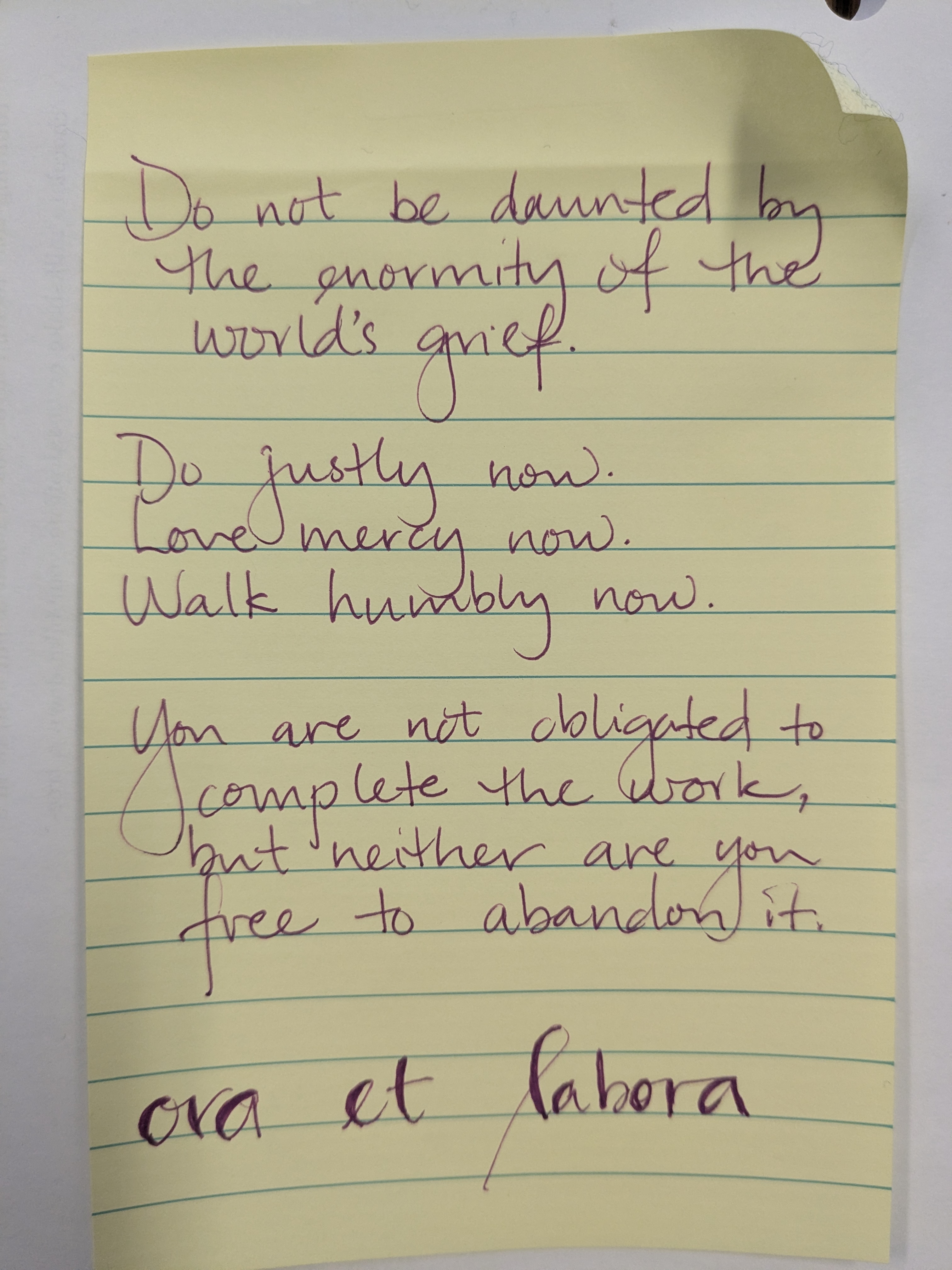
There’s a quote from the Talmud that I write on a sticky note and keep on my computer. It fades, then I copy it every few months to replace it because I need to keep it in front of me. I share it with you as a way to walk into questions with no answers.
Do not be daunted by the enormity of the world’s grief.
Do justly now. Love mercy now. Walk humbly now.
You are not obligated to complete the work, but neither are you free to abandon it.
*Here’s my Spotify and YouTube choral playlists because I’m kind of a junkie that way. And don’t come at me if some of the music doesn’t suit you!
For whatever reason, I don’t love liturgical experiences. I can be ok with liturgy in some contexts, but I usually find it too confining, too structured for my heart to feel at home in.
There. I said an uncool thing.
Even so, I love following the church calendar. Especially I love following the seasons of Advent and Lent. Western Christianity tends toward appearing glossy, smooth, smiley, and satisfied, and it tends to not account for or acknowledge the crazy hard, bewildering, unfair parts of life. It sings “trust and obey, for there’s no other way to be happy in Jesus” but I often wonder–what does ‘happy in Jesus’ even mean?
And if you sing more of that song, you come to “Not a shadow can rise, not a cloud in the skies, but His smile quickly drives it away” and you think, “Well… it’s not always been that quickly for me.” However, sloppy theology in songs is another subject for a braver day.
Advent and Lent give 28-40 long days to sit with the unaskable questions we hold. Advent and Lent let us name our hopes and fears, our anxieties and obsessions, and our longings in a dark season that is aching for the light of Christmas and Easter. These generous weeks in the church calendar give us space to lament–an essential part of the human experience–at least for the human who wants to be whole and healthy.
Lament is not a pity party or a sob story that wallows in misery. Lament is a gutsy wail that says not all is as it should be and I don’t like it and this stinks. People who deserve babies can’t conceive and people who deserve to die keep on living and people who deserve to live suddenly die and none of it’s fair or right or beautiful.
Maybe you thought being happy in Jesus means never saying any of this out loud and especially not to God. But if you can’t name your questions and put words to what feels grossly unfair, what does ‘healthy relationship’ even mean?
The difference between lament and self-pity is that lament turns toward Jesus and self-pity turns inward and spirals down. Lament goes somewhere with its sorrow and it wrestles and groans, sometimes for a very long time. It does not insist on always being polished and presentable and it does not follow a timeline.
But lament is a season, even though it doesn’t listen to any kind of time limit. Christmas and Easter come at the end of that season, and they remind us that it won’t always be winter, barren, dark.
Lament howls around for however long it needs to but because it turns toward Jesus, it finds comfort and soothing–eventually. This is a deep knowing, a solid confidence, a quivering consolation in the person who knows so much about grief that He’s called the “Man of Sorrows.” You can hold that reality close forever, and you have my permission to never sing “happy in Jesus” again.
If we’re honest with ourselves, we’re not always happy, and we are all waiting. We are waiting for many joys that Jesus also longs for. Just because He’s God doesn’t mean He gets what He’s waiting for either.
When Lucy met Mr. Tumnus in Narnia, he told her that it’s always winter and never Christmas. I think about that these days on my walks in the icy cold and I hear a stream trickling under the snow. The sound tells me that Aslan is on the move and Christmas–joy and feasting and merriment–is coming, and I don’t only mean smoked salmon at breakfast and turtle cheesecake for second breakfast.
This last night of Advent, I wish for you bright, shining tomorrows and the dripping of ice even in your lamenting, even in your waiting.
A couple days ago, a friend emailed to ask my opinion about several Christian books and their critiques. She heard they had questionable messages, and didn’t want her family or her concept of Jesus to be destroyed by the books’ messages.
The question touched a nerve for me, and I fired back a reply. This is the edited form of what I answered, without names or titles, because those aren’t the point of this post:
I think it’s fair to say that some book isn’t my style, or that it doesn’t speak into this season of my life. But being a writer who has been treated respectfully but also criticized, I am reeeeeeally slow to say that someone shouldn’t read another Christian’s book. My premise is Jesus’ words: “He that is not with me is against me.” Anything can be taken out of context, misunderstood, applied in wrong ways. There ARE wolves in sheep’s clothing. The enemy IS out to seek, kill, and destroy. But books that focus on Jesus and how to get to know Him better have to be a good thing.
I don’t think we have to be scared of these books. The Spirit is a communicator. He will tell us if the fruit of the books are wrong or bad. Has the fruit/result of the book benefited you and your family? Then thank God for sharing His truth and light. No one produces light/truth on their own–it all comes from God and the praise should go back to Him and be spread to our world.
There’s going to be error in any book we read. That’s a given. Parents should protect their children; families definitely need to be a safe place to shelter children because there is evil out there. But somewhere, somehow (don’t ask me how parents should do this–it’s not my job!) children should grow to be adults who can DISCERN–key word here–what’s good and what’s not. Reading should be like eating fish–get the goodness out of it and spit out the bones.
I believe in universal truth and beauty, which means that non-believers can say and do things that are true and beautiful, mirroring God’s image in them, and testifying to the fact that satan cannot bring anything original, or create anything. Everything that comes from him is deception in some way, a twisting/perverting/distorting of the original stamp of beauty and truth that God gives to every person.
Christians have a higher call than only to mirror universal truth, because we are to be light in darkness and salt for insipidness. We are to teach and disciple and equip. Writing books is one way of doing that. It is ill-fitting for Christians to throw rocks or try to debunk other Christians who are sincerely trying to be voices that teach and equip and encourage. It is really dangerous to judge another Christian’s motivation or level of sincerity.
Where there is obvious sinful teaching that is not repented of, there is cause for caution and concern. (And ironically here, the internet is not the most reliable source of truth.) Where there is blatant falsehood or open defiance of God’s word or where good is called evil and evil is called good–these are reasons for not buying a book or not encouraging others to read it. There are spiritual powers and battles around us that we easily forget, and we should know that what we read and say has direct influence on the spirit world, for good or evil. BUT we should not be paranoid or flailing at bookshelves to make sure that no evil thing is in any book.
Is our faith in our expertise/wisdom/discernment, or is our faith in the Lord and His spirit and His endless faithfulness?
Will He or won’t He let us stray?
Are we or aren’t we safe in His hand?
Does a Christian author really have the power to take our faith away and turn us and our family off the narrow path of life?
If we ask God to guide us, and if our hearts are clear before Him, He will not accuse us. Satan is the accuser. The Spirit is faithful to convict. The peace of God is our umpire and can call the shots and tell us if something is wrong or dangerous. If our hearts are soft and sensitive to His gentle, loving voice, we don’t have to be scared that He will let us slip and swallow poison. His heart toward us is to keep us faultless, not to catch us making a mistake and jump on us!
I think _________’s book is a powerful message to this generation. I believe strongly that her wisdom is from God and echoes His heart. I think she is an anointed woman for this time in history, and I think she and her family have special temptations and attacks that no one else knows about because satan hates her kind of message, and her kind of family and marriage.
It is really wrong for Christians to attack each other. Even when there is obvious error, we should be the ones who can speak honestly about it while handing out equal amounts of grace and forbearance. Christians fail each other, and some Christian writers fail terribly. They carry a great responsibility (to whom much is given, much is required) but it is not a fellow Christian’s place to accuse and debunk. We should be known for our love and wisdom and grace, not our rigidity and harshness.
People liked spending time with Jesus, and I’m sure it was because of how much He lived in grace and truth. He is my hero and I want to live and read like that too.