Charity Concert

This is an old, out-dated poem, but it doesn’t go away. This is not a statement about politics but tears for the forgotten women and children suffering because of others’ arguments.

April 2, 2022

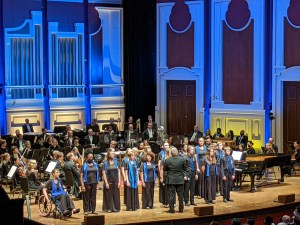
Orchestra musicians and choirs

Donated a free concert in aid of

Ukraine.

Guests waved blue and yellow flags,

Wore blue and yellow clothes

Or gorgeous flowy Ukrainian blouses.

No one clapped the whole evening

Until

Every song and every poem and the grand

Ukrainian national anthem

Faded into silence.

And then

The appropriate applause lasted for a long, loud time.


Surrounded with plush red velvet, dim lighting,

Glittering chandeliers,

We called this solidarity.

We called it respect. And it was.

And the music had been beyond beautiful.


But how does velvet sit in

Harmony with missiles and battered bags,

Fractured families, mass graves?

The irony, the audacity

Sits heavy on my chest.


And

Where were the charity concerts

For starving Afghanis hiding from their government?

Why is no one singing

The Sudanese national anthem

And remembering their child soldiers?


Ukraine is close enough and

White enough

For America to do something—anything—even

Host a luscious night of music and call it

Care.


Beneath my confused anger

Weeps grief.

Above the globe

Weeps Jesus

Over the wreckage of the world.

It Just Happened

I keep asking God to grow my trust in Him. It’s been my recurring prayer this year. Then He sent me a hummingbird.

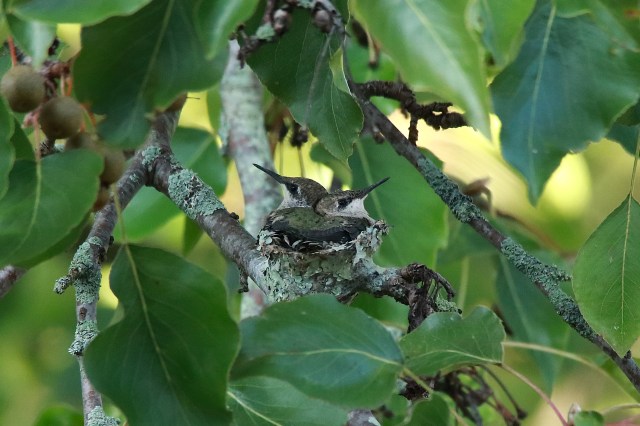
One day in late summer at my second story office, something kept flying in and out of my peripheral vision around the pear tree outside the window. When I stopped to look, I saw it was a hummingbird, and it perched on a branch that pointed toward me about fifteen away.

I called my coworkers to come see, and did anyone have a set of binoculars? The next morning, Sheldon brought his pair and we could see the little bird was clearly building a nest.

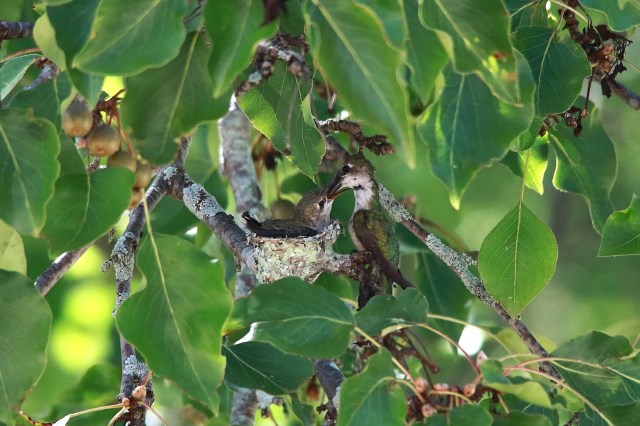
I can tell you that I watched a busy little hummingbird make her nest, but then I choke up and my eyes start leaking. I don’t have words to explain how beautiful it was to watch her. She zipped in and out all day, just outside my window.

A neighboring family from church—five little ones and their mom, avid bird lovers—brought their binoculars one day to watch. They told me she would build her nest from moss and spiderwebs.

Sure enough. When Danny*, my co-worker across the hall, got his big camera to capture the action, he caught a shot of a wisp of web on her bill and extra spider webs stockpiled beside the nest.

July 25, 2024

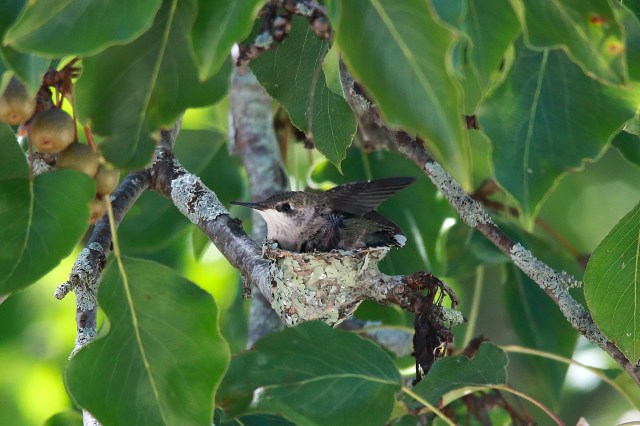
She used her bill to shape and punch and work her nest. She sat in it and scooched around in it to shape its bed. She used lichens from the tree for the outside of the bowl, which was a splendid camouflage. Often when people came to see the nest, it was hard for them to find it because the whites, grays, and greens looked just like the branches surrounding it. Her own green back matched the leaves around her. She was very watchful as she worked, constantly on the look-out.

I watched her build for two weeks. My eyes learned to know exactly where to look, and how to direct others’ eyes to find her. I watched for her partner with his ruby throat, but he never showed up. These are not romantic birds, I understand. Maybe it’s those bills.

Then she sat on the nest for two weeks. The nest was nearly eye level to us, and we wished we could look down into the nest to see the eggs, but we never could. It seemed significant that she usually faced away from my window and toward the tree trunk. I wondered if she felt that direction held her greatest threat, and our brick building with rows of windows felt safe enough to not keep an eye on it.

She was a distraction and many brain breaks and a deep message to me. She was teaching me something about how it looks to rest and trust. I wondered if she knew how small she was and how big the sky is, but she didn’t seem bothered. I couldn’t possibly survive in the wild like her, but I got a front row seat to watching her manage and thrive.

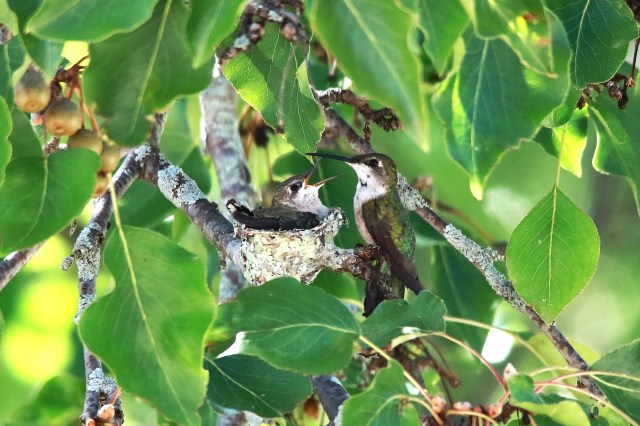
The eggs hatched on August  21 and she started feeding her two babies! It was unbelievable. How was it safe to poke her bill deep into her babies’ mouths? Where was her partner? How could she feed her babies alone?

September 2, 2024

September 3, 2024

Apparently, hummingbirds eat insects in addition to nectar, but still, how is it possible to supply the babies’ growing metabolisms and get them and herself ready to migrate? How can the little mites fly 1,000’s of miles south so soon?

September 3, 2024

Eventually, it looked like the babies were spilling out of the nest. We kept wondering how they practice flying.

September 3, 2024

We never saw the first one leave. Then there was one left. It perched on the edge of the nest and whirred its wings into a blur on and off for a whole day. The next morning, while Danny and I were watching, it hopped onto several branches surrounding the nest, then zoomed away. It took maybe fifteen seconds for it to hop out and decide to fly. We never saw any of them again.

I look out at that tiny, hidden nest every day and I miss that sweet little mama and her babies. I’m not a birder, but she was an immense gift to me this summer. She didn’t understand big words like camouflage or regurgitate or migrate but she knew what to do. In that nest, she rested and trusted something bigger than her.

This summer, it just happened that I noticed her graceful swoops to and from the pear tree. It just happened that I work across the hall from someone who likes wildlife photography and has the equipment for it. It just happened that another neighbor had binoculars that could sit on my window sill for six weeks. It just happened that a plucky little single-parent hummingbird chose a branch that made my office window the best vantage point. It just happened that Danny and I got to watch the last fledgling leave.

Now the leaves in the pear tree are slowly turning red and orange. It’s time for a new season. I understand that hummingbirds won’t come back to their old nest and I’m sad. But this season of watching those birds taught me something deep that I’m still mulling.

I asked for deeper trust and He sent me a hummingbird.


*Thanks to Danny for the wonderful pictures!

On Turning 50

Once at the edge of a crowded Dublin sidewalk, I was waiting for the crosswalk. Just as the pedestrian light turned red, I started to step off the curb, intending to cross quickly before the traffic started. A tall man beside me put out his arm to stop me. His elbow grazed my shoulder. “The man who made time made plenty of it,” he said. I laughed, chastened with his Irish humor and forthright advice.
Turning 50 turned me both pensive and excited about time. We have plenty of it, yes.  But time is a weird part of life that we can’t ever get enough of, and yet we’re sad we have it (At least, sometimes. It’s fashionable at some birthdays to be sad about another year.)

I feel an odd mix of exhilaration and bewilderment, and the puzzling compounds when people say they can’t believe I’m 50. “I’d have guessed you about 34 or 36,” they say, and they’re right: that’s how old I feel. But numbers don’t lie, and the math says 1974-2024=50. And what do my friends really mean? That I don’t act my age? How does 50 look? How does 50 live?

My cousin’s 12-year old thought I’m younger than his mom. I can understand him. I don’t have a husband or children, which is how one’s timeline unspools in his world, so to him, I’m just not old enough yet to have a family.

But there’s something in the wider air, beyond his cozy farming community, that doesn’t make sense to me. The math doesn’t work. It’s this:

Everyone is supposed to become the best version of themselves, grow, learn, develop, be all you can be. BUT don’t grow at the expense of becoming old.

Even if we don’t want grandmothers to be dressing like teenagers, we still have this deference for youth and beauty that we’re loathe to lose.

Youth and beauty are wonderful in their time. I live and work around 20-year-olds, and I love their wit and perspectives. But I LOVE being 50 and not 20! I have much to learn and hold many questions, but these 50  years have given me so, so much that I benefit from, give out of, and I would never want to go back to a smaller number.

Some mornings, though, it’s disconcerting to look in the mirror and see more gray hair, or to notice wrinkly skin on my hands. I don’t love that, or the gap in my grin because one year took a tooth. But when I take stock of the richness of my years, I can’t resent the gray and wrinkles. And I have seen repeatedly how a plain face becomes beautiful with a smile, and I don’t think my smile has to sag for a very long time.

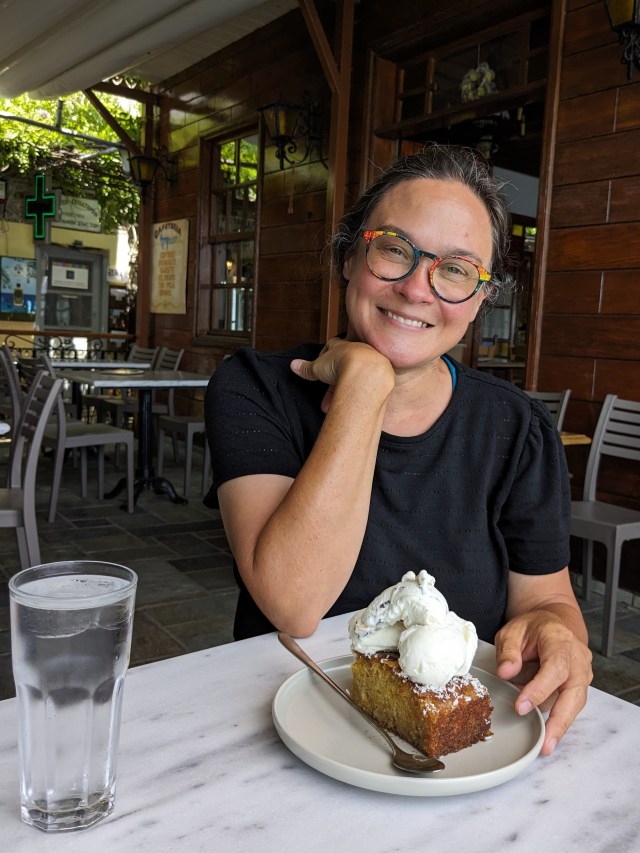
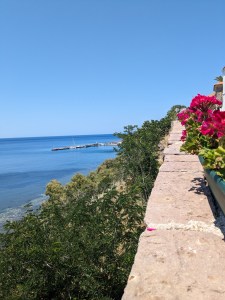
Partly because I think 50 is cool, and partly because I want to push against the worship of youth and beauty, I started celebrating my 50th birthday for the full year before my birthday, and past it. Because why not? I started by going to a wonderful concert in Carnegie Hall and wrote briefly about it here. I bought raspberry batik fabric to make a dress that I love wearing. I went to Greece for three beautiful weeks. I’m going to another concert with another friend in August. There were other planned celebrations, and there might be more. Someone said these were excuses to do something, but I said turning fifty is a REASON, not an excuse to celebrate.

We don’t celebrate enough. I’m sure of it. Our Germanic genes make us too efficient and task-oriented to put effort into taking time to reflect and enjoy the end or beginning of a decade or a summer or a week or an accomplishment. We think we don’t have time, but the man who made time made plenty of it. When I think about how long God has been patient with me, and how many days and years He waits to ripen His purposes, I realize that He isn’t a bit concerned about time or efficiency. Remembering this helps me calm down and breathe deep and wait on whatever He’s up to.

I’ve earned these grey hair and wrinkles. A lot of tears and weights and waiting came before them. I can still be unreasonably chirpy, but I hope I’m a little more measured and thoughtful than I use to be. Fifty years have been very kind and beautiful to me, and I am grateful beyond words.

I wrote this poem last year in anticipation of turning 50:

Nut-brown silk wrapped
Smooth over knuckles,
Gapped grin in line of white,
Silver filaments framing face—
These parts of portraits
Plot a stretch of time,
Paint my story line
Of years, quick and slow,
Rich and deep and variegated, full.

This sagging silk? That dark spot?
They show my days stacked high
Of treasures found in hummocky shamrock fields,
Incandescent faces, glowing coves,
Humming train platforms,
Quiet words and bonfires,
Endless tea and steaming curries and
Tablescapes and holding hands for prayer.

The years and wrinkles converge, collect
To sketch a picture deep beyond
Cosmetics, profile, cursory glance.
Numbers only mark a page.
Wrinkles only touch a face.
My pulse glows calm, claims this age,
And names my story
Very good.

Things I Learned in Greece

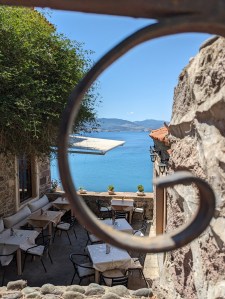
Here is a list* of things I learned on my summer vacation on Lesvos, Greece in June. I spent three delicious weeks there to celebrate my 50th birthday, be alone, and spend time with two sisters, one brother-in-law, one nephew, and two friends who joined me after the first ten solo days.

I learned:

  • The island life is perfect for a restful, slow vacation.
  • The plane ticket is the most expensive part of the trip because accommodation and food is way cheaper than vacationing at home.
  • Jetlag is the price to pay for crossing seven time zones in a day.
  • Airline agents are very generous and kind when I treat them like good humans who have feelings.
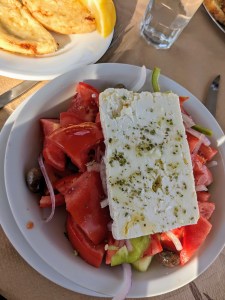
  • Traditional Greek food is fantastic, simple, and bursting with flavor, and lemon chunks squeezed on everything make it even better. Ranch would be a serious desecration. Ketchup would be even more scandalous.
  • I wonder if most Greeks are Ennegram 7s.
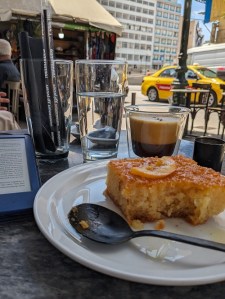
  • Europe’s outdoor café culture is the best. And Greek freddo cappuccinos are valid reasons to go to Greece.
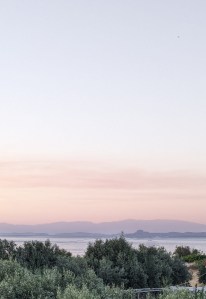
  • Sky and water in all its mirrored shades of light calms me like good music.
  • The lemon tree outside my studio apartment was covered with and dropping so many lemons, my landlady wanted me to take all I wanted. I can’t imagine living with such wealth.
  • Part of the efficacy of restful vacation is not needing stack activities. I can do one thing at a time: Drink coffee in silence. Read my Bible. Listen to music. Take a long walk in silence. Listen to an audio book. Read poetry aloud. Watercolor. No need to multi-task or watch the clock=bliss.
  • When I witness multiple nationalities and languages worshipping in one place, I always cry. Every time.
  • Beauty is profoundly healing.
  • Sunshine and solitude is deeply restful.
  • Some dreams come true. Others haven’t.
  • God is immensely generous to me, far beyond my deserving.
  • When I’m swimming and my friends on the beach decide to move down to a better spot, they can move my stuff and I can swim to the new place. Just like a mermaid.
  • Swimming alone is boring but still wonderful.
  • A three-year old nephew is completely irresistible when he cocks his head and says, “I want to chat with you!” I will happily talk or listen as long as he wants to chat.
  • Playing in the water with the nephew is the best playground in the world for both of us.
  • Sunscreen is worth the effort.
  • A day in Turkey gave us a taste of Middle Eastern welcome and warmth that seemed to go beyond mere salesmanship and I want to be like that too.
  • After three weeks of slow days and wholesome, fresh food and daily exercise and sunshine, I felt about 20 years younger. I felt. So. Good. In every way that’s possible to feel good.
  • Daily sunshine might have been the biggest, best thing about the three weeks. Locals don’t comment to each other about the nice weather because it’s always nice, and nothing to pay attention to.
  • I can drag my suitcase from the island, onto agents’ counters and over ramps to my house but I can never get the sand out of it–and I don’t want to.

*Inspired by Harry Baker’s poem, “Things I Learnt While Interrailing.

What I Wish I Would’ve Said

Photo by Clay Banks on Unsplash

Last month I gave a talk on Strength to Strength Sisters about God’s design for older women to teach the younger. You can call it mentoring or teaching or friendship or influencing. One Biblical term is “discipleship.” It was for women who want to live with eternal purpose, but don’t have 10,000 followers on Instagram like big influencers do. I didn’t talk about following a particular mentoring program, but about ordinary women connecting in ordinary ways.

I gave the talk via Zoom, which I don’t love. Physical presence matters enormously to me, so it was hard to speak alone in my empty office. But this technological platform gives the possibility to cross time zones without anyone needing to leave their couch, plus it preserves the words for people to access afterwards (as a YouTube and podcast recording) but still, I don’t love Zoom.

And as always, after speaking, there were details I wish I could do over, or examples I wish I could’ve added or reworded. That’s what this blog post is, which is another benefit of technology.

But before I say what I’d change about the talk, I want to say what I liked about it. I loved that I could see a few dear faces on the screen–especially friends who never turn on their cameras, but they did so for me, and it was super sweet of them. It’s why I rarely looked up at my computer camera, but always just below it at the faces I wanted to see.

I also loved telling the women “You are a tree!” and the simple interactive assignment that came out of that–a fun, meaningful exercise for all of us. And I loved telling the story at the end of what Pastor John told me when I didn’t know how to make a decision. His words to me that day were so confident and strong and simple that I could believe what he said. In turn, I can hand those words to others. It’s my favorite, beautiful part of giving away what I’ve been given.

The Q&A at the end of the talk was the hardest part for me. I felt self-conscious because I wanted to give good advice but didn’t have time to offer something thoughtful, and wasn’t at all sure that I answered carefully or sensitively.

Finding a mentor you can trust

One of the questions was about how to find a mentor you can trust, “who will keep things confidential.” I hear this question often. I never know if the question comes because some women can’t trust, or because some women aren’t trustworthy.

If you’re looking for a mentor you can trust, you need to risk exposing your soul, and you need to know that no mentor will be perfect.

I wish I would have said: If you want be a mentor, you don’t need to overthink it. It’s not complicated. All you need is to love God supremely and your neighbor as yourself. The shape of your life will influence others whether or not you intend that it does. That’s why friendship and conversation is so powerful. But it’s also why gossip is so devastating. It should never be said of you that you passed on carelessly what someone confided in you (except the threat of harming someone).

Most women, for whatever reason, love to be the first to tell a piece of news. But usually the most loving thing you can do for someone is to hold their confidence as sacred. Not even share it as a sanctified-sounding prayer request.

You don’t actually pop.

The soul is very elastic and can hold quite a lot of words and feelings, and it doesn’t explode.

We should work hard to be safe women for each other. When there are interpersonal problems and questions, we should be careful to talk only with the people who are part of the problem or the solution. I wish I would have said that because it’s what my parents taught me and it works for me.

Recommended reading

Someone asked for recommended reading on mentoring. I love talking about books! But I hesitate to recommend specific titles for specific purposes, because reading is so subjective. What is meaningful and helpful to me might not connect with you, and vice versa.

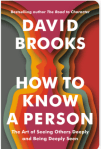
But I do recommend Getting to Know a Person by David Brooks. He writes for a secular audience but holds strong Judeo-Christian values. He says when we listen to people talking, we should listen so hard that we burn calories as we listen. Sounds like a good weight reduction plan! Seriously, if we would all follow Brook’s advice, we would be better people and able to mentor/influence/friend/disciple better.

I wish I would’ve said that.

But it’s ok. I keep learning. And keep taking in. And giving away. It’s the rhythm of a good life, the shape of a flourishing tree.

Come to the Feast of Love

This is the last of four weekly devotionals from the archives. They first appeared in the lovely Daughters of Promise devotionals way back in February 2018! I felt it’s time to get these words out, dust them off, and think about them again. (The imaginary scene at the beginning  comes from a restaurant I walked past many times, experienced, and wrote about here. But I digress.)

You pass by this scene every day on your walk to work:

Candles flicker on the stone step outside the door. String lights swoop toward the center of the ceiling. Waiters place hors d’oeuvres onto tables sparkling with goblets and silver. You catch whiffs of expensive cologne, alfredo, lemon, basil, coffee.

You peer into the banquet room and linger in its fragrance for a couple seconds. But you never step further because you know you could never eat there.

It’s way too expensive.

I’m alone and it’s a place for couples.

I wouldn’t know what to do with all those forks and spoons.

My clothes smell like work.

This banquet and this hesitating is the setting for George Herbert’s poem called “Love.” The poem is a story recounting the exchange between Love and a hungry, aching soul. Each of us can read it in the first person, first placing our feet at the banquet door. (The words in parentheses are my responses.)

Love bade me welcome; yet my soul drew back,
Guilty of dust and sin.
 (My clothes smell like work.)
But quick-eyed Love, observing me grow slack  
From my first entrance in, (He saw me every time I lingered at the door.)
Drew nearer to me, sweetly questioning
If I lacked anything.  

‘A guest,’ I answer’d, ‘worthy to be here:’
Love said, ‘You shall be he.’
 (Me? No, you can’t mean me.)
‘I, the unkind, ungrateful? Ah, my dear,  
I cannot look on Thee.’ (You are very kind, but I don’t belong here.)
Love took my hand and smiling did reply,
‘Who made thine eyes but I?’ (Hmmmm. He made this banquet—He even made me. And my shy eyes.)
‘Truth, Lord, but I have marr’d them; let my shame
Go where it doth deserve.’ 

‘And know you not,’ says Love, ‘Who bore the blame?’ (He says He made me worthy of this feast. He wants me here. How can it be?)
‘My dear, then I will serve.’ (No, no—I won’t eat. You are my master. I’ll be your waiter tonight.)
‘You must sit down,’ says Love, ‘and taste my Meat.’ (‘Says’ is present tense: He is STILL speaking!)
So I did sit and eat.

As we read George Herbert’s lines, we see that the man knows how to be proper, dutiful, and fair. He knows about protocol and propriety to maintain at all costs. When Love pronounces him as the worthy guest of the feast, Herbert is incredulous and gives reasons why he can’t possibly accept. Sounds familiar, right?

When Love invites us to His banquet table, we learn, like Herbert did, that love is not a place, or a feeling, or a flavor. Love is a person, and His name is Jesus. Hearing His voice and seeing His eyes is the best thing that could ever, ever happen to us.

And the feast will  never, ever end.

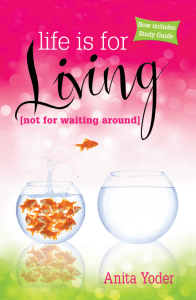
I wrote a book one time about living well and living loved—even without romance. You can order your copy here!

Love’s Posture

I wonder if you’ve seen how you’re surrounded by love this month. I wonder if you’ve been surprised or disappointed. I wonder how you’re responding to that surprise or let-down.

When we open our hearts to ahava, we risk loss, misunderstandings, and even heartbreak. One human response to this is anger and a commitment to avoid ahava in the future.

But the posture of ahava is an open hand. I’m here to serve you. What do you need that I can give?

Alternatively, the posture of anger is a clenched fist. I can’t wash my neighbor’s feet with my fists, and it’s hard to ahava (give to) someone if their hands are closed. There are a lot of clenched fists around these days. And sometimes the fists belong to me.

John, who found his identity in being the disciple Jesus loved, pointed out that love casts out fear, and he added that fear possesses terror. Apparently, he believed that the opposite of love is fear. Let’s contrast more words connected to love and fear.

These lists demonstrate love’s enormous power to transform, heal, and free. Like the sun shining on a cold day inviting you take off your coat, instead of the wind that makes you hang onto the coat even tighter, love melts open a clenched fist and a stiff exterior. It invites dialogue and a smile. It gives a cup of water, the simplest of gifts.

If we would love like Jesus did, generously and winsomely and in hidden ways, we could change the world! We can live in love and not fear when we embrace our deepest reality—that we are deeply, outrageously, undeservedly loved. It seems John knew how much Jesus loved him, and he never got over the wonder of it. It shaped how he saw himself, and influenced how he spoke and taught.

The ahava God pours on us is an endless supply to share with our world. We can approach the difficult person and the stranger with open hands, and mirror the warmth and comfort of Jesus. In doing so, we help to soothe the crippling, damaging fear that keeps people from living with open hands.

If the posture of ahava is open hands, it means that love has nothing to defend and no personae to keep polished. It is genuine and honest, simple and frank. It is not driven by the destructive, irrational fear of criticism or failure. Living with open hands is possible by a power far beyond human limitations, and its results reach further than we can know or dream.

Will you move into this week with open hands, giving and receiving love?

I wrote a book one time about living well and living loved—even without romance. You can order your copy here!

God So Loved That He Gave

One of the times I felt most alive was when my friends and I swam in the Dead Sea. The buoyant water let us do gymnastics we could never do before! The clear, turquoise water, briny with salt and minerals, made my skin silky smooth, and soothed the sunburn from the day before.

An Israeli company takes the salts and minerals from the Dead Sea and produces a beautiful line of skin care products, choosing the name Ahava for their brand. A friend I was swimming with in the Dead Sea gave me a tub of lovely Ahava body sorbet that I love using.

Ahava means love. It’s the same word God used in Leviticus: You shall ahava the Lord your God, and your neighbor, and the foreigner among you.

Why did God command a condition of the heart instead of action with the hands or feet? Or is ahava only an emotion, an intangible word?

The root word of ahavah means “to give.” To ahava the Lord and our neighbor is an act of intentional giving, serving, focusing on the other. Love is far more than a warm feeling deep inside. It is action and generosity, sacrifice and service.

In this week of masses of pink and white fuzzy animals, red-foil balloons, and heart-shaped chocolates, it is normal to focus on what we might or might not get, and what makes us feel warm and loved. Romantic love is beautiful and life-changing, and carries enormous power to heal and restore. Valentine’s Day is often the most noticeable, accessible (and consumerist) form of romantic love, but ahava is far bigger than a day on the calendar.

God modelled ahava for us when He loved us so much that He spared nothing and gave His only Son. God’s call for us to ahava is a call to the shape of a life, the deeds and habits of a heart that gives and serves the neighbor and the family member and the stranger. Ahava is not expecting to receive nice things or to stay comfortable.

However, in a beautiful paradox and a curious exchange, when we ahava God and others, we receive stupendously in return.

In this week of pink and white and red all around you, how will you receive and give ahava?

I wrote a book one time about living well and living loved—even without romance. You can order your copy here!

Surrounded by Love

Surrounded by Love

This is the first of four weekly devotionals from the archives. They first appeared in the lovely Daughters of Promise devotionals way back in February 2018! I felt it’s time to get these words out, dust them off, and think about them again.

On my desk at work, I have a Willow Tree figurine. She’s holding a spray of red flowers and burying her face in them. The title of the figurine is “Surrounded by Love.”

I keep her there because she reminds me, with her relaxed posture and exuberant enjoyment of the flowers, that I, too, am surrounded by love. It’s in the air I breathe on my walk to work, the flavors I relish at lunch, the laughter I join in.

Now and then, I forget that love surrounds me. I become fretful, touchy, defensive. I feel I need to prove myself to my world. I need to control my surroundings to be safe and predictable, because no one else is making that happen.

Those days could be titled “Surrounded by Fear.”

This is not an attractive, restful figure. It’s ugly and obnoxious, and no one would ever cast a figurine of that to keep on a desk.

Here’s a thought experiment:

What would change in us if we lived in the awareness that each of us is truly, deeply, freely loved? That we could never earn or perform well enough to deserve the love that surrounds, covers, carries us?

How would this awareness change how we see our world? How would it affect the way we look at other people, knowing they are loved like we are?

This week, look for the ways you’re surrounded by love and write them down. Because you see what you look for, chances are good that you’ll come up with an impressive list. If you can’t see anything, ask God to open your eyes to His love. Read I John and Luke to see God’s heart demonstrated in Jesus.

Looking for His love might mean that you see in a shape you did not expect. You might be in for some surprises!

I wrote a book one time about living well and living loved—even without romance. You can order your copy here!

Hope Opens Every Door

Photo by Jan Tinneberg on Unsplash

This is the time of year when all the Christian writers come out of the woodwork to offer their Advent devotionals. Every year, I get tired of all the serious, sober one-liners we should reflect on for the whole season. They’re all wise and thoughtful, but it gets to be too much to take in.

So if you can’t absorb one more pithy statement or rumination about how a Christian can approach Christmas, please scroll on, with no hard feelings.

These days, I keep thinking about hope and its agony, how warming hope’s promise is, but how devastating its wait is. I used to think Emily Dickinson’s lines were so sweet:

“Hope” is the thing with feathers –
That perches in the soul –
And sings the tune without the words –
And never stops – at all –
And sweetest – in the Gale – is heard –
And sore must be the storm –
That could abash the little Bird
That kept so many warm –
I’ve heard it in the chillest land –
And on the strangest Sea –
Yet – never – in Extremity,
It asked a crumb – of me.

But I know better now. I don’t know a hope that doesn’t ask for even a crumb. That sounds like limp-noodle passivity, shut-down apathy, which is not a healthy way to live.

I find that vibrant, throbbing hope asks for a lot, lot, LOT of surrender, trust, agony–words I prefer to forget about.

I’d love a conversation with Miss Dickinson and ask what she meant by saying that hope doesn’t ask a crumb of me. She’s a brilliant writer, and she must have had some good reason for the line. I like these of hers better:

Not knowing when the Dawn will come,
I open every Door.

I think it’s hope that motivates a person to “open every Door.” And to be clear: I’m not talking about hoping it rains tomorrow, or hoping your cold will go away soon, or wanting to get pregnant and holding your newborn ten months later. I don’t mean to dismiss that kind of hopefulness, but let’s be honest: praying the same agonized prayer for years or decades is another kind of hope.

The kind of hope that opens every door is a hope that’s been waiting a long, long time–years and years and years with no sign of anything ever changing. This hope longs for dawn, aches for light and relief from murkiness and questions and waiting. This hope is a tenacious push, a desire that never goes away, eyes that long for the night to end.

In the Christmas story, hope is what the Jews held close to their hearts every time a woman was pregnant, because they were so desperate for Messiah, a rescuer. They were living under an oppressive regime, and they believed the prophets’ words that had never yet come true, not even after thousands of years. They still hoped for Jesse’s rod to bloom into justice. They hoped for the Prince of Peace to reign on David’s throne. They didn’t know what shape their hope would take, but the ones who were attuned to their hearts’ desire opened every door, looking for their Dawn.

Did you ever notice how often the familiar prophecies use will?

The LORD will indeed give what is good, our land will yield its harvest.

The desert and the parched land will be glad, the wilderness will rejoice and blossom.

They will enter Zion with singing; everlasting joy will crown their heads. Gladness and joy will overtake them, and sorrow and sighing will flee away.

Today, far removed from Jewish women’s hopeful waiting, we carry our own stories of night and longing–at least all those attuned to their inner pulse. Single women hope for true love and meaningful work and a place to belong. But we don’t have a monopoly on longing and hope. Hope for dawn, for change, for the night to end, is the common thread that connects all people who carry hope for years.

But here’s the kicker: hope is slippery.

Hope is shaped by and linked to desire.

And desire is closely akin to demand, which is where hope turns ugly.

We know how those demanding faces look. We’ve heard the bossy, impatient voices in our living rooms or in front of us at Starbucks. Next time, let’s listen with compassion to that brassy, harsh woman. Maybe her hope went awry. Maybe her hope was sweet at first, but that was ten years ago, then her hope spiraled into demand, and the woman’s crustiness has nothing to do with the poor barista and everything to do with heartache.

When the Jews didn’t get their promised Messiah for thousands of years, their hope wept and moaned, “How long, O Lord?” What I love about this is that God never told them to stop groaning and asking.

Lament is a form of hope because it looks outside itself for the dawn. Lament acknowledges the deep holes of the soul; lament names what is dark. And with tenacious, stunning courage, lament lifts its eyes beyond the closed door to the eastern horizon.

Hope requires immense courage and staggering risk, holding throbbing possibility that sometimes makes me feel I’ll bleed out. With all due respect to Emily Dickinson, hope asks me for far, far more than crumbs.

The Psalms model for me hope’s posture: name what is unbearably dark and unfair, weep and howl over it, and open my door to God who brings the dawn.

The purest form of hope is worship. Hope doesn’t kick open the door nor slam it shut and go silent. Hope turns the knob, risks the click of the latch and mourns the devastating darkness and speaks to the Man of Sorrows who’s acquainted with grief. Lament is worship because it trusts the only one who can do anything about the dark, and it declares Him endlessly loving and mighty and wonderful.

Hope is not a chirpy Pollyanna. Hope is nurtured in silence and secrecy, but its softness and expectancy leak out in winsome, delightful ways of living. In contrast, crushed hope-turned-bitter festers in invisible places of the personhood, but reveals itself in caustic words and ugly negativity. The old saying is true: what’s in the heart comes out.

Luke records that Zechariah, finally able to speak after his son John was born, crafted a prophetic poem of worship. His people’s long wait was nearly over, and he worshiped:

…the tender mercy of our God, by which the rising sun will come to us from heaven.

Zechariah had opened every door, didn’t stop hoping for Dawn, and named what He loved about God: His tender mercy.

Maybe hope involves more than the thing hoped for, more than the dawn waited for. Maybe the best part about hope is that it’s the place we experience, sweetly and piercingly, God’s tender mercy even in–especially in–the dark.

I wrote a book one time about living well in a place I hadn’t planned to be. It also talks about how to dream, which is akin to hope. You can order your copy here!