Set on Pilgrimage

Every Easter makes me pensive. When I read the story, I wonder about so many things. I’m awed that the biggest and best news in the world was first announced to women, and they were told to tell others. And this in the day when a woman’s voice didn’t count.

I wonder what Jesus was up to there. Was He making a statement about the worth of a woman’s word? Or was it just because He knew how much they love to be the first to hear things and tell them?

Either way, it’s beautiful.

Then I think about the men who ran to the grave. They didn’t believe the women’s words, so why did they run? That kind of stunning courage, running toward what could devastate them, knocks me over.

But my absolute favorite story is the walk to Emmaus. My heart always breaks a little when I read how the men admit “We had hoped he would be the Messiah” and I think of all the times I’ve heard (and said) “We had hoped…”

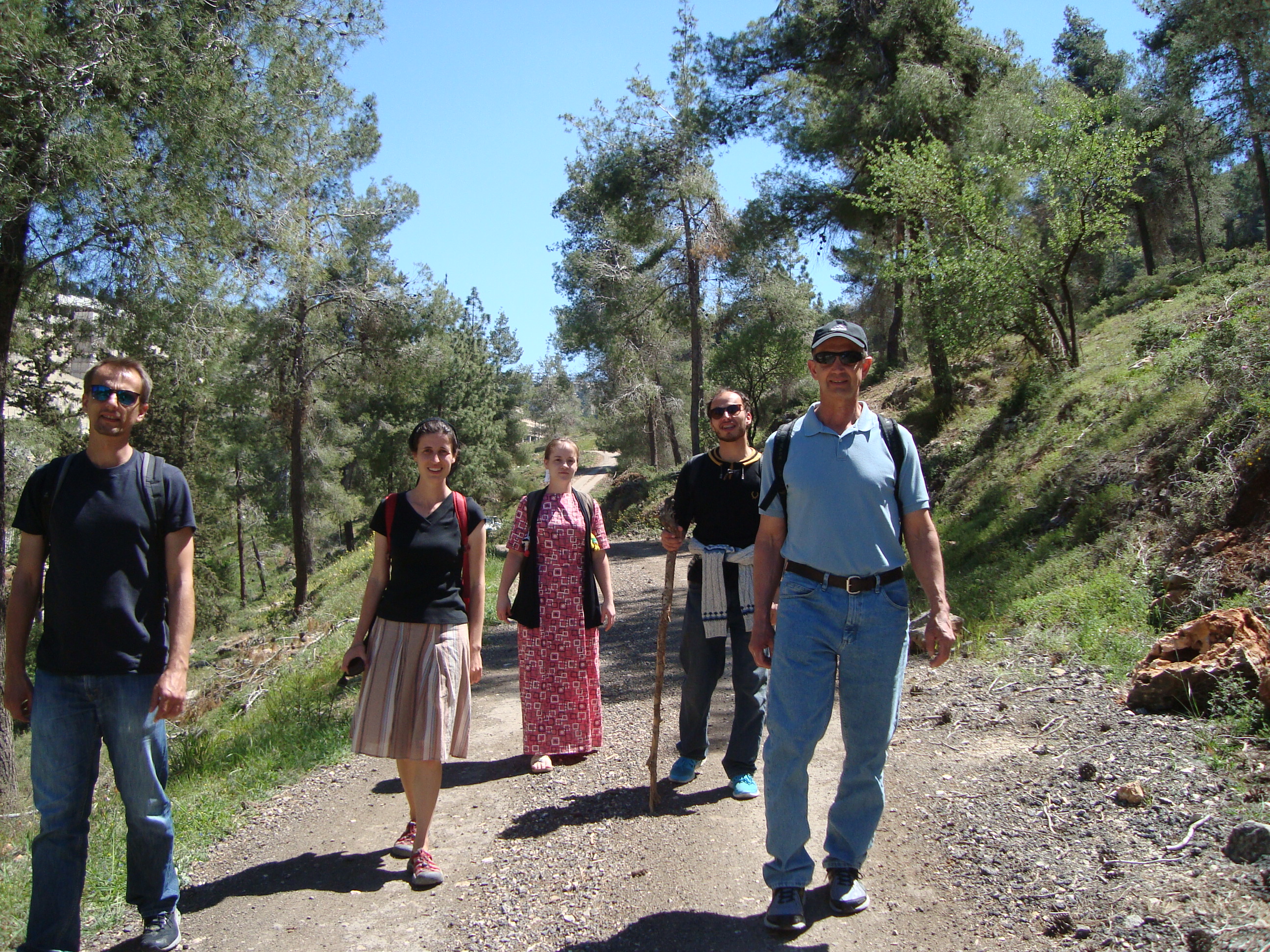
Three years ago, my sweet friend Lisa did extensive homework so that she could take me and my friends on the walk to Emmaus. On Easter morning, we met in the courtyard of the Church of the Holy Sepulchre. The bells were ringing so loud we had to shout to hear each other. We walked miles outside Jerusalem under blue sky and between pine trees. I kept looking up the sky and thinking it’s the sky Jesus saw when He was there, because nothing else around me was the same as in His time. Lisa read the story to us, and we ate chocolate at a picnic table and sang as we walked. It was the loveliest, richest Easter of my life.
I’m thinking that a walk, or any kind of journey, between Point A and Point B brings some kind of change. The men in Emmaus were in a different place in themselves when they arrived home compared to when they left, because of what happened en route. Christian was different when he came to the Celestial City than when he had left the City of Destruction, because the journey changed him. Sam and Frodo were different when they came to the White Ships, compared to who they were before they left the Shire.

‘Blessed are those whose hearts are set on pilgrimage.” The Jews sang this on their annual journey to Jerusalem. I think good things happen any time we wrest ourselves away from what is familiar and cozy and predictable, and put one foot in front of the other, and walk toward Point B. Or Point T, as the case may be. And of course it’s the journeys of the heart that effect the most change, when we don’t board a train or a plane, but we push through the next hard thing to get to the other side, stepping into the narrow stream of light that shows the next step and no more.

There are alternatives. We can hunker down and stay in the same place (in our heart or house) and stay stuck in the mud because it feels too risky to do the next thing. People choose that option all the time, but I don’t think it helps to become better, bigger, more whole people. This is not  faithfulness and steadiness. This is choosing the easier thing out of fear of what might happen. There might be a lion out there, you know.

“It’s a dangerous business, Frodo, going out your door. You step onto the road, and if you don’t keep your feet, there’s no knowing where you might be swept off to.”

The best part of the Emmaus story is how Jesus met them, asked them questions that He already knew the answers to, and walked with them. There’s nothing in the world I want more than that. Until I can walk beside Him in person, I know by faith that He has come to me here and now, walks with me, invites my questions, and eats with me. This kind of journeying brings about the most enduring change of any trip I’ve taken.

Prayer Day and a Paraphrase

Something I love about where I work is that twice a year, we have Prayer Day. The institute empties for most of a day, and people scatter throughout the surrounding area to find solitude and fellowship with God.

As part of my Prayer Day last Wednesday, I paraphrased parts of Lamentations 3. I thought it would be a nice exercise. I didn’t realize how accurately it would reflect my story.

My paraphrase of parts of Lamentations 3: 15-33:

He made me eat distasteful, disgusting things. He filled me with bitterness. When people bumped me, I spilled over with acid and scorn.

He filled my mouth with grit. I lay lower than the curb and sidewalks. I had no rest in my soul, no quietness, nothing to soothe me–not even a padded savings account.

I can easily recall the awfulness. It’s always just under the surface of my thoughts. It’s easy to say “I’m desolate, bereft, devastated, ugly. What I thought was lovely about me or my life is gone. God has broken my heart.”

The memories haunt me. I remember the depression, the acid, the hardships and injustice. I can feel the old darkness and and heaviness and suffocation again.

BUT

I remember something else, and this keeps me from despair.

I was low, but God’s immense, endless love kept me from death. His care and deep concern for me never stopped, even when I forgot Him and gave in to darkness.

The signs of His care surround me. Every morning’s light reveals new love notes from Him.

Every morning.

Every morning.

His mercy always shows up again.

So I remind myself of what is true: “My God is my life. I will die without Him. He has proved Himself, and when I can’t see or feel Him I will wait. I will rest quietly, confident that He’ll show up again. When my eyes are cleaned from their cloudiness, I see He was with me all the time.”

On those whose gaze is fixed upward and outward, He pours His goodness. To the one who craves His presence, He presses in close.

It’s good to be quiet and rest instead of strive. It’s good to watch, hand over mouth, at how He saves the day again. It’s good to work hard before I’m old because it develops the muscles of faith and teaches me how utterly and completely dependable He is.

Though He allows hardship, His care never stops. He weeps with me, and covers me with endless love. He doesn’t enjoy seeing His children struggling in loss and grief. He knows tears too. And He knows that pain isn’t the end of the story.

Come to the Feast of Love

You pass by this scene every day on your walk to work:

Candles flicker on the stone step outside the door. String lights swoop toward the center of the ceiling. Waiters place hors d’oeuvres onto tables sparkling with goblets and silver. You catch whiffs of expensive cologne, alfredo, lemon, basil, coffee.

You peer into the banquet room and linger in its fragrance for a couple seconds. But you never step further because you know you could never eat there.

It’s way too expensive.

I’m alone and it’s a place for couples.

I wouldn’t know what to do with all those forks and spoons.

My clothes smell like work.

This banquet and this hesitating is the setting for George Herbert’s poem called “Love.” The poem is a story recounting the exchange between Love and a soul. Each of us can read it in the first person, first placing our souls at the banquet door. (The words in parentheses are my responses.)

Love bade me welcome; yet my soul drew back,
Guilty of dust and sin.
 (My clothes smell like work.)
But quick-eyed Love, observing me grow slack  
From my first entrance in, (He saw me every time I lingered outside the door.)
Drew nearer to me, sweetly questioning
If I lacked anything.  

‘A guest,’ I answer’d, ‘worthy to be here:’
Love said, ‘You shall be he.’
 (Me? No, you can’t mean me.)
‘I, the unkind, ungrateful? Ah, my dear,  
I cannot look on Thee.’ (You are very kind, but I don’t belong here.)
Love took my hand and smiling did reply,
‘Who made thine eyes but I?’ (Hmmmm. He made this banquet—He even made me.)
‘Truth, Lord, but I have marr’d them; let my shame
Go where it doth deserve.’ 

‘And know you not,’ says Love, ‘Who bore the blame?’ (He says He made me worthy of this feast. He wants me here!)
‘My dear, then I will serve.’ (No, no—I won’t eat. You are my master. I’ll be your waiter tonight.)
‘You must sit down,’ says Love, ‘and taste my Meat.’ (‘Says’ is present tense: He is still speaking!)
So I did sit and eat.

As we read George Herbert’s lines, we see that he knows how to be proper, dutiful, and fair. He knows about protocol and propriety to maintain at all costs. When Love pronounces him as the worthy guest of the feast, Herbert is incredulous and gives reasons why he can’t possibly accept. Sounds familiar, right?

When Love invites us to His feast, we learn, like Herbert did, that love is not a place, or a feeling, or a flavor. Love is a person, and His name is Jesus. Hearing His voice and seeing His eyes is the best thing that could ever, ever happen to us. And the banquet never, ever ends.

*****This is the final in a series of 4 weekly devotionals that I’ve written for the lovely Daughters of Promise. Sign up here to get all of them in your inbox every Monday from now on!

Gold and Cracked Pots

I enrolled in a class the last two weeks of Winter Term: Growing into a Godly Woman. I took it because I like knowing more about how a wise woman should live and how she should see God and her world.

It was intense, and the homework every night kept me hopping, but the effort was very worth it. We looked at subjects like forgiveness, vulnerability, friendships, and trusting God. We read wonderful, wise books and responded to their themes. We were listed our dreams, memories, fears, and disappointments.

Making lists  is a good discipline because it pushes me to own the thing. As long as it’s a distant, foggy idea, I don’t have to grapple with it, but when it’s in black and white, it actually exists, and then I have to do something with it.

I couldn’t come up with 10 fears to list because I try very hard to live without fear. Fear is paralyzing and ugly and damaging and I try hard to live in ways that don’t let fear call the shots. But maybe I have more fears than I think, and I just didn’t think long enough to list them.

The list that gave me the most pause was the list of disappointments/losses/failures. It was easy to think of 10, but as I listed them, I kept wanting to give qualifiers for them, and explain what happened next, and that it wasn’t the end of the story. I keep thinking about that impulse to explain and assure.

The last day of class, each of us shared the time line we’d made of our life. We were to share birthday memories, school memories, when we felt most alive, and a time of disappointment or loss.

This is not the platform for me to tell the world-wide-web about my losses and disappointments. There are plenty of them, and the story I told the class still pierces me with its staggering pain.  But it occurred to me several days later that even that story is not the end of the story. There are good things, benefits, beauty that came out of it–and can I say it?–joy. The pain still takes my breath away, but so does the piercing goodness that came of it.

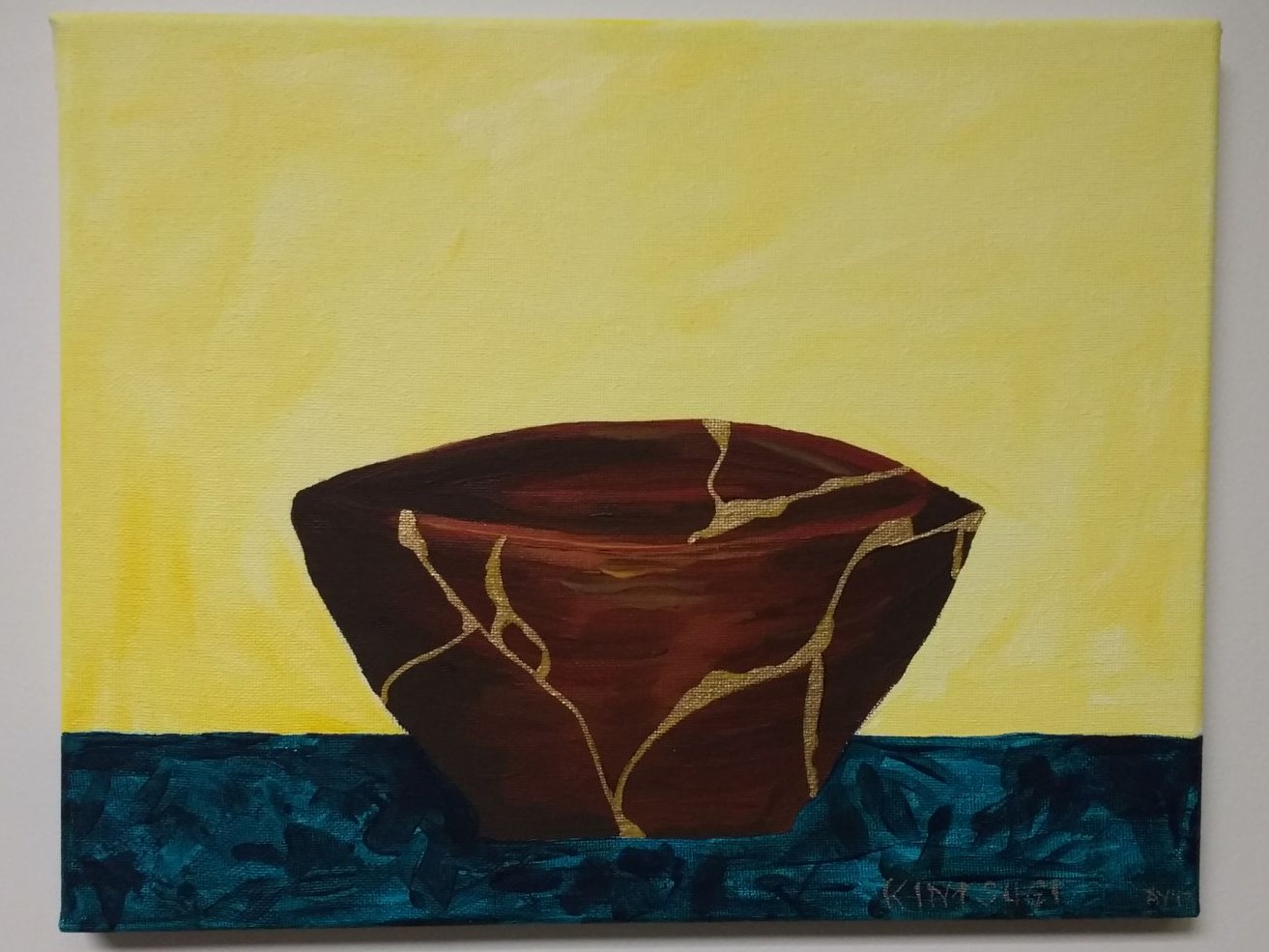
It reminds me of the painting I finished last year to illustrate my idea of kintsugi, the Japanese art of mending broken pottery with gold.

The idea is that the bowl is more beautiful because of its broken pieces.The gold adds to the beauty and the overall design of the piece of pottery.

This is not something to trip out glibly when you hear a distressing story of grief. Romans 8:28 is true, but it’s not a lot of comfort in the depths of loss. The pattern for good is more true and deep than anything else, but it can take a long time to come to see or feel or know it. Sometimes it takes a lifetime. Sometimes it’s not visible in this life, but heaven is true and real and long enough to solve those mysteries.

Meanwhile, I work on my pottery painting collection and try to perfect my bowl shapes!

His Own Secret Stairs

Years ago, I was reading The Lady’s Confession by George MacDonald, and was thrilled to come across this poem. It felt like a bonus, to find this treasure in the middle of a story.

Now, every year, in Advent and the extended celebrations leading up to Christmas, I revisit the poem often.

They all were looking for a king
To slay their foes and lift them high;
Thou cam’st a little Baby thing
That made a woman cry.

O Son of Man, to right my lot
Naught but Thy presence can avail;
Yet on the road Thy wheels are not,
Nor on the sea Thy sail.

My how and when Thou wilt not heed,
But come down Thine own secret stair;
That Thou may’est answer all my need,
Yea–every bygone prayer.

I reflect on God’s ways, and witness His comings and goings that are completely unpredictable. In my beautiful, broken world, He keeps showing up. He changes things and heals hearts and bodies. He does it in endlessly creative ways without fanfare or announcement, and never in the way that I was expecting.

This is a season that always invites me to nostalgia and reminiscing. I mark time and progress in myself by what other Christmases were like. Four years ago, two weeks after major surgery, I flew home, using the airport’s handicap services. Three years ago, I ran and up down four flights of steps to host a ladies’ evening at a friend’s apartment. Two years ago, I was newly living in the US, visiting my sister and her little family. One year ago, I was in Greece with another sister who supports those caring for refugees.

Greece broke something in me that is still not cured or answered or solved. I cannot reconcile my comfort and ease of living while thousands of beautiful women, children, and men barely survive in super-crowded, cold refugee camps.

There are lots of overwhelming, devastating things going on across the globe that tempt me to despair. I want answers, solutions, a king to sweep in and slay the foes.

I would most certainly despair if I weren’t so sure that He has His ways, His own secret stairs, and somehow, in a most mysterious exchange, my by-gone prayers make a difference.

On this surety, I can sleep well and delight in beauty and rejoice in miracles and not stay crumpled in a heap about the injustices in my world.

Who can know how He’ll show up today?

Translators Needed

You know how sometimes memories emerge that were buried for years, but now and then they pop up on the screen of your mind? This story reemerges now and then, with no particular trigger, but it illustrates what seems to be part of my life work.

I was in my teens, eating Sunday lunch at a church family’s place, and they were also hosting a visiting couple who had never been at a Mennonite church before. So the dinner time was full of discussion and questions. I was listening and observing. The conversation went to how we value community and help each other in difficulties.

“So for example,” our host explained, “When someone’s house needs major repairs like putting on a new roof, we’ll have a frolic.”

Something washed over the guest’s face, and I knew that when he heard “frolic” he did not hear what my host meant.

Two things happened in that moment:

  1. I stayed quiet (another subject for another day)
  2. I knew that someone got a grossly misleading impression, and it never got resolved.

Worse things could happen.

But.

Sometimes what you say is not what I hear, so I don’t know more than I did.

If we don’t care about communication and understanding each other, we may as well all stay home and talk to ourselves and take selfies all day.

But if we were designed to do life beside and among and around people, and if we have something that’s beautiful to say, I care that that message gets transmitted well, and translated when necessary.

When I finished five years in Poland and came to the US, I reveled in talking English to my heart’s content. I mean, I could walk into a store and ask ANYthing! I could even make small talk with other customers. So novel! But every now and then, in those first months, I heard a mumbled announcement or a colorful idiom and I would catch myself whirling around to make sure my neighbor understood it. Translating to my friends in Poland had been such a way of life for me that it took awhile to realize that everyone here knew more idioms and one-liners than I did and I could take off my translator hat now. Other times, everyone around me was laughing at some remark, and I didn’t know what was funny. I think now that it was all part of reverse culture shock or culture fatigue or something else unpleasant like that.

Language and communication and understanding has so many intricacies and nuances and layers that it takes special effort to do well with it. Humor and laughter require another dimension to understanding. When different languages and cultures come together, the dynamics become exponentially complex. Among English speakers like at that Sunday dinner, wires get crossed. Sometimes even people who’ve known each other all their lives still need a translator.

There are many places where we need translators between people and groups. Actually, wherever there are people, we need translators. I think of it especially in some church services. Maybe it’s because it’s generally a formal place, where there is tradition and unspoken expectations, and a new-comer feels especially foreign.

This is not a critique about how to do church. That’s a subject for wiser, stronger people than me. This is a call to think about being translators for visitors, new friends, foreigners new to your culture and your spoken or unspoken languages.

I was glad for a translator when I visited a church where the minister asked for testimonies from the audience, but the lady beside me leaned over to tell me that he is talking to the men, because the women don’t speak.

I wished for a translator when visitors at church weren’t oriented to what was happening now, nor what would be happening next. Especially when the speaker asked us to kneel and everyone swirled around in their benches. Just between you and me and don’t tell anyone, I think kneeling back into the place we were just sitting is very uncivil and undignified and I love the gracefulness of kneeling forward to pray. However, if that’s not your culture’s tradition, you can help the visitor beside you by translating the invitation to kneel.

If I could do that Sunday dinner over now, I wouldn’t hesitate to clarify for our guest what our host was saying. It could be done without making anyone feel foolish. The point is clarity and explanation and education, and at the end, everyone understands each other better. Which would actually help a lot of issues everywhere, come to think of it.

Anyone can be a translator. At least, anyone who values what they have, and wants to share it beyond their borders. And anyone who understands that English doesn’t always sound like English.

Things I’m Noisy About

“Anita, are you hungry?” My friend asked me in the lunch line. “You’re exclaiming at everything you’re seeing, and I’m just enjoying hearing your delight!”

Well, I was hungry, but the real truth was that I’m always noisy about the things I love, so when there’s wonderful colors and flavors around me, I start crowing and cheering and talking in superlatives. Plus, I haven’t lost the wonder of working in an institution where lunch–colorful, fresh, creative food– is waiting when I walk to the food bar every day. And today’s fish tacos with cilantro lime slaw really and truly was the best lunch all year.

Since bloggers are allowed to rant and rave about whatever they want, and this blogger tries hard not to complain or rant, (but sometimes she fails, judging by the looks of another post that’s simmering) I’m going to be noisy about two things I’m excited about at the moment.

  1. People frequently ask me for book recommendations, and I’m thrilled to give them ideas and push books into their hands, but it always mystifies me because I don’t know why they come to me with their questions about books. There are other people who read far more than I, but I wonder if I get asked about books because I’m just noisier than others about the books I read.

I’m part of a book club, where we read a book a month and the person who chose the book leads the discussion afterwards. (We take a break in the summer, in which our sole group activity is a grilled steak dinner. The men grill, and the women bring salads and desserts. “This is such a perfect evening” we kept saying to each other as we cuddled babies around the fire and drank coffee and looked at the stars. I’m the newest member, and don’t know all the traditions or rhythms yet, but it has been most enjoyable.) Our current read is River Town, two years on the Yangtze by Peter Hessler, who relates his experience as an English lit teacher in China with the Peace Corps.

 It takes me to my own experiences of teaching English as a second language, the child-like identity you have to take on as a foreigner, the way life narrows down to finding the right word to buy supper, the simpler lifestyle that comes with living in a small apartment in town far away from family, the freedom of stepping on a train to explore an even newer place, the love/hate relationship locals have with foreigners, the stereotypes that every nationality presupposes on other nationalities. Peter tells his story with great heart without being sentimental, and I frequently giggle at the stories. The folk lore, the quirks such as the “Happiest Man in All of Fuling as well as the Luckiest,” the teaching bloopers, and can you imagine–pet birds in cages that you bring with you and hang in the rafters when you hang out in the teahouse with your cronies. Can you imagine!

Everyone should experience being foreign at least once. It is terrifying and embarrassing, but wonderfully clarifying and exhilarating and deeply enriching.

19 Travel Quotes to Inspire Your Wanderlust

2. For many years, I dreamed of taking voice lessons. Then for a couple months in Poland, I was at the right place at the right time and exchanged voice lessons for English lessons, which was a singular experience.  I think the Slavic way of singing is different from what I was wanting, plus, my teacher wanted to make me a soprano and insulted me when he said “Most altos are lazy sopranos.” I have no hard feelings. It makes a good joke, and now I think I understand the point he was trying to make. I will always treasure the English lessons where we watched musicians’ speeches and songs. His English was advanced enough to understand the poetry, and I always think of him when I sing “Heal their hearts, heal their souls, their lives can be golden if your love enfolds.”

Last summer, I started going to a voice teacher at the local college. My friends had told me I’ll like her, and they were right. Claire is an incredibly gifted soprano, deeply sensitive to her students. I often wished for 30 minutes to catch up and then 30 to sing, because it was like meeting a friend every week. She hears what isn’t said or sung, and knows what I need to hear or do to improve. In the lessons, I learned that when you hand your soul to a stranger you don’t die, which helped me feel less fear in other settings like public speaking. I learned that driving onto a campus and finding my way into the right building isn’t impossible. I learned that I can sing higher  and sustain lower than I thought I could. I learned that I can bomb a recital, forget everything I knew to do, and still not die. Unfortunately, I’ll never be a credit to Claire, and this week I had my last lesson with her. New responsibilities and other things to learn have crowded out this privilege, but I will always value those lessons. I experienced the law of the echo and the enriching power of a focused discipline.

Of course, the best voices train for years, but I think everyone should take voice lessons for at least one year.

Blest be the Synergy

We gathered under the trees and around salads and grilled kebabs and before prayer, our host said, “Be thinking about how to answer this question: why did God put you here in this place and time? What were you born to do? We’ll talk about this later in the evening, so this is your heads-up.”

Then we ate wonderful food and cuddled the baby and stirred the fire and talked on high for hours. We were seven people joined by common experiences and passions, and there are always stories to re-tell and howl about, and new parts of our lives to share, and there is never silence between us. When the darkness settled and the children were put to bed, and the coals glowed, I thought it was time to wrap up and leave, but our host brought up his question: “What were you born to do? We’ll go around the circle and hear from everyone, and I’ll start.”

The fire became an altar, and the circle a sacred place, and time stopped while we heard each other’s dreams and goals and affirmed what we heard.

“Yes, you ARE a shepherd. Hey, I want to tell the rest of you about the time he was a shepherd to me.”

“The way you love on troubled children is the way you show them Jesus. You WERE born for that!”

I was the only single among the three couples, and they prayed for a husband for me, and we prayed for each other’s visions and unanswered questions and quests. Sacred is the only word I can use to describe it, and even the next day I still felt hushed in wonder at the beauty and power I’d witnessed.

This was one of several small groups I’ve been part of. Various times and incentives shaped the groups. Similar interests. Common training. A work team. Sitting at the same table for supper in the cafeteria.

The synergy that rises out of asking questions and brainstorming and bringing one’s whole self to a group energizes me for several reasons.

  • It is an adventure, because there is no predicting what will happen.
  • It is empowering to be heard, to be given space and time where your voice matters.
  • It provides shared experience that becomes a reference point for further interaction.
  • Life and death are in the power of the tongue.

Sometimes a group has to wrestle with a dilemma that has no easy way forward. If one person were alone in a room wrestling with the sticky problem, they would get tired and despair and make a bad decision. But in a group, with more ears tuned to what’s being said, and more than one heart engaged with the issues at hand, good and beautiful things happen.

What happens in group is not limited to the time in the circle. Sometimes Often I perceive or say things in the moment that I would see differently if I had time to mull over it. But it gives a starting place for more thought and change. Group work also pushes me to ask God for the most pressing need of my whole life: wisdom.

Here are some life-giving words I’ve heard in group:

“When you said that, I got this picture of…”

“I really like that idea!”

“Can you tell us where those tears come from?”

“You’re being quiet over there. What are you thinking?”

“What would happen if…?”

“I see your point, but what about…?”

“That took some courage to say.”

One group was so sacred that I can’t talk about it here except to say it involved snowballs in the dark, and honesty and anger and courage shimmered around us in a way that would hardly have happened had we stayed around the table in the dining room.

So setting is important. A bonfire helps. Or a chalk board. And snacks–at least chocolate.

There are no guarantees for resolution, and there is always risk.  Risk that my words will be misunderstood. Risk that I’ll fall apart. Risk that I’ll walk away with fewer answers than I want. Risk that my heart will break.

But risk is the price you have to pay to keep walking toward wholeness and a full life.

I am deeply grateful for the groups I’ve been honored to be part of. They shape me into a person I could never become if I would try to wing it alone.

We Are Too Easily Satisfied


This prayer by Wilbur Rees keeps coming back to me.

I wept when first heard it read about a month ago.

I don’t think it needs commentary.

I would like to buy $3 worth of God, please.

Not enough to explode my soul or disturb my sleep,

but just enough to equal a cup of warm milk

or a snooze in the sunshine.

I don’t want enough of God to make me love a black man

or pick beets with a migrant.

I want ecstasy, not transformation.

I want warmth of the womb, not new birth.

I want a pound of the Eternal in a paper sack.

I would like to buy $3 worth of God, please.


It’s Not Fair

One student makes straight A’s without trying, and another does everything she can to pull a C.

One sister has stair-step babies, and the other can’t conceive in twenty years.

One friend’s parents thoughtfully encourage their children’s strengths. Another set of parents disregards or disapproves.

One lady has a husband and a respected degree by age thirty. Another has neither at sixty.

One girl is wooed by the man of her dreams. Another girl is invisible except to a male mental patient.

One friend has money to vacation in Italy while another can’t afford a $20 concert ticket.

One couple celebrates one year of marriage and pronounces the year fun. Another couple fights three kinds of deadly cancer in their first year.

It’s not fair.

You shake your head at the balance scales. You whisper the words to a friend because for some reason you’re not supposed to say them out loud. Or you sob into your pillow until you snort, and the universe keeps on humming, and friends never mention the disparity, and the scenario keeps on not being fair.

To the one with a grim diagnosis. To the single bridesmaid at the eleventeenth wedding. To the bereaved and wrecked and poor: it’s not fair.

This is reality when the sun shines or when the rain blows. The Almighty and Omnipotent Father sits on His beautiful hands and does nothing to level the balance scales. There is no justice. You can do everything right and be a good girl and do what you were always told to do but there are no guarantees that you’ll get what you ask for and it’s a fallacy to believe that everything will turn out like it should.

Part of my journey to wholeness includes being honest about the injustices I observe and experience. It seems more wholesome to be able to call a spade a spade than to act as if it’s something else.

So: it’s not fair.

There are things I weep and howl over, dreams I ache for, friends I hurt with, prayers I beg God with the most persuasive words I can find. To do otherwise would be to deny reality and be a flippant, chirpy, hollow, obnoxious voice in a cavern of unanswerable questions.

While maturity acknowledges that things aren’t fair, wisdom doesn’t stay there. It’s a child who mopes and sits outside the game and whines that it’s not fair. An adult who does that for days and weeks and months is pretty ugly, in my opinion.

There’s no easy way to do this, but when that forty-leventh bride has been whisked into the sunset, you sometimes have to take yourself by the scruff of the neck and turn yourself 180 degrees toward the east and make a list of other things that aren’t fair.

This is part of my list:

  • I sleep on a dry, thick, super-comfy Tuft and Needle mattress while refugees sleep on blankets that hang out of their thin, compact, squished-together tents.
  • I have a job that enabled me to buy a car, while a friend can only afford to drive a borrowed car.
  • I’m lonely and long for companionship but it’s not fair that another woman’s loneliness is infinitely, agonizingly greater after her husband abandoned her and their three little children, the baby with Down Syndrome.
  • I had major surgery in a foreign country and had the best of care and no complications and have been given a new life but my friend battles incurable illness and huge medical costs.

It’s not fair.

I’m stupendously, staggeringly, unreasonably rich and spoiled and comfortable, and it’s not a bit fair.

It’s not fair that my friends and the rest of humanity walk through crazy amounts of pain and tears that I never do. I’m not being glib or flippant about this. I cry often about sad things and injustice and longings on my behalf and others’. I experience hard, hard, things about each of my list entries.

But the great and grand and shining reality is that the present injustice is not all there is. It takes the long view to see more than is apparent to the naked eye. The long view is the truest view.

It’s ok to say it’s not fair, but it’s not ok to stay there. Because at some point–after about an hour or a day or a week–wisdom and grace and the presence of Jesus are waiting to turn us to the east and see light and hope and a far green country under a swift sunrise.*

*That last phrase is what Gandalph said.

Save
Save
Save
Save
Save