The Hardest Peace, book recommendation


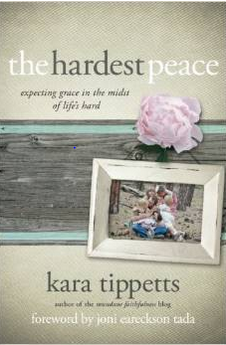
Hardest Peace  I first heard about Kara Tippets when I read a letter she wrote to a young lady who was suffering from cancer and planning a physician-assisted suicide because she didn’t want to fight it and suffer the ravages that were sure to come. Kara has cancer too, and could identify completely with the lady’s pain and fears, and Kara plead for her to look for beauty and hope, because it’s there.

The letter was so beautiful and compelling that I went to Kara’s blog to read more of what she wrote. She was an English major, so it figures that she has a way with words. I loved what she wrote, but I left the blog and didn’t go back to it for awhile because it felt voyeuristic to read about the body blows the cancer was wrecking on her.

But I went back when I realized the wonder of how Kara writes with beauty and grace about their immeasurable pain and sorrow, and it showed me how grace and light is always bigger than whatever darkness is around. I started following her on Facebook because I wanted to bear witness to that light and strength and joy.

Kara is 38, a wife of a church planter, and mother of four children. They never expected their story to look like this–beautiful, but not pretty, as she says.

I was restless this week for a good book, found Kara’s book, The Hardest Peace, on my house-sister’s bookshelf, and finished it today. It undid me in many ways. I cried through most of it. It is poetic and heartbreaking and honest and brave and anointed. Everyone should read it, but you should probably have someone to debrief with.

Kara is home from hospice now, her hair is growing back, but she’s writing less and less. Most mornings, I wake up and wonder if she’s still with us. There is a network of believers laced all over the globe, praying for her, supporting the beautiful family, waiting with them in wings before she enters the throne room. This waiting is sacred, crushing, unbelievably cruel, and beautiful.

My Favorite Therapy

Several years ago, I was home for a weekend, and mom showed me some art. Its official brand name is called Zentangle*, and it was created by Rick and Maria, who give classes to train and inspire people with this kind of art. Some people feel uncomfortable with that name, so they call it ‘pentangle’ or ‘creative doodling.’ Either way, it’s a kind of art she thought I might like.

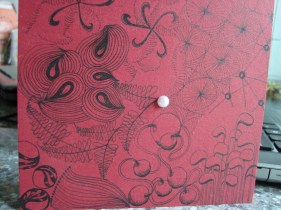
I DID like it, and I still do. So last night I made this for a friend’s birthday:DSC06381

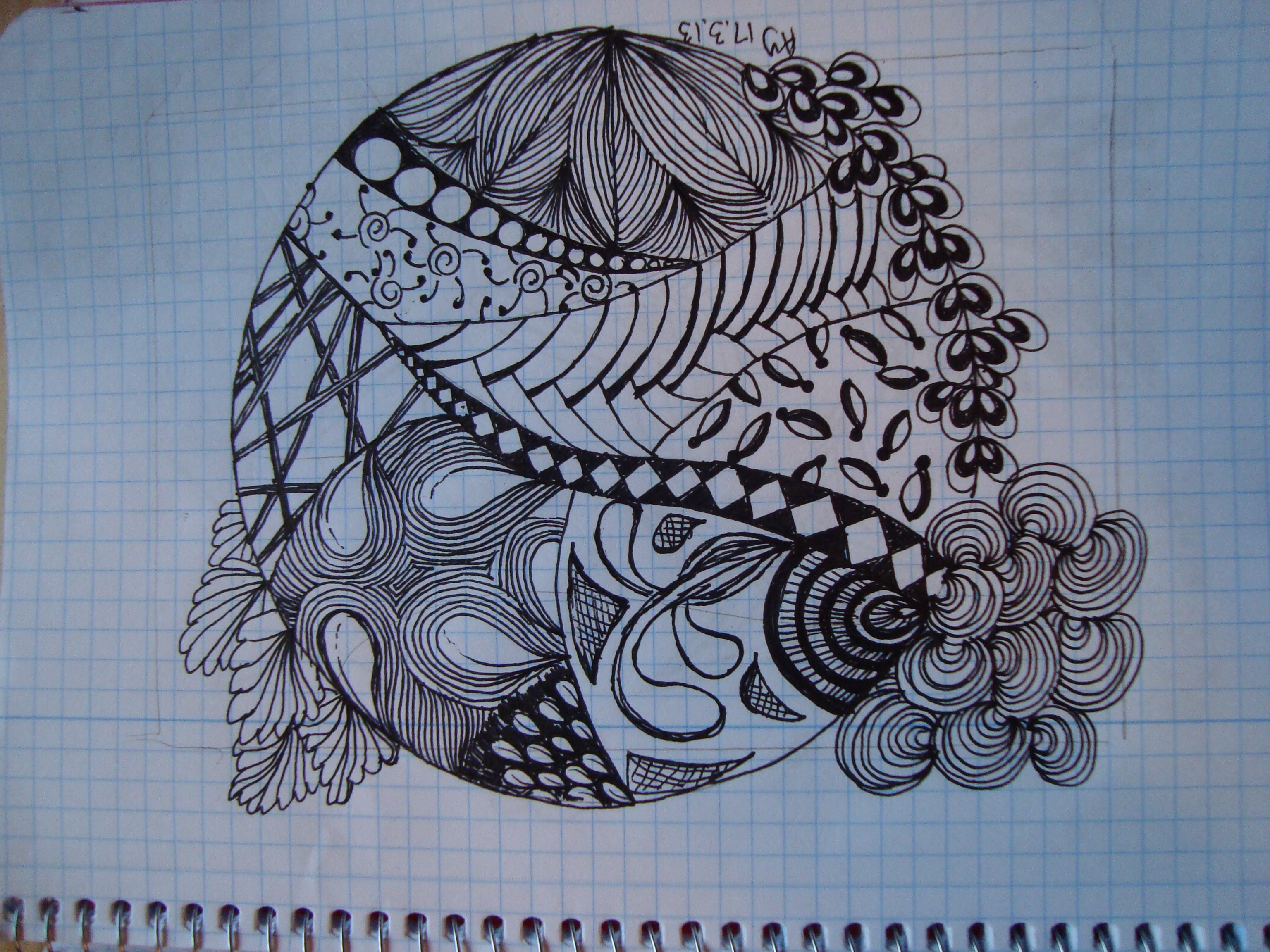
Basically, it’s an elaborate form of doodling. This is from my first practice notebook:

DSC04100  DSC04102

Technically, every pattern has its own name but I don’t know any names. I just find a pattern I like, and do it. You start with a square or circle or any shape, and with a pencil, draw random lines and swirls, and then use a pen to fill in those shapes with designs of your choice. Afterward, erase the pencil lines.

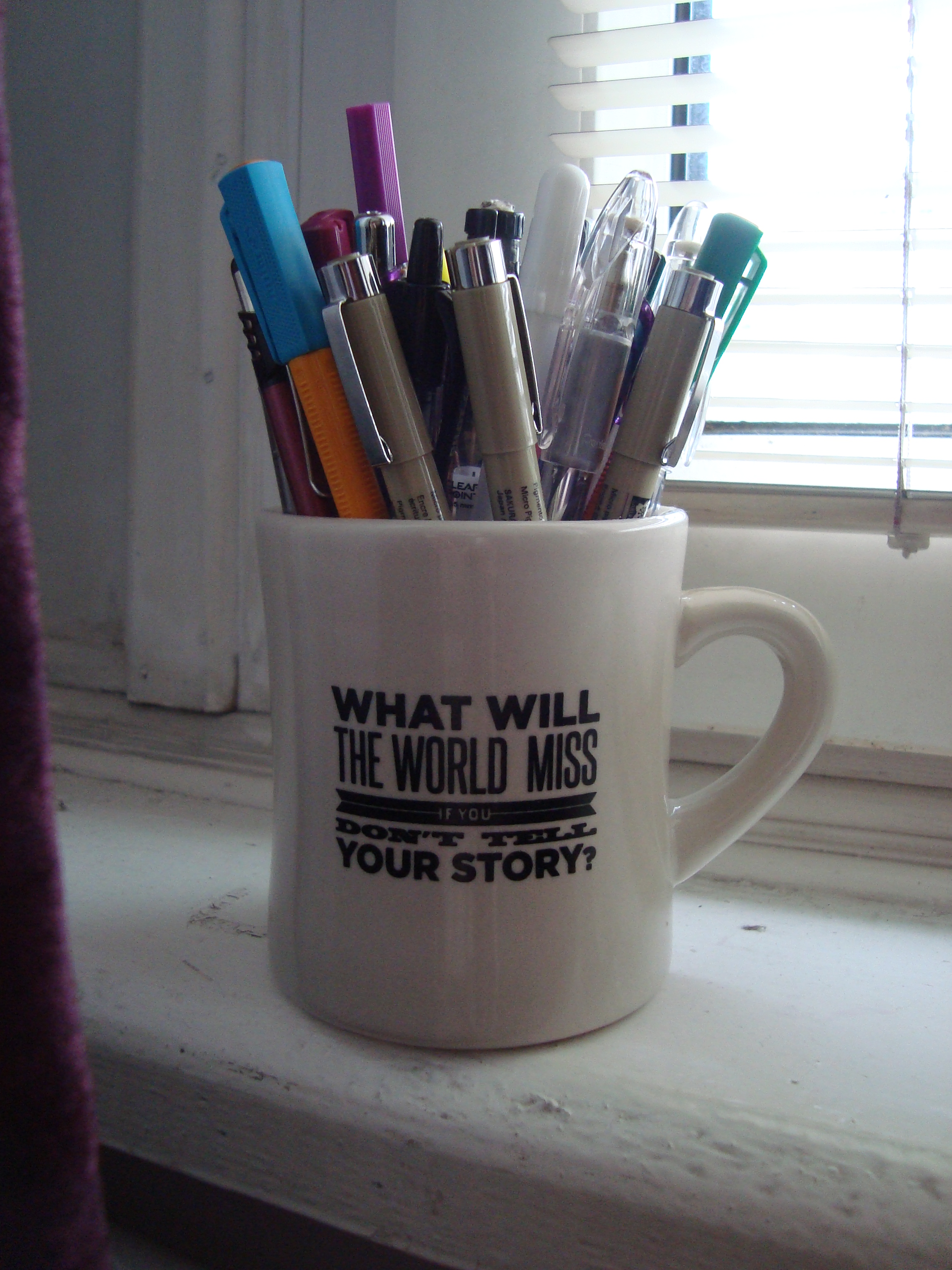
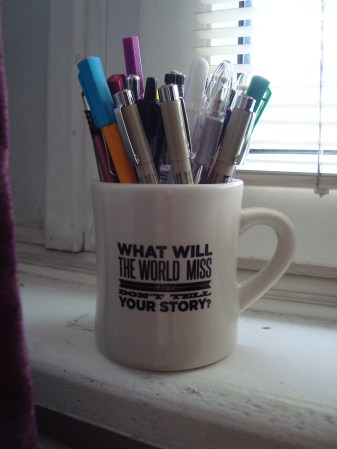
It appeals to me because of its simplicity and I can be an artist without being an artist. All I need is a pen and paper. At home, this is my tool box:
DSC06375

but when I leave the house, all I take is one pen (usually black gel) and one small hardcover unlined notebook where I practice and can slide in a card or two to work on. I’ve stopped doing much work in the notebook except for practicing patterns a little, because I’d rather put that time into something useful.

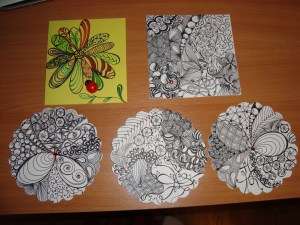
So I make cards. I LOVE buying cards, but I’ve hardly bought any the past couple years. One thing better than buying (or getting!) cards is making them. One of my favorite things to do in the evening is to sit down with my pens and a blank card, listen to something, and doodle. Pop a little jewel sticker on somewhere, and that’s it.
DSC05219 DSC05259 DSC06383

They’re not witty or gilt-edged or elaborate, but they’re original and full of heart, which is what a card is about, isn’t it? The middle one was a wedding card. The round ones are die-cut cards I bought really cheaply at Michael’s when I was in the US a couple years ago, and now I just cut my own from card stock. I experiment with colors of paper and ink, but always go back to the classic black on white.

I like the rich darkness of a gel Pilot pen,(but it smears if I’m careless) but micron pigma pens are also nice because the different size nibs give you texture and variety. I’d like to learn more about shading, but so far, I’m scared that using a pencil to shade will get too smudgy.

The post-modern mantra that some of the artists use in this is “There are no rules.” But I disagree. My rules have to do with texture and balance. I want the eye to move around the page, so that not everything is immediately apparent. I like starting a piece and not knowing what it’s going to look like in the end.  I like the tactile limitations of pen and paper, and the mindfulness it demands. Disclaimer: This is NOT something to do when listening to a boring lecture or message. I always dislike when my students doodle while I’m talking, so I try to give speakers the attention they deserve, and you should too!

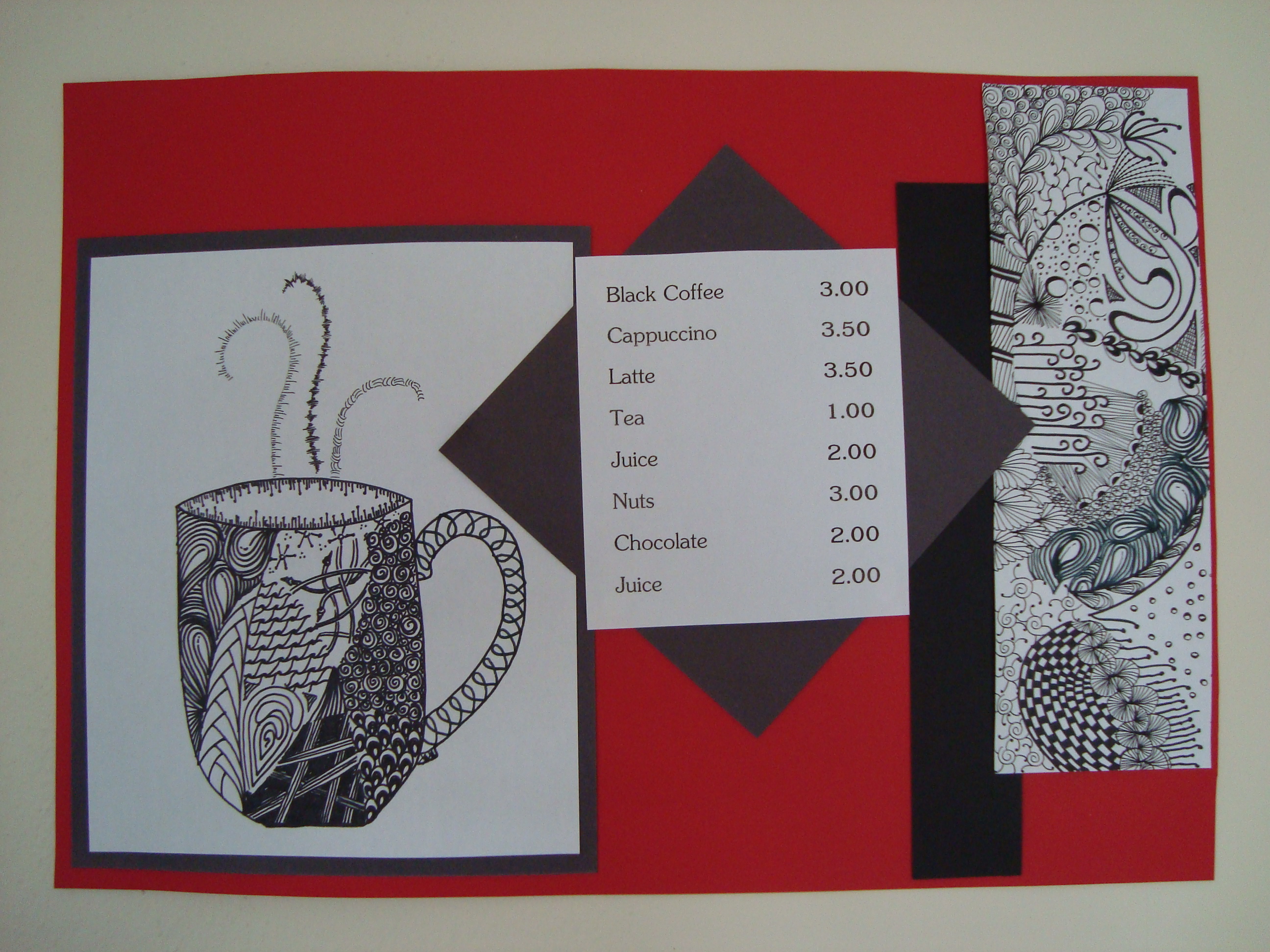
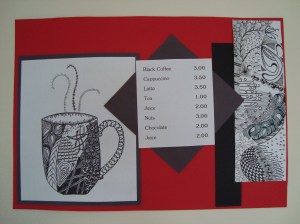
The possibilities with creative doodling are endless. You can use a sharpie to put any design on any piece of ceramic, bake it to set the ink, then paint over all of it with clear nail polish. You can use it in woodburning, quilting, on a chalkboard (isn’t that all the rage right now?), an envelope, or the frost of a window. I used it to decorate a price list at school: DSC04120
You know as well as I do that our world is increasingly narrowing into digital medium. Have you never spread out your fingers on a book page to make it bigger? That’s a dead give-away that means you need to do something creative with your hands. Zentangling is one of my methods of finding alternatives to a digital world. I believe very strongly that we are more whole people if we use our hands to make something that didn’t exist before. You can do this in a myriad ways: plant seeds, make kefir, cut an onion for soup, wash a window. Not only is hand-work practical, but it involves the whole person, and releases tensions that get knotted up if you’re just being sedentary all day.

I found this art in a time when I was in deep depression, and it met a need I didn’t even know I had. Since then, my eyes have been opened to details of light and lines and design. I’ve discovered a new world I never knew before, and it even led me to dabbling in acrylic paint and chalk pastels, something I thought only artists or school children do.

I don’t see myself as an artist, but more as a student discovering beauty. My therapy of choice is creative doodling. I go for a week or so and then my fingers get itchy to do something, and after I make a card, I feel relaxed again. (I think my house-mates are glad when I’m not so twitchy. Do I tangle for their sakes? Not really.) I find most patterns on Pinterest, (you can follow my ‘dangles to tangle’ board) but sometimes I see a pattern in ironwork or a fence or an ad’s graphics and make it my own. My favorite artist is Helen Williams because of her use of lines, light, and shadow. Rick and Maria are real masters, and find inspiration in anything. Their slogan is “Everything is possible one stroke at a time.”

After a few years of experimenting and learning, I’m sort of starting to believe them.

*Disclaimer: please don’t jump on me for the name. It’s just a word. I find no spiritual process in it, no zoning out, no meditation, no aligning my center. It’s just something I do with my hands that makes me happy on many levels. Is that fair enough?
Footprints on the Ceiling, Dorcas Smucker–A Double Giveaway!

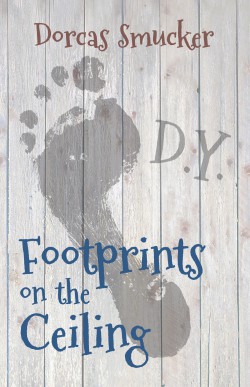
The initials on the front cover could be my dad’s initials, but they’re not. You’ll have to read the first chapter to find out the story behind the book title and the initials.ds.fotc.cover

Because I’ve been following Dorcas’ blog for years, I’ve already read all the pieces she has in the book. So I’d read the delightful story of the footprint and initials, but had forgotten about it.

That’s one of the reasons I like this book: I get to revisit the lovely stories I’ve already read, but their details are hazy in my brain.

Footprints on the Ceiling, as all her other four books, are compilations of Dorcas’ monthly newsletter pieces. As I read this book, I repeatedly was amazed at Dorcas’ skill in organizing the stories to make them fit perfectly into this  new setting.  And the sections correspond with the title: kinds of footwear that connect with parts of life: children, change, forebears, travel, reflecting.

What I love about these stories is that they are filled with quirkiness and color. The lines that emerge when you turn the page are  not what you expect, and even if you’ve read the blog posts before, you’re still surprised and amused. For example, the waddling Canada goose in the opening paragraph in “A Knack for the Absurd” had me in giggles until the end of the chapter.

 Though there’s a lovely light-heartedness all through-out, the book isn’t all jokes and silliness. Dorcas thinks deeply and processes well, but she keeps her own advice and (usually) doesn’t take herself too seriously. This is a trait that I find endearing and inspiring.

There are tears in the stories too. I cried at the beauty of a family wedding that celebrated deep joy and healing after shattering loss and grief. Dorcas’ world-view doesn’t get stuck in pain and she lives in the reality that stories do go on, and it won’t always be dark and gloomy, so her words birthed hope in me.

Dorcas loves her family well, with fierce loyalty and service to her husband and children and extended family. She always blogs with great respect and love for her father who lived with them last summer, and in the book writes warmly of her mom’s character and legacy since her death. The stories are honest, but not voyeuristic. They are candid, but not at the expense of someone’s dignity. So we know that these Smuckers are normal people who fight and make up, and make messes and lose things but at the end of the day they don’t stay mad and they keep talking things out. Which is what every healthy relationship is made of, especially the family, God’s ideal social structure.

This is probably the quality that brings readers back to Dorcas’ stories: it’s real life. No fluff, no fancy-schmancy lingo. Forget the idea of blankety-blank Amish novels. Last winter when I was teaching at CBS, the chapter about Bible schools came out, and it was so on-the-money that it made the rounds to all the teachers. We completely identified with the rules, unspoken rules, and laughed knowingly about the signs God sends. Her novel, when it comes, will be made of the same colorful, earthy, human stuff, and I can’t wait!

For now, Dorcas is giving away a signed copy of Footprints on the Ceiling. To enter the giveaway, leave a comment below. I’ll close it next Wednesday, Dec.3,  and you should get it in time for Christmas–a treat for yourself or a friend! This is going to be a double give-away, in that Dorcas will send a copy to the winner in the US. But if you live in Europe, you’ll be eligible for my copy. Isn’t that fun?!

Footprints on the Ceiling is available for $15 per book, postage included.  You can mail a check to Dorcas Smucker, 31148 Substation Drive, Harrisburg, OR 97446.  US addresses only.  To send a copy to Canada or overseas, email Dorcas at dorcassmucker@gmail.comOr find it on Amazon here

We Have Only to Look

the winds of skagit.

Recently I read the book The Glass Castle by Jeannette Walls. It’s the riveting story of her childhood, raised by her artist/hippy/rebel/paranoid parents who were always on the run. She writes with great candor and grace, never bitter about how she got dangerously burned while boiling hotdogs at age 3, or how she was forced to root in the garbage cans for food in high school because she was starving.

(It’s a really rough story in spots, and I don’t recommend it for young readers or to anyone who takes offense at honesty.)

I listened to several interviews with Jeannette, and something she said keeps coming back to me: the worst thing that happens to us is actually the best thing that happens to us.

So she was starving during much of her childhood, but it means that now she appreciates how she can go to a grocery story and buy ANYthing she wants. Their poverty limited them terribly, but it didn’t keep her dad from taking her out on the porch and giving her the planet of her choice for Christmas. He’d said she could have any star she wanted, but when she asked for Venus, he said “It’s Christmas. You can have a planet if you want.” What other child ever got Venus for Christmas?!

It keeps coming back to me–the idea that the things that are ‘bad’ can become something good. I say it carefully here, because I’ve not walked through the deep, devastating losses that many people have. But I want it to be true, that pain doesn’t have the last word, and that the yucky can be changed into good.

In my days and hours and minutes, it looks something like this:

  • When I repeatedly bruise myself in our poorly-designed kitchen, it means we have food to cook and dishes to wash.
  • I don’t like living on the first floor of our apartment building, but just outside my bedroom window yesterday I got to watch an older man carry a wooden cabbage slicer the size of Texas. It was wide enough to take a whole head of cabbage. Only in Poland!
  • A student who drains me is the reminder that I have energy to work and I have a job where I can be creative and be challenged every day, keeping boredom far away.
  • Housemates who have different priorities than I, resulting in potential frustrations, means I don’t live alone. Thus, I’m rarely lonely, and hopefully I won’t become stiff and unbending. (For an excellent read on this phenomenon, please treat yourself here.)
  • Being single when most women my age are mothers of teenagers means I am free to plan trips with my friends at a moment’s notice. Or pile books on the empty half of the bed.
  • Having undergone a harrowing surgery and long recovery gives me sensitivity to others’ physical pain and limitations.

Part of me doesn’t like listing these things, in fear that it feels chirpy. No one who is walking through a dark time wants to hear glib, pat words like “Look–you have dishes to wash which is more than some people have!” Or “Hey, be thankful for your freedom to travel!”

I think the transformation of good coming out of bad is a process of perspective that is hardly possible in the middle of the mess. There is value in being honest and saying “This really stinks, and I hate this.” But to walk out of that and look back on it from a safe distance is redemptive and healing.

Which is what God is all about. The change of perspective is way more than positive thinking and pulling yourself up by your own shoe strings. The picture of peace and joy and glory shining out of negative situations has God’s fingerprints all over it. Because His character is light, and the darkness will never, ever, ever over-power it.

This is what I hang my heart on.

Read The Glass Castle if you want to read a story told by a masterful writer. But more importantly, maybe today you can try to step back from your story and find the streaks of light piercing your clouds.

The beauty might surprise you.

There is glory and beauty in the darkness, could we but see!

And to see, we have only to look. –Fra Giovanni, in 1513

Why You Need My Book

In case you didn’t get the memo, my book has a brand new look!

This is the new and improved edition:

ta daa!


book cover

Because I’m more artist than business person, it is super hard for me to promote or manage or try to sell my book. But here I am, trying to do that.

Why would you want to buy this book? (This is the first tool of the salesperson, you know: create a need for the product.)

You need this book because you feel left behind while your friends are all doing amazing things like dating, or planning weddings, or having babies. You’re watching it happen all around you but it’s not happening to you. You nearly swallow the tantalizing lie that God is organizing others’ lives, but expects you to manage your own by yourself.

Or some of those exciting things have happened to you but you feel empty and your days blur into each other and you wonder if life is just about surviving every day until the supper dishes are washed.

If none of this applies to you, you know you have a friend who feels this way, almost dipping into desperation sometimes, and she needs a message that she can identify with. She needs to know that she’s not the only one to feel this way, that other women say “You? Me too.”

After you buy this book that you need, you find that you like it too. You like it because of the perky little fish on the cover that decided not to keep swimming in circles. You like it because there are sweet swirly graphics between the chapters. And an engaging study guide in the back.

And best of all? In my opinion?

There are lots of sidebars throughout the whole book–and none of them repeat any words in the text. This is my pet complaint in other books: they have little distracting sidebars here and there, and when I finally read them, it only repeats what I already read on the page, and it makes me impatient. Not in this book. The (pretty) sidebars are bonuses to the text, not repetitive distraction.

This new and improved edition has the same general message as the first edition. This one has been edited for tighter writing, fewer exclamation points, less italics (though you wouldn’t think it, seeing this post) and more clarity.

This book won’t answer all your questions or give you pat answers or neat formulas. But it does walk with honesty into basic questions such as Who is God, and who am I, and what shall I do with my unwieldy dreams?

This is not about taking charge of your own life, nor about proving that your life is better than another’s. It’s about living in the reality of knowing that the greatest thing that could happen has already happened–the creator of the universe chose you for eternity–and nothing can ever, ever change that. It’s about making choices decisively so as to guard against selfishness and stiffness. It peers into others’ stories to give you perspective and a sense of not feeling so alone.

Because one of the deepest fears of a woman is that she is alone. This book confronts that fear and reassures you that you are never, ever, ever alone.

If you don’t need this assurance, you know someone who does.

Order your copy from your local book store or the helpful staff at Christian Learning Resource:

Toll Free: 877-222-4769        Fax: 814-789-3396              Email: clr@fbep.org            Online: www.Christianlearning.org


What Shape is Love?


My personality loves spontaneity and diversity. I like to live large and expansively (not to be confused with expensively!) and strict, sterile routine suffocates me. I need plenty of air to  breathe deeply, and feel stifled in tightly-fitting squares.

However.

Part of living a whole life includes some structure.

There are parts of my day that don’t change. The days are free-form and unpredictable but the beginnings and endings of the days have fixed points that give me stability and rest and predictability.

Coffee is one of those things.

But there’s more. Much more.

Some people call it ‘having devotions.’ I don’t, usually, because it sounds too sterile to me, but for all practical purposes, that’s what it is. It’s my quiet time, the time especially reserved for talking with God. It’s the still point around which everything else whirls. It’s the bread that keeps me alive, the exercise that keeps me healthy, the words that keep me sane.

It’s not all about me, but it’s my initiative, my decision, my deliberately moving into a position to focus and take part in something way, way bigger than me.

I’ve heard many people say they have trouble ‘having their devotions regularly.’ I say this quietly and humbly because I have a lot of trouble with a lot of things, but this particular issue not one of them. I DIE without those fixed points in my days. I get weak and whimpery and grouchy if I don’t keep that structure.

I’m talking about this here, not because I want to talk about me, but to encourage and nudge and facilitate you to find the same kind of sustenance if it’s been alluding you.

There are a ridiculous amount of devotional books out there with laughable titles that could make you cringe. (Don’t get me started!) None of them work for me, but if one does inspire you, or helps you focus, help yourself. What I love, love, love, is this monthly printable of adoration from Sara Hagarty. Every day has a different word to describe and adore God, and the rich words can set the tone for my whole day.

A little  chocolate icing on the cake is Grace Notes, daily readings compiled of Philips Yancey’s books and magazine articles. He’s my favorite contemporary Christian author, and there’s nothing cheesy or schmaltzy about his writing, so reading a page of his words gives me something substantial and dynamic to think about.

I’m not a Bible scholar. Should I be? I read the Bible to live. It’s bread and milk and meat to me. For several years, I’ve read the One Year Bible in the New Living Translation. I love the freshness and variety of daily pieces from both Old and New Testaments, Psalms, and Proverbs. The daily portions aren’t long, and are usually not enough food to feed me completely, but it’s a place to start.

In the evening, before I let myself pick up a book or turn off the light, I pick up my Thanks Journal and write at least one gift in the day.  I’ve blogged about this before here and here but I’ll say it again. Deliberately writing down gifts and reasons to be thankful is the simplest and  most effective way to keep a positive outlook and maintain a life-posture of worship. It’s not magic. It doesn’t help everything. But it helps a great deal.

Relationship with God has similarities to any friendship with a person. Healthy relationship includes seasons of  excitement,  silence, wonder, anger, questions–but always communication in some form. I don’t blog about all the details of my relationship with God because it’s way too intimate to share with many people, but to those who have trouble maintaining communication with the Creator of the Universe, I want to say: do what it takes to fill your part of the friendship.

Your part is to show up.

For my own sake and because I love him, I show up routinely.

He does His part.

My Diet

Embed from Getty Images

I came to the US with plenty of extra space in my suitcase. On my return flight, that space will be taken up completely with books. This is the promised land of books, and they’re arriving by post these days, which is so, so exciting. The stacks are growing! Between classes and chapel and walks and socializing I’m gorging on books.

I overheard a conversation lately where one person was saying they don’t read, and if they do, it’s a discipline as in, “This month I will read one book.”

That’s ok for them, and they are very useful in God’s Kingdom, but not reading is the discipline for me.

I’m reading Oceans Bright With Stars, the second in a series by Rachel Devenish Ford, which is a compilation of her blogging while her family moved from California to Goa in West India. My life is nothing like hers, because she writes of she and her husband travelling with three children while she’s pregnant with her fourth, and she talks about how exhausting and bewildering and exhilarating her family and surroundings are.

The book keeps me up reading way too late because she’s so honest and refreshing like cool breezes. In a most inexplicable  way, even if our lives have little in common, I feel like she understands me. Her writing isn’t comedy, but it makes me laugh aloud because I get her humor and crazy metaphors and because I see so much of myself in her, especially in the way she mixes up her words like I do.

Then I just finished The Tiger Rising by Kate DiCamillo, a beautiful little gem that made me smile and cry. It’s reminiscent of Bridge to Terebithia.  I love the writing that sparkles off the page and the way the story blends Blake’s Tiger poem in with it.

If you never read it, just try to be the kind of person that when someone tells you they saw a tiger in the woods, you don’t say they’re crazy, but ask “Where?”

It’s All Good News

The lecture comes first and then the fun part:

I was with my family visiting another family whom we didn’t know well. When us girls were getting acquainted, one young lady’s first question to me was “So, do you have a boyfriend?”

I said no. I was so stunned by her question that I still, eighteen years later, remember reeling from the realization that having a boyfriend was the way she valued/ranked her life and her friends’ lives.  While I wanted a boyfriend, I still felt deeply that not having one wouldn’t keep me from living well. Some years later, this girl was so crushed when her sisters married, that she couldn’t function well, and was so desperate that she made tragically unwise, harmful decisions to take whatever man would take her.

In our sub-culture that is pro-family–and rightly so–the girl who has no boyfriend or husband feels a lot of pressure and silent questions. She might be 20 or 29, and very satisfied and fulfilled.  OR she might be 19 or 23 and feel cheated and left behind and missing out. People wonder if she chose to be single. She wonders if she’ll ever get to choose a baby name. People unhelpfully recommend a good man to her, but what can she do about him?

I wrote a book called Life is For Living–Not for Waiting Around for the girl who is forlorn and desperate, because I know that God had infinitely more in mind for her when He first dreamed her up. The book doesn’t answer the unanswerable questions, nor resolve all the hang-ups we get stuck on. One of my friends said that when she reads it, she feels like I understand her and am walking with her in this solo walk. It was high praise, and fulfilled part of what I dreamed the book would be.

Because a big fear of women is that we’re on our own. I think we can do anything if we know we’re not alone. My book is a kind of companion that says “I get it. I know, me too.”

Wives and mothers tell  me they like the book as well, because everyone needs a voice beside them that urges them to search out abundance and fullness in Jesus. Romance and children are beautiful and rich  gifts, and not everyone is given them. Is that fair? Hardly. But the good news is that life and fulfillment for every lady is found in one person, and his name is Jesus.

The fun part is this: we’re doing a close-out special, a 60% discount, on my book until March 31.  Which means it’s $4.40 now instead of 10.99.  Order here from Christian Learning Resource. Wholesalers, contact the office and  get 75% off. 

This would be a good chance to buy copies for a study group. Contact me and I’ll be glad to send you a study guide–free!–for your group.

Spread the word–let your friends know, forward this post, share it on your networking places–and I would be so grateful!

Transplants and Love Does

1. Today I was one of three girls walking across campus, and on the other side of the drive was another group of three girls walking together. What we two trios had in common was that each group has lived outside the US. They, in Kenya, we, in Europe. Now we’re in the US for various lengths of time, enjoying the benefits and ease and junk food of it, but our hearts are always feeling stretched across time zones and cultures, and we wonder if we will ever feel at home anywhere. Or know where we’re from. Or if we’ll ever fit in anywhere. I’m thankful beyond words for the high privilege of living outside my birth country for nearly half my life, but it comes at considerable cost. This isn’t the time to talk about that cost, but for now the understanding and kinship of others who share my experience is something I treasure deeply.

2. If you’re hungry for an easy-read, this is a must-buy: Love Does, by Bob Goff. From the website: “A book and a movement about love in action.” I heard Bob Goff speak last week, and it was phenomenal, the way he lives large, and loves big. I will never be the same again, watching how he loved on his audience and told us stories of teaching witch doctors in Uganda how to read and write. “Walk in grace, live in love” was the theme of his talk, and he urged us to make it our mantra when we walk: walk in grace, live in love, walk in grace, live in love.  People won’t know we love them if it just stays inside our heads. We have to DO love. A key word in the book is “whimsy.”  This is the man who wakes up his Sweet Maria every morning with a cut rose from their garden (this is possible in San Diego) and jumped off the dock with his children to wave goodbye to Don Miller, their guest leaving by boat. My favorite story in the book is when he got his children, in response to Nine-Eleven,  to write letters to hundreds of world leaders in order to dialogue with them and send them house keys to invite them to come stay with them. Walk in grace. Live in love. This is the mantra that will change the world.

Ann Kiemel and Don Miller

1. Ann Kiemel Anderson died a couple days ago, and her funeral is Saturday. Dying in the Lord is not a tragedy, but it’s an enormous loss to her family and larger world. Ann is the girl who sang songs to her taxi driver and loved her neighborhood by baking cookies and buying ice cream cones. She inspired many people in several generations to say YES to God, and run to change the world. I heard a wise man say “The most gifted ones struggle the hardest,” and I think that was true for Ann. She fought a lot of personal demons, got addicted to fame and drugs and running, and hated herself for it, and failed often, but kept stumbling back to God for help. I think she fought well, cancer was her last enemy, and now she can rest well.

Related post: Yes, Lord 

2. I’m coming off such a good weekend that it deserves a whole big post all to itself but it would sound like I’m gushing. My good friend Janelle flew with me to San Diego for  the ’14 Storyline Conference. I knew it would be good, but it was way better than I was expecting. We were 1,700 people in the Point Loma Nazarene University chapel, focusing on how to live a good story. Donald Miller was the main speaker then there were many others, writers and visionaries, who told us their stories and life missions. It was authentic and honest, not glitzy or emotionally manipulative which is why I could respect it and take in what they were saying. Three recurring  points:

  • Life is going to be hard, very hard, either because of our own mistakes or just because life is unfair.
  • God is fathering us, and He’s a good father.
  • Every bad part of our story can be redeemed.

I heard and saw so much grace, love, and hope poured out, and it fed something deep inside me that had felt parched. I will never be the same for having witnessed people loving their world and equipping others to live well, stop being a victim, make wise choices, and stumble to Jesus for forgiveness and freedom.  For anyone wanting to refocus and be refreshed, I recommend this conference. And if they have it in San Diego again, you will love Point Loma.  How can you beat bird-of-paradise and roses blooming in February?