Home Matters, Part II

Last week, this post gave the first part of this article on “home.” It introduced the idea that God cares that home creates comfort and safety. One day in chapel this week, we read Psalm 27 and my brain starting pinging when I saw all these words about God’s home: house, temple, dwelling, tabernacle. This concept must be important to God. I wonder how that should inform how we live, how we see the church and individuals?
Rublev’s “Trinity”

Creating welcome for the stranger

In addition to creating comfort and safety, God designed the home to create welcome for the stranger.

The picture of Revelation’s wedding feast shows us a place of welcome, generosity, and abundance. As we reflect God’s character of housekeeping, we can offer His warmth and welcome by embodying hospitality in our physical places. This can reach beyond walls, doors, and a roof.

In Free to be Single, her excellent book now out of print, Elva MacAlister points out that even when I walk across a college campus and fall in step beside a friend, I can welcome them into my space, my personal bubble, and show them hospitality as we walk together. Our personhood, the space we take up on a sidewalk or a car or a park bench, can be a place where we embody welcome, care, and interest in this person at this place and at this time.

God’s spaces reflect His selflessness, His intention toward people, and His deep care for us. We are most like God when we focus on others instead of our default selfishness. This is the biggest part of being hospitable.

Creating our spaces in pressure to compete with the latest influencer or neighbor will drain us instead of help us thrive. On the other hand, creating home as a place to welcome the stranger, which is really anyone, frees us to express our individuality in ways that help our people feel at ease, loved, and refreshed. One homemaker will prioritize plants and toys while another puts her energy into minimalism or coffee, but each can be responding to God’s direction to create order and welcome the stranger.

Home looks different for all of us, depending on our ages, seasons of life, and native abilities. But Christians can always reflect God’s homemaking skills in ways that make order out of chaos and offer life and beauty to people.

Trinity is an old painting by the Russian artist Rublev that moves me deeply. Showing us a peek into God’s character, the medieval painting depicts themes of fellowship, unity, order, and hospitality. Three angels sit around a table at Mamre, while Abram, childless and out of sight, prepares a feast for them. The angels represent the Trinity, a unit of perfect love, fellowship, and safety. They graciously accept Abram’s eager hospitality. Abram, is, after all, reflecting God’s generosity and care, demonstrating what He knows about God’s character.

As homemakers made in God’s beautiful image, we extend, arrange, offer safety, and create homes because we first receive it from God’s heart. Rublev’s Trinity shows how home, fellowship, and hospitality comes full circle: we receive and offer in response, we give out of what God gives us, and we can never out-give God!

Is home a person, feeling, or place?

When I look at the glad fellowship of the Trinity and see how Jesus showed us the Father’s face in a particular time and place in history and geography, my love deepens for the Father, Son, and Holy Spirit, and I discover my true home. In the Trinity’s circle of beauty and truth, home is a person, a feeling, and a place. Because I’m in a body and not only a soul, I learn from God that place, stuff, food, furniture, things I touch, all matters because it matters to Him.

In the trailer we rent, our shared space isn’t trendy or influencer-worthy, but my housemate and I try hard to blend our differing color preferences, use indirect lighting, white walls, original art, and plenty of blankets within reach to make a comfortable space for ourselves and our guests. I like to put tea and scones on the battered coffee table so that people don’t have to move far for it, and they can prop up their feet wherever they’re comfortable. Friends often step from the porch to the living room and sigh “Oh, this looks so warm and cozy” which is exactly what we want them to feel!

Does home matter to God?

God cares deeply about home as a place of safety and welcome.

In a world that’s constantly degenerating into entropy and disorder, God’s people have a high responsibility to bring beauty, order, and welcome wherever we can. Women (and some men!) are especially good at this, regardless of their personalities or Enneagram numbers.

 Of all the careers you’ve dreamed of, imagine reflecting God’s character of being a home-maker!

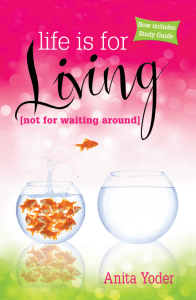
I wrote a book about living well in a place I hadn’t planned to be. Turns out that’s where a lot of us find ourselves. You too? Order your copy here!


Home Matters, Part I

Over two years ago, the lovely team at Daughters of Promise asked me to write a thoughtful, theological article on home. It was to explore this question: “Why does home matter in the bigger context of God’s story?” It was a new idea to me, but I quickly got excited as I began to study and ask questions about home. Since then, it has become something I think about often and take notes about and dream of expanding this article to something significantly more substantial. For example, what is special or significant about women in their ability to reflect God’s character as homemaker? And how does mundane, unseen work become meaningful when we think of ourselves as co-creators with God who is in the business of making all things new–pushing back entropy? So many rich questions to untangle! But that will be the work of another several years. For now, here’s the original (slightly polished) article, coming in two parts.

Is home a person, feeling, or place?

As a third-culture kid who feels at home in multiple states and countries, I have wrestled with this conflicted question for years.

If I don’t have a home, does it matter?

Is something important missing from my personhood?

Does God care about home since my homes have been so interchangeable?

I walk in a refugee camp in Greece and saw tents and blankets for houses. Under news headlines, I see photos of tent cities sprout up in Syria after another earthquake. I have suffered nothing like these beautiful people have, but I know the search for home. I’ve wondered if it should matter so much to me, and if home even matters to God because there are a great deal of other big questions that need His attention.

But when I observe people, listen to their stories, read literature, study the Bible, and cringe when people ask me where I’m from, it’s clear: home matters.

The immense disruption, disorientation, and restlessness over the loss of home shows me that home is important, does matter, isn’t a question to hush and try to forget.

Home can be a person or a feeling. But seeing God’s heart in the Biblical stories of Genesis to Revelation, it seems clear that God cares enormously about home as a place.

People and feelings do matter to God, because He says much about how to love Him and our neighbors. But He also holds place as very important, which gives us a way to think about our homes as places that matter to God.

In spiritual matters of the heart, we tend to live in our heads and work hard to think kind and gentle thoughts and nurture loving and patient attitudes. But in physicality, in places, our thoughts become embodied and visible.

For this and many other reasons that I’m still exploring, matter matters.

Bodies matter.

Places matter.

Home matters because God cares about physicality, clay, dust, tangible pieces of His creation. The incarnation of Jesus proves that, in case we doubt whether God values physicality. Jesus’ body, His dusty life as He touched people and got hungry and tired, elevates for us the gritty reality of matter, stuff, tangible pieces of living.

Once when I was reading John 14, I actually gasped when I read verse 23: “We will come to him and make Our home with him.” Jesus is talking about Himself and His Father, and He’s saying they are homemakers!

What kind of home do they make? How do they work together? What does their home look? They’re making their home in me? What does that even mean?

God’s homemaking in me is a spiritual reality with profound significance that ripples into physical reality even when I’m not conscious of it. Further, when I know something about His character and get to know Him as a homemaking person, I can grow in reflecting that part of His character.

Like elegant bookends, the special, prepared places in Genesis and Revelation show us what God thinks about home. And in between those places, we see many ways and times where God valued home as a physical place. He asked Mary to give a home to His Son Jesus, and placed that home first in her womb, then in Nazareth, specific places at specific times. God ends the Biblical timeline with a picture of our eternal home, a place too wondrous to describe, but we know it includes a wedding feast (I think there will be lots of cake!), cultural diversity, a river, and a fruitful tree. All these scenes happen in specific places, not just in our heads.

As I study the Bible and get to know God’s heart, I see His homemaking reveals many things about His character and here are just two:

  1. He creates order and safety
  2. He welcomes the stranger

This concept gives me goosebumps because these characteristics are beautiful and actionable for all of us!

Creating order and safety

God’s design of home holds an atmosphere of safety, rest, and belonging, seen both in Eden and our eternal home. God crafted them as places for fulfillment and fellowship where humans and nature can flourish and expand to their fullest capacity.

Home is a nest that protects fledglings from storms and predators. Home is a fuzzy blanket that wraps children in warmth and keeps out the world’s cold, hard edges. Home is the inviting smell of gingerbread baking. Its physicality engages all our senses and grounds us in this place, right now. Its daily, weekly, annual rhythms shape our neural pathways and linger in our subconscious.

In the absence of safety (wars, famine, abuse, neglect) humans tend to become less-than-ideal versions of who they were intended to be. The loss of home as a place is one reason refugees and natural disaster victims turn to violence and become people they would otherwise not be. In addition to suffering from emotional and spiritual damage, their material losses devastate their lives profoundly because physicality matters. No one just lives in their head.

But in safety and belonging in physical spaces, we flourish because that’s how God designed us. It’s the kind of homemaker He is.

From ages 35 to 41, I lived in five places. In each place, I arranged furniture, organized a kitchen with a housemate, and found a rhythm of keeping order that worked for that season of life. Then I walked away from it, left the stuff behind me (except for a mug or two), and started over in the next place. By the fifth place and the third country in six years, I wanted to think that home and belonging didn’t matter because it was too hard to reckon with all the loss and change I was living in.

But I’ve come to see that those transitions were so shaping and impactful to me precisely because home is so important. I couldn’t brush off the loss of home as if it didn’t matter.

The longing for home and belonging is an ache as deep as time. The loss of home is probably one reason Cain cried when he realized would never belong anywhere and would live in a place that means “wanderer.” We were made for home as a place that provides context for the connections in relationships that make us better people. Even literature knows this. Think about your favorite stories and books and how they center around the search for home and belonging.

  • The Odessey
  • Anne of Green Gables
  • Hannah Coulter
  • Gilead
  • News of the World

To be clear: home is not the most defining thing about us, but it IS basic to the need of our flourishing. This need doesn’t require us to live in one place all our lives. But creating home as a safe place to thrive means we can order our present spaces in ways that are restful and calming wherever we are.

When God gave humans dominion over creation, He was letting us be homemakers, designers of places. He was setting us free to innovate, create, and bring order out of the chaos that cascaded out of the fall. He could have regimented every part of keeping the first home, but He didn’t want Adam and Eve to be robots. Every healthy person carries some capacity to create, experiment, and maintain (“dress and keep”) home. As we carry out that work, we become better people ourselves and provide a comfortable, organized environment for others to flourish.

Up next Friday: Home Matters Part II, Creating Welcome for the Stranger

I wrote a book about living well in a place I hadn’t planned to be. Turns out that’s where a lot of us find ourselves. You too? Order your copy here!

Walking Beside Each Other

Photo by Rajat Verma on Unsplash

Last week, the lovely Daughters of Promise team asked me for a writer’s interview on Zoom. It was in connection with their Brighter Winter program, which gets participants into lots of books during January and February. I agreed to the interview even though I’d never done anything like it. In the moment, it was mostly enjoyable even though I don’t love being the focus in a virtual conversation. My hosts helped me feel comfortable, and seeing a few friends’ faces made the call enjoyable.

We talked about my book, the process of writing and self-publishing, and my goals for the book. My goal was—and is—for it to be a companionable voice on a lonely path. Then a question came that I wasn’t prepared for: what can the church do for singles to support them and recognize their gifts and contributions to the Kingdom and not make them feel left out?

I stumbled around, offering ideas off the top of my head, but I didn’t feel good about it. So I decided this space (ironically another virtual platform) might be a place to think longer about the question and possible answers. I’m thankful beyond words that in this current season I can put down these ideas from a place of abundance, gratitude, and fullness rather than resentment, scarcity, and envy. I wish all single women’s churches and work places would support them as mine do. I hear many single women’s stories, and this is not their reality.

  • We want to be known and seen as contributing citizens, not oddities, even in our pro-family sub-culture. So please meet our eyes. Notice our appearance. Ask us questions about our latest holiday or visit home or latest book or hopes for the new year.
  • Give us responsibilities in church that fit our lifestyle. Keep in mind that most of us are working 50-60 hour weeks, and we love our work, but we have very little discretionary time. At the end of a long work day, we still have to maintain the car, see the dentist, buy groceries, do laundry, and cook. Did I mention take care of the house or lawn or garden? And all solo? That doesn’t give much time for babysitting, making church bulletins, or hosting–even if those are all things we are able to do and enjoy doing when we find cracks of time in evenings and weekends.
  • We love meal invitations and leftovers. We love hosting too, but it takes a lot of planning ahead because if hosting involves food, we don’t always have food in the fridge.
  • Hug us freely and often. We live in an adult world and often go for days without physical touch.
  • In family-centered activities like meals and picnics, invite us to join your family. We don’t always know where to stand or who to sit beside, and it’s lonely to stand alone in a circle, and we never get used to that.
  • If you don’t know us well but you have a potential boyfriend in mind for us, stay quiet and pray. If you know us well and we’ve confided our dreams to you, set us up with good men. Ask us on a double date or a blind date. We know that marriage won’t solve all our problems so you don’t have to tell us that but we need you to celebrate your beautiful, strong marriages and darling children and we need you to love us where we are and hold hope for us.

I can already hear howls of protest from some singles who feel misrepresented in this list. What I put on the table here is true for some but not all single women. That means it’s on every person to get to know the single lady beside her and love her as a one-of-a-kind individual, not as a piece of demographic information.

Singleness is hard and marriage is hard. That’s what Sam Alberry says, and I believe him. That means that all of us need all of us to accompany each other in this beautiful, broken world, to smooth the path a little bit for each other, to be present and available and tender toward whoever is walking beside us.

What I Wish I Would’ve Said

Photo by Clay Banks on Unsplash

Last month I gave a talk on Strength to Strength Sisters about God’s design for older women to teach the younger. You can call it mentoring or teaching or friendship or influencing. One Biblical term is “discipleship.” It was for women who want to live with eternal purpose, but don’t have 10,000 followers on Instagram like big influencers do. I didn’t talk about following a particular mentoring program, but about ordinary women connecting in ordinary ways.

I gave the talk via Zoom, which I don’t love. Physical presence matters enormously to me, so it was hard to speak alone in my empty office. But this technological platform gives the possibility to cross time zones without anyone needing to leave their couch, plus it preserves the words for people to access afterwards (as a YouTube and podcast recording) but still, I don’t love Zoom.

And as always, after speaking, there were details I wish I could do over, or examples I wish I could’ve added or reworded. That’s what this blog post is, which is another benefit of technology.

But before I say what I’d change about the talk, I want to say what I liked about it. I loved that I could see a few dear faces on the screen–especially friends who never turn on their cameras, but they did so for me, and it was super sweet of them. It’s why I rarely looked up at my computer camera, but always just below it at the faces I wanted to see.

I also loved telling the women “You are a tree!” and the simple interactive assignment that came out of that–a fun, meaningful exercise for all of us. And I loved telling the story at the end of what Pastor John told me when I didn’t know how to make a decision. His words to me that day were so confident and strong and simple that I could believe what he said. In turn, I can hand those words to others. It’s my favorite, beautiful part of giving away what I’ve been given.

The Q&A at the end of the talk was the hardest part for me. I felt self-conscious because I wanted to give good advice but didn’t have time to offer something thoughtful, and wasn’t at all sure that I answered carefully or sensitively.

Finding a mentor you can trust

One of the questions was about how to find a mentor you can trust, “who will keep things confidential.” I hear this question often. I never know if the question comes because some women can’t trust, or because some women aren’t trustworthy.

If you’re looking for a mentor you can trust, you need to risk exposing your soul, and you need to know that no mentor will be perfect.

I wish I would have said: If you want be a mentor, you don’t need to overthink it. It’s not complicated. All you need is to love God supremely and your neighbor as yourself. The shape of your life will influence others whether or not you intend that it does. That’s why friendship and conversation is so powerful. But it’s also why gossip is so devastating. It should never be said of you that you passed on carelessly what someone confided in you (except the threat of harming someone).

Most women, for whatever reason, love to be the first to tell a piece of news. But usually the most loving thing you can do for someone is to hold their confidence as sacred. Not even share it as a sanctified-sounding prayer request.

You don’t actually pop.

The soul is very elastic and can hold quite a lot of words and feelings, and it doesn’t explode.

We should work hard to be safe women for each other. When there are interpersonal problems and questions, we should be careful to talk only with the people who are part of the problem or the solution. I wish I would have said that because it’s what my parents taught me and it works for me.

Recommended reading

Someone asked for recommended reading on mentoring. I love talking about books! But I hesitate to recommend specific titles for specific purposes, because reading is so subjective. What is meaningful and helpful to me might not connect with you, and vice versa.

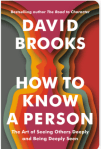
But I do recommend Getting to Know a Person by David Brooks. He writes for a secular audience but holds strong Judeo-Christian values. He says when we listen to people talking, we should listen so hard that we burn calories as we listen. Sounds like a good weight reduction plan! Seriously, if we would all follow Brook’s advice, we would be better people and able to mentor/influence/friend/disciple better.

I wish I would’ve said that.

But it’s ok. I keep learning. And keep taking in. And giving away. It’s the rhythm of a good life, the shape of a flourishing tree.

God So Loved That He Gave

One of the times I felt most alive was when my friends and I swam in the Dead Sea. The buoyant water let us do gymnastics we could never do before! The clear, turquoise water, briny with salt and minerals, made my skin silky smooth, and soothed the sunburn from the day before.

An Israeli company takes the salts and minerals from the Dead Sea and produces a beautiful line of skin care products, choosing the name Ahava for their brand. A friend I was swimming with in the Dead Sea gave me a tub of lovely Ahava body sorbet that I love using.

Ahava means love. It’s the same word God used in Leviticus: You shall ahava the Lord your God, and your neighbor, and the foreigner among you.

Why did God command a condition of the heart instead of action with the hands or feet? Or is ahava only an emotion, an intangible word?

The root word of ahavah means “to give.” To ahava the Lord and our neighbor is an act of intentional giving, serving, focusing on the other. Love is far more than a warm feeling deep inside. It is action and generosity, sacrifice and service.

In this week of masses of pink and white fuzzy animals, red-foil balloons, and heart-shaped chocolates, it is normal to focus on what we might or might not get, and what makes us feel warm and loved. Romantic love is beautiful and life-changing, and carries enormous power to heal and restore. Valentine’s Day is often the most noticeable, accessible (and consumerist) form of romantic love, but ahava is far bigger than a day on the calendar.

God modelled ahava for us when He loved us so much that He spared nothing and gave His only Son. God’s call for us to ahava is a call to the shape of a life, the deeds and habits of a heart that gives and serves the neighbor and the family member and the stranger. Ahava is not expecting to receive nice things or to stay comfortable.

However, in a beautiful paradox and a curious exchange, when we ahava God and others, we receive stupendously in return.

In this week of pink and white and red all around you, how will you receive and give ahava?

I wrote a book one time about living well and living loved—even without romance. You can order your copy here!

What We Make Much Of

Women often tell me, “I don’t have anyone experienced I can talk to about this.” Or “I’d like to have a mentor, someone I can ask questions of and learn from, but I don’t know how to find one.”

I make at least two deductions from this common theme:

  1. Younger women need older women in their lives.
  2. Older women rarely advertise their willingness to walk beside younger women.

There are a million influencers out there and some of them contribute to some women’s anxiety, FOMO (fear of missing out), feeling inadequate about their house or their children or décor or skin care routine. (Notice the qualifier “some.” Influencers are good if they’re good influences. Obviously.)

But there’s little substitute for real-time, life-on-life connection that teaches, shapes, influences, mentors, shows a way through. You hear inflections in the voice. You see a flash fall over a face. You see a shrug in a throw-away comment. You feel a fingertip on your arm or shoulder. And it all adds up: the influence of an older person’s loves and driving motivation, which informs the younger’s definition of what is good and true and beautiful.

Not many women are going to walk up to someone younger and say “I really like you and I’d love to be your mentor.” That puts it on the younger ones to ask someone to be a mentor.

It also means that the older woman shouldn’t overthink it and feel she’s not a good enough influencer to be a mentor. Unless she has some glaring unrepentant sin, or she fritters her hours away on cat videos or women’s fashions, she’s able to mentor someone in some way.

A mentor, loosely defined, is someone who has more experience in some area of life than someone else and is able to communicate that experience. Mentoring isn’t a new idea. It’s been around for as long as people have wanted to learn informally from others who knew more about weaving or investing or baking or laying stone. The Biblical term for women mentors is simple: “the older teaching the younger.” I tell women to look for someone with gray hair because they’re usually the ones who have the stories to learn from. I can’t tell you how much I benefit from the gray haired ladies I talk to.

But let’s not get hung up on years or age. Let’s think about it more in terms of having more or less experience and more or less time given to a particular interest or cause or love. I know many ladies younger than me who teach me about relationships and life skills, and it’s a wonderful thing. I’m a better person because of what I learn from them. I’m healthiest when I’m in the middle of a spectrum: receiving from the more experienced, and giving to the less experienced.

I wonder how younger women can tap into the wealth of experience and observations of older women. For starters, it means connection, communication, an exchange of stories, ideas, and questions. Most of all, teaching the younger requires engaging the whole person, not just a slice of information that is inserted at choice times.

So how does one become a whole person, equipped to be a mentor and have a voice that deserves to be heard?

I’m privileged to work on a team where a two-year mentoring program is baked into the rhythms of our weeks. It’s a beautiful plan, and I love putting energy into it. But it’s only a program. Mentoring as a program is only as good as the individuals who facilitate it. And even so, it’s not a guarantee that mentees will become the people we or God dream for them to be, because none of us are robots, and all of us make more or less wise or foolish choices.

I’ve heard my pastor John say many times that helping people in matters of the soul is not conditional on having letters behind our names or reading certain books, but on how well we know Jesus. I think he’s absolutely right.

My pastor is writing a book on discipleship (the biblical term for mentoring or following Jesus) but before the book is published, he’s teaching a Sunday school class on the content, and it’s gold.

He began the study by saying “We don’t make enough of Jesus.” And I’m not that old or experienced, but I totally agree.

So it seems the best way to become the kind of woman who can influence wisely is to become a woman who loves Jesus more than she loves anything else. More than managing a designer house. More than curating a large Instagram following. More than pulling off a cute outfit. More than making a stunning loaf of sourdough–though all of those are valid in their place. Especially the sourdough!

I dream of women’s conversations that discuss what they love most. It might be a challenge to turn a conversation there after church or after a meal, but it could be a life-changing, life-giving conversation.

Mentoring and knowing Jesus is not about being noisy or profound. The woman who never says anything in Sunday school may be the woman who could tell you how she’s able to love her difficult husband well. The girl who makes fantastic sourdough may be the one who shares that bread with her neighbors and you never hear about it except to see the shine in her eyes.

To love Jesus supremely, He has to become part of the air we breath, not just time we spend sitting with him and coffee and a candle, though that’s important. Another way of thinking about this is: whatever we make much of will influence others.

Some ideas for starters:

  1. How about staying in only Matthew, Mark, Luke, and John for a month’s Bible reading? For a year? Reading them over and over, observing Jesus’ interactions with people, mulling over His words?
  2. How about praying aloud the Lord’s prayer every day? Every day for a month? Every day for a year? How might His words become our words? His goals become our goals?

I wonder. It would be a way to walk toward making much of Jesus.

These are not quick fixes or over-night changes, but ways we can open ourselves to grace, to God’s powerful, beautiful presence that restores, teaches, grows us. Time doesn’t heal all, and learning doesn’t change us. It’s God who heals and changes and grows us, and we, no matter our age, get to choose to join/cooperate/align with Him and His goals for us and for those we love.

That’s true, enduring influence, and we all need more of it.

Join me?

Are You a Theologian?

My friends and I used to amuse ourselves by inventing cutesy, cringy names for women’s devotionals:

  • Coffee Time with God
  • Puppy Snuggles with God
  • Tea Cups and Promises

Our amusement came from what we saw as fluffy women’s devotionals that were packaged to make the content as winsome and inviting as possible, and we had no time for it.

I still don’t.

Observation 1: The devotional guides I’ve seen for women have disappointed me by being consumer-driven, comfy platitudes that try to make readers feel better. If you’re partial to a book or writer, and if you’ve found life in that content, I’m happy for you. There are some good writers out there but exceptional women’s devotional guides are rare.

Observation 2: Women need life-giving, rich input from God in order to fill their responsibilities well. I look at moms and the ways they see after their children, household, and neighbors with deep love, wisdom, and skills, and I think “How does she does she do it? She’s heroic!” Singles have other ways in which they give and feel depleted, but we all need so much more goodness and light than we can produce on our own.

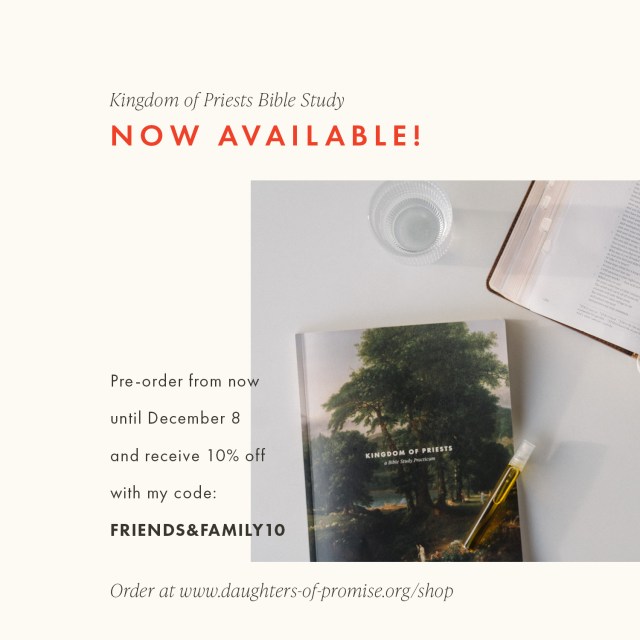
This why I’m SO excited about the new Bible study guide, Kingdom of Priests! And until December 8, you can use a discount code to pre-order it: FRIENDS&FAMILY10. Run and get it for yourself and your friends, your small group, your neighbors. This is a meaty, serious, solid guide that you can take with you and be fed. A bonus for me is that my good friend Kristi wrote it, so I loved hearing her voice in it!

As a pilot tester, I got to do five of the ten lessons in the book. I loved the scope of the study, and how it explores the theme of priests from Genesis to Revelation. For years, I’ve been been thinking about the theme of temple—the places where we meet God—so studying priests fit perfectly into my line of interest.

The last few weeks, I began each day doing part of a lesson, and later, in the cracks of the day, my brain was pinging with ideas and words and concepts about priests and temples, the ways God shows His glory, the ways fallible humans represent God to their world. How does He trust us with so much! I kept thinking how much dignity and worth this calling of priesthood gives every person, how much responsibility women carry to represent God well regardless of their life calling.

In addition to probing the specific subject of priesthood, each chapter/lesson introduces a tool or a lens for exploring any Scripture passage. This gives readers ways to study themes and passages of their interest, ways to teach Sunday school, and methods to study or lead Bible studies.

Probably the biggest weakness with women’s Bible studies is that we rush from the text to ourselves. We think “What’s in it for me? How does this speak to my situation?” I think that’s why those cutesy titles are wrong: they serve the reader who loves coffee or puppies instead of calling the reader to serve the text and its intentions.

Instead, we need to come to Scripture asking “Where is God here, and how is He revealing Himself? What is the author’s intent? How can I align my life with the ways God reveals His heart in His story?”

Imagine the results if women would sit in circles to explore these questions instead of talking about recipes and décor and gardening—all worthy topics in their places—but let’s not give ourselves a pass from studying Scripture, shrug, and say we’re not theologians or leaders. We ARE theologians—priests—in all the ways and places that we represent God to our world.

He doesn’t require us to be perfect, silver-tongued teachers, but shouldn’t we aim to be the best representatives of God we can be?

What They’re Asking

sven-6h6eXFQ239E-unsplash

Photo by Sven on Unsplash

This poem refers to Britt Marie Was Here, a novel by Fredrik Backman. I didn’t love the story, but Britt Marie’s empty, desperate life pierced me. I felt that her hunger was not as odd as it might seem, so I wrote this response.

Britt Marie displaced her husband’s shaver
So she could hear him say her name
To ask where it was.
He didn’t say it nicely
But it was her name and
When he said it
She knew who she was.

Backman’s novel is truer than fiction
And older than Enneagram numbers
Because women have always
Wondered and wandered
To voices that grunt, nod, or whisper
Answers to their questions that echo
Echo over oceans, porches, trails, cereal bowls—
Do you see me?
Am I beautiful?
With this mole and with this limp
And even when I can’t see you and
With that mistake—
Do I matter?
Can you read my voice?

I don’t know and I can’t hear and
What did you say?
If you said yesterday
That I’m the sun and moon to you
I wonder if today it’s true.
Do you see past my brain to my pulse,
And what do you see there?
Is it pretty? Do you like it?

She may not mouth the words or
Trust her lisp to ask
But she puzzles, dreams, doubts,
Whoever she is—
The lithe bride, the mall janitor,
And the receptionist’s hello—all ask,
Sotto voce, just like
The sparky barista, the wallflower,
And the social butterfly
Who visits all the sweet spots.

She never displaces a shaver
But she still listens
To be named,
Seen,
Belong.

Always A Bridesmaid and Never a Bride

12698453_805008379644694_4219333476885333484_o (1)

Last week, my good friend Shari posted a guest post I’d written for her blog. I wrote 500 words about something I don’t hear a lot of conversation about. I wasn’t planning to post it on my blog, but here we are, in a more-or-less quarantine, on-line more than normal, with more free time than normal. I don’t usually ask for interaction from readers, but there again, we’re breathing different air right now.

So let’s talk.

“My church doesn’t know what to do with me.”

I’ve heard this line from singles many times. Maybe it’s the default setting in a sub-culture that greatly values marriage and family, but it always makes me sad. However, I’m deeply grateful for a church that gives me a place and lets us singles feel welcome, equal, and human.

Some things they do to give us a place:

  1. The ladies look for ways for us to be together—ladies’ evenings when the men have brother’s meeting, women’s retreats, extra ladies’ nights when we relax and laugh and tell stories.
  2. The men meet my eyes and shake my hand after church. They regularly publicly honor and praise single and married women’s contributions to the families, school, and church.
  3. Families invite me for meals and tuck leftover food into my bag as I leave because they know I don’t have all day to cook.
  4. They treat me like an individual with a life: they remember my birthday and ask about my family. They care about my dreams.
  5. The men generously give advice and assistance in their area of expertise: purchasing and maintaining a car, phone, house, or garden, which can include pest control, yard work, or a mechanic’s number.
  6. They send us reports of member’s meetings.
  7. Church treats us like people who have something valuable to contribute, and so we’re on the hostess list and the church cleaning list and the list of people for jobs on reorganization night. And no, I don’t like the job they gave me but it means they believe in me.
  8. They compliment my clothes. They remember I was gone last week and ask about the trip. They remember to ask about things we’ve talked about before.
  9. They don’t ask us singles to serve the Valentine’s banquet.
  10. They invite me to join their family in the fellowship dinner line.

Some time ago, in another place, I was helping to host an event and several men acted as if I wasn’t there. Were they wanting to prove their loyalty to their wives? Was I intimidating or dangerous? I got a taste of my friends’ lines: “They don’t know what to do with me,” and I felt newly thankful for the conversations, camaraderie, and support the men in our church give to me and other single women.

A key part of this is that healthy relationships are two-way streets. I aim to give more than I take. I need to contribute, not just consume. I must plug in, make effort, invest, because the good life is not about me and my comfort. I often don’t feel like going to cell group or bringing food for an event or doing my assigned job, but who does? And who will have the richest life—those who stay home and curl into a ball when they feel like it, or those who push themselves to do hard things and love their people?

It goes both ways, but if you know a single in your church, think about how you could love her well and let her feel like she matters and belongs.

Now back to you:

What would you add to this list of 10? Which ones do you feel aren’t important?

What keeps you from engaging with someone with a different marital status than you?

What do we single women do that makes us seem threatening or dangerous to men?

To be clear: extended singleness isn’t the worst thing that could happen to a person. It’s not a crisis situation, and there are much, much worse, harder scenarios to live in.

But singleness IS a disenfranchised grief. There are no sympathy or thinking-of-you cards that address it, and singleness doesn’t keep getting better every year like a good marriage apparently does. So it’s a lonely place for most of us, and one where good role models are scarce, and it’s hard to talk well about it without sounding bitter or desperate.

So.

Let’s hear each other, ask questions, and walk toward wholeness and mutual understanding. This isn’t a platform for bitterness or accusation. We all need each other and we’re all far more alike than we are different.

We all want to matter, to make a difference.

We all want to know we’re beautiful and loveable and not obnoxious.

We all are hungry for more connection and less isolation.

What would you add to the lists of commonalities and ways to integrate?

Giving and Receiving Life

Recently at work, when sending an email to over 60 people, I made an innocent but dreadful, mortifying mistake. While I was writing the message, intending to send it with Mail Merge, I didn’t realize Word was tracking all the changes, and the message went out with red lines and replaced red words all over it. It looked like a something a child would do. It looked confusing and ugly and awful, not like an informative message.

I saw the first message in my sent items, in shock and disbelief and horror, and started wailing. Loudly. Luckily, the office was empty except for Lucy, who came running. I showed her the garbled messages, still trickling into my sent items. “I’m so sorry,” she said, and started rubbing my shoulders. “It’s really going to be ok.” But I couldn’t believe her, and the shoulder rubbing wasn’t calming me down.

Then my phone rang. It was one of the recipients. “I just got your email, and in case I was the first person you sent it to, it looks like there’s some problem with it.” I wailed and whimpered to her, and she was very sympathetic, and while we were still talking, my inbox pinged. It was from another recipient: “Am I supposed to respond to this?” His bluntness and confusion tickled my fragile emotions, and I started howling with laughter. Thankfully, it was a perfect storm in that my message showed simple, honest editing, and nothing incriminating.

But still. It took me at least 24 hours to recover.

Later, Lucy told me, “I felt so bad that I couldn’t help you feel better and that it was someone else who made you laugh.”

But Lucy was wrong because she HAD helped me enormously. She’d run to my desk the second she heard me wail. She’d asked questions and heard me out. She kept me from needing to process the stress alone. That was what I’d really needed in that moment. Later that evening, she brought it up again to see how I was.

There are older and wiser people who’ve said this with more explanation and insight, but my simple way of saying it is: Women need to talk about their experiences, and an experience isn’t complete until they talk about it.

What Lucy did that evening is one example of what many good, wise, solid, life-giving people have done for me all my life.

Talking is how we experience life. We talk about the details, the best parts, the worst parts, the emotions, and our responses to an experience. We tell the back story and the spin offs and the lingering questions. Sometimes we get a bad rap for it and sometimes we deserve that, but usually we’re just women experiencing life more broadly by talking about what just happened.

We tell someone about what just happened because we can’t just stay quiet about it. It happens every day all over the world:

  • letters, texts, and status updates
  • school children coming home from school talking about the day
  • pictures and crummy, topsy-turvy, jerky videos sent to friends
  • strangers talking to strangers in waiting rooms and grocery check out lines
  • phone calls and Whatsapp voice messages

I hear and read:

  • in a Facebook group post: “This is off topic, but I just had to tell someone.”
  • “Can I tell you about what happened when I was at home?”
  • “Thanks for listening. I just had to talk about it. I feel better now.”

The internet takes this to another level and feeds on our inherent narcissism and loneliness, but I want to say that it also taps into what is innately human: that we are more whole and balanced when we tell someone else about our experience.

I’m not promoting navel gazing and endless self-expression. I’m not encouraging everyone to start an Instagram account. I’m saying we are better people for getting out what’s simmering inside, and when we tell someone about it.

That’s why journaling is so therapeutic. It’s why children want to tell about what they saw on their walk to the barn. It’s why I tell my friend how blue the sky is. It’s why debriefing after a traumatic or unusual event is so healing. (It’s why I LOVE Whatsapp: I can talk to my friend about what’s going on and she can respond when she has time, and I don’t feel like I’m imposing on her.)

Sometimes you don’t have time or energy or opportunity in the moment to talk about what’s troubling you or making you ecstatic, but at some point, it needs to come out. There are women who talk all the time only about themselves. That’s not wise or healthy. There are seasons when you feel consumed with your latest crisis and feel more needy than you like, but hopefully that’s a season, not the shape of your life. In the talking and processing, it’s a good rule of thumb to talk to someone, or write them about whatever is simmering, or journal it out, before putting any of it on the interwebs.

There are two sides to this kind of life-giving exchange: the speaking and the listening.

If we live life better and more fully when we talk, we also offer life to others when we give them opportunities to talk. It’s very simple. It just takes time and ears and lots of heart. Oh yes–and staying quiet and not finishing the other person’s sentences are the skills I’m working on. I think the most whole woman has people she talks to and people she listens to.

I think about what I’ve heard from those inviting me to talk:

  • I want to hear what happened yesterday!
  • You said something about ________. Tell me more.
  • What did you mean when you said that?
  • What are you feeling now?

We can give life with words like these.

Women are good at talking and we are designed to be life-givers. What would happen if more of us would give and receive life by inviting and listening well, and also giving ourselves permission to talk to someone else?

I wonder.