How does God host us? How does God’s woman host? I think about this often and I don’t have all the answers, but I’m sure that part of hospitality involves our own person and how we bring ourselves to the space we’re in. We can be should be hospitable outside our homes and welcome others into our presence in casual, brief interactions, such as with the shelf stocker in the grocery store or the hostess who seats us at a restaurant. People always deserve our respect and love, and presence and conversation is a gift we bring to our world and that’s why I refuse to use an automatic checkout unless someone’s waiting for me. This story of hospitality on a sidewalk happened to me over a year ago and its beauty will always stay with me.
The pair caught my eye as I sat at the table with my friend Melody outside my favorite coffee shop in Pittsburgh. The lady was largely pregnant, in a soft teal green sweater dress stretched over her stomach. Her husband’s hand reached protectively to support her back as she stepped up on the curb then into the cafe. Minutes later, I noticed them leave, coffee cups in hand, walking as if every step was a gift.
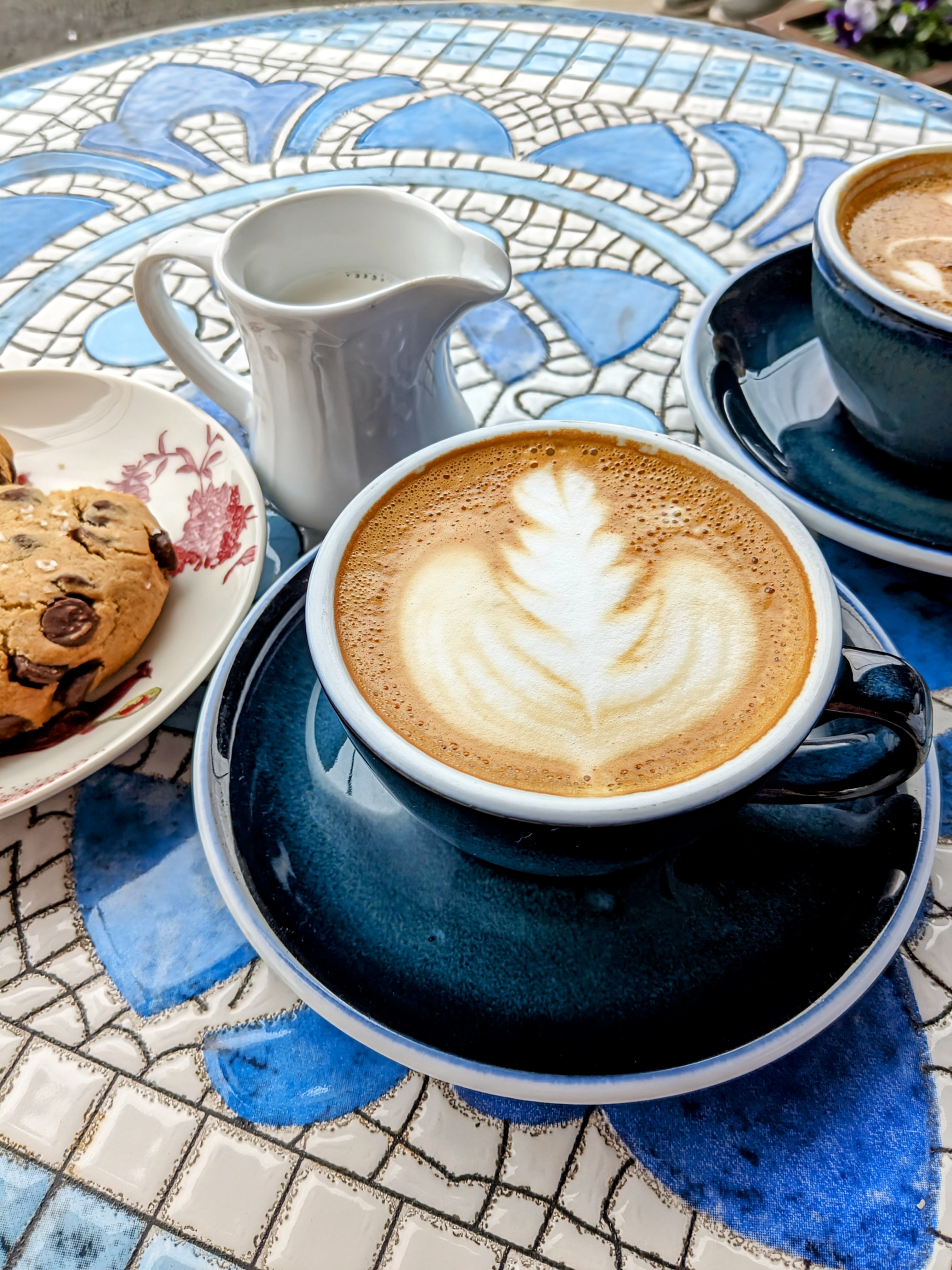
Melody and I finished our gorgeous, rich cortados in gorgeous, bright blue pottery, ambled through a funky, fun doughnut shop (Peace, Love, and Little Donuts!), then around the corner. Ahead of us walked the young couple I’d noticed earlier.
We quickly caught up with them because they were taking their time. I turned my head because I heard Melody say something but she wasn’t talking to me. She’d asked the lady when her baby’s due.
The man and woman stopped as if glad for the break from walking. Their friendly, open faces clearly wanted to exchange more than polite pleasantries. “I’m due on Sunday, Mother’s Day, so we’re just walking to pass the time. Do you ladies have any advice for a first-time mom in labor?”
I’m always surprised when strangers expect me to have a family, but I said nothing and Melody answered as if she was waiting to be asked, her eyes warm: “Well, Jesus endured the cross for the joy that was set before Him. Childbirth is like the cross and its pain, but we endure it for the joy that’s coming.”
The young mother nodded and her husband said, “You’re right. The Gospels talk often about the Christian experience being like childbirth.” He quoted several lines and his wife nodded.
They clearly wanted to talk more, so we introduced ourselves and said where we’re from. They were Catholics from a neighboring town, and they farmed with horses. The four of us stepped to the side so we wouldn’t block the sidewalk. We could’ve talked a long time; they were so engaging and thoughtful, but they needed to keep moving. We wished each other God’s blessings and walked away.
Later, I was curious, so I asked Melody why she referred to Jesus so quickly, before she knew they were believers and would give credence to what she said. “I saw such openness and gentleness in the man’s face, and I felt free in my spirit to quote from Hebrews.”
We wonder where they are now, this couple and their child, and we treasure that conversation on the sidewalk. Poet Danusha Lameris calls these brief moments of exchange “dwelling places of the holy” and “fleeting temples” because for just a few moments on a spring day, we recognized the presence of God on a dirty, common sidewalk. This is what hospitality and welcome can look like as we live with open hands and open faces.
For whatever reason, I don’t love liturgical experiences. I can be ok with liturgy in some contexts, but I usually find it too confining, too structured for my heart to feel at home in.
There. I said an uncool thing.
Even so, I love following the church calendar. Especially I love following the seasons of Advent and Lent. Western Christianity tends toward appearing glossy, smooth, smiley, and satisfied, and it tends to not account for or acknowledge the crazy hard, bewildering, unfair parts of life. It sings “trust and obey, for there’s no other way to be happy in Jesus” but I often wonder–what does ‘happy in Jesus’ even mean?
And if you sing more of that song, you come to “Not a shadow can rise, not a cloud in the skies, but His smile quickly drives it away” and you think, “Well… it’s not always been that quickly for me.” However, sloppy theology in songs is another subject for a braver day.
Advent and Lent give 28-40 long days to sit with the unaskable questions we hold. Advent and Lent let us name our hopes and fears, our anxieties and obsessions, and our longings in a dark season that is aching for the light of Christmas and Easter. These generous weeks in the church calendar give us space to lament–an essential part of the human experience–at least for the human who wants to be whole and healthy.
Lament is not a pity party or a sob story that wallows in misery. Lament is a gutsy wail that says not all is as it should be and I don’t like it and this stinks. People who deserve babies can’t conceive and people who deserve to die keep on living and people who deserve to live suddenly die and none of it’s fair or right or beautiful.
Maybe you thought being happy in Jesus means never saying any of this out loud and especially not to God. But if you can’t name your questions and put words to what feels grossly unfair, what does ‘healthy relationship’ even mean?
The difference between lament and self-pity is that lament turns toward Jesus and self-pity turns inward and spirals down. Lament goes somewhere with its sorrow and it wrestles and groans, sometimes for a very long time. It does not insist on always being polished and presentable and it does not follow a timeline.
But lament is a season, even though it doesn’t listen to any kind of time limit. Christmas and Easter come at the end of that season, and they remind us that it won’t always be winter, barren, dark.
Lament howls around for however long it needs to but because it turns toward Jesus, it finds comfort and soothing–eventually. This is a deep knowing, a solid confidence, a quivering consolation in the person who knows so much about grief that He’s called the “Man of Sorrows.” You can hold that reality close forever, and you have my permission to never sing “happy in Jesus” again.
If we’re honest with ourselves, we’re not always happy, and we are all waiting. We are waiting for many joys that Jesus also longs for. Just because He’s God doesn’t mean He gets what He’s waiting for either.
When Lucy met Mr. Tumnus in Narnia, he told her that it’s always winter and never Christmas. I think about that these days on my walks in the icy cold and I hear a stream trickling under the snow. The sound tells me that Aslan is on the move and Christmas–joy and feasting and merriment–is coming, and I don’t only mean smoked salmon at breakfast and turtle cheesecake for second breakfast.
This last night of Advent, I wish for you bright, shining tomorrows and the dripping of ice even in your lamenting, even in your waiting.
Last week, this post gave the first part of this article on “home.” It introduced the idea that God cares that home creates comfort and safety. One day in chapel this week, we read Psalm 27 and my brain starting pinging when I saw all these words about God’s home: house, temple, dwelling, tabernacle. This concept must be important to God. I wonder how that should inform how we live, how we see the church and individuals?
Rublev’s “Trinity”
Creating welcome for the stranger
In addition to creating comfort and safety, God designed the home to create welcome for the stranger.
The picture of Revelation’s wedding feast shows us a place of welcome, generosity, and abundance. As we reflect God’s character of housekeeping, we can offer His warmth and welcome by embodying hospitality in our physical places. This can reach beyond walls, doors, and a roof.
In Free to be Single, her excellent book now out of print, Elva MacAlister points out that even when I walk across a college campus and fall in step beside a friend, I can welcome them into my space, my personal bubble, and show them hospitality as we walk together. Our personhood, the space we take up on a sidewalk or a car or a park bench, can be a place where we embody welcome, care, and interest in this person at this place and at this time.
God’s spaces reflect His selflessness, His intention toward people, and His deep care for us. We are most like God when we focus on others instead of our default selfishness. This is the biggest part of being hospitable.
Creating our spaces in pressure to compete with the latest influencer or neighbor will drain us instead of help us thrive. On the other hand, creating home as a place to welcome the stranger, which is really anyone, frees us to express our individuality in ways that help our people feel at ease, loved, and refreshed. One homemaker will prioritize plants and toys while another puts her energy into minimalism or coffee, but each can be responding to God’s direction to create order and welcome the stranger.
Home looks different for all of us, depending on our ages, seasons of life, and native abilities. But Christians can always reflect God’s homemaking skills in ways that make order out of chaos and offer life and beauty to people.
Trinity is an old painting by the Russian artist Rublev that moves me deeply. Showing us a peek into God’s character, the medieval painting depicts themes of fellowship, unity, order, and hospitality. Three angels sit around a table at Mamre, while Abram, childless and out of sight, prepares a feast for them. The angels represent the Trinity, a unit of perfect love, fellowship, and safety. They graciously accept Abram’s eager hospitality. Abram, is, after all, reflecting God’s generosity and care, demonstrating what He knows about God’s character.
As homemakers made in God’s beautiful image, we extend, arrange, offer safety, and create homes because we first receive it from God’s heart. Rublev’s Trinity shows how home, fellowship, and hospitality comes full circle: we receive and offer in response, we give out of what God gives us, and we can never out-give God!
Is home a person, feeling, or place?
When I look at the glad fellowship of the Trinity and see how Jesus showed us the Father’s face in a particular time and place in history and geography, my love deepens for the Father, Son, and Holy Spirit, and I discover my true home. In the Trinity’s circle of beauty and truth, home is a person, a feeling, and a place. Because I’m in a body and not only a soul, I learn from God that place, stuff, food, furniture, things I touch, all matters because it matters to Him.
In the trailer we rent, our shared space isn’t trendy or influencer-worthy, but my housemate and I try hard to blend our differing color preferences, use indirect lighting, white walls, original art, and plenty of blankets within reach to make a comfortable space for ourselves and our guests. I like to put tea and scones on the battered coffee table so that people don’t have to move far for it, and they can prop up their feet wherever they’re comfortable. Friends often step from the porch to the living room and sigh “Oh, this looks so warm and cozy” which is exactly what we want them to feel!
Does home matter to God?
God cares deeply about home as a place of safety and welcome.
In a world that’s constantly degenerating into entropy and disorder, God’s people have a high responsibility to bring beauty, order, and welcome wherever we can. Women (and some men!) are especially good at this, regardless of their personalities or Enneagram numbers.
Of all the careers you’ve dreamed of, imagine reflecting God’s character of being a home-maker!
I wrote a book about living well in a place I hadn’t planned to be. Turns out that’s where a lot of us find ourselves. You too? Order your copy here!
Over two years ago, the lovely team at Daughters of Promise asked me to write a thoughtful, theological article on home. It was to explore this question: “Why does home matter in the bigger context of God’s story?” It was a new idea to me, but I quickly got excited as I began to study and ask questions about home. Since then, it has become something I think about often and take notes about and dream of expanding this article to something significantly more substantial. For example, what is special or significant about women in their ability to reflect God’s character as homemaker? And how does mundane, unseen work become meaningful when we think of ourselves as co-creators with God who is in the business of making all things new–pushing back entropy? So many rich questions to untangle! But that will be the work of another several years. For now, here’s the original (slightly polished) article, coming in two parts.
Is home a person, feeling, or place?
As a third-culture kid who feels at home in multiple states and countries, I have wrestled with this conflicted question for years.
If I don’t have a home, does it matter?
Is something important missing from my personhood?
Does God care about home since my homes have been so interchangeable?
I walk in a refugee camp in Greece and saw tents and blankets for houses. Under news headlines, I see photos of tent cities sprout up in Syria after another earthquake. I have suffered nothing like these beautiful people have, but I know the search for home. I’ve wondered if it should matter so much to me, and if home even matters to God because there are a great deal of other big questions that need His attention.
But when I observe people, listen to their stories, read literature, study the Bible, and cringe when people ask me where I’m from, it’s clear: home matters.
The immense disruption, disorientation, and restlessness over the loss of home shows me that home is important, does matter, isn’t a question to hush and try to forget.
Home can be a person or a feeling. But seeing God’s heart in the Biblical stories of Genesis to Revelation, it seems clear that God cares enormously about home as a place.
People and feelings do matter to God, because He says much about how to love Him and our neighbors. But He also holds place as very important, which gives us a way to think about our homes as places that matter to God.
In spiritual matters of the heart, we tend to live in our heads and work hard to think kind and gentle thoughts and nurture loving and patient attitudes. But in physicality, in places, our thoughts become embodied and visible.
For this and many other reasons that I’m still exploring, matter matters.
Bodies matter.
Places matter.
Home matters because God cares about physicality, clay, dust, tangible pieces of His creation. The incarnation of Jesus proves that, in case we doubt whether God values physicality. Jesus’ body, His dusty life as He touched people and got hungry and tired, elevates for us the gritty reality of matter, stuff, tangible pieces of living.
Once when I was reading John 14, I actually gasped when I read verse 23: “We will come to him and make Our home with him.” Jesus is talking about Himself and His Father, and He’s saying they are homemakers!
What kind of home do they make? How do they work together? What does their home look? They’re making their home in me? What does that even mean?
God’s homemaking in me is a spiritual reality with profound significance that ripples into physical reality even when I’m not conscious of it. Further, when I know something about His character and get to know Him as a homemaking person, I can grow in reflecting that part of His character.
Like elegant bookends, the special, prepared places in Genesis and Revelation show us what God thinks about home. And in between those places, we see many ways and times where God valued home as a physical place. He asked Mary to give a home to His Son Jesus, and placed that home first in her womb, then in Nazareth, specific places at specific times. God ends the Biblical timeline with a picture of our eternal home, a place too wondrous to describe, but we know it includes a wedding feast (I think there will be lots of cake!), cultural diversity, a river, and a fruitful tree. All these scenes happen in specific places, not just in our heads.
As I study the Bible and get to know God’s heart, I see His homemaking reveals many things about His character and here are just two:
He creates order and safety
He welcomes the stranger
This concept gives me goosebumps because these characteristics are beautiful and actionable for all of us!
Creating order and safety
God’s design of home holds an atmosphere of safety, rest, and belonging, seen both in Eden and our eternal home. God crafted them as places for fulfillment and fellowship where humans and nature can flourish and expand to their fullest capacity.
Home is a nest that protects fledglings from storms and predators. Home is a fuzzy blanket that wraps children in warmth and keeps out the world’s cold, hard edges. Home is the inviting smell of gingerbread baking. Its physicality engages all our senses and grounds us in this place, right now. Its daily, weekly, annual rhythms shape our neural pathways and linger in our subconscious.
In the absence of safety (wars, famine, abuse, neglect) humans tend to become less-than-ideal versions of who they were intended to be. The loss of home as a place is one reason refugees and natural disaster victims turn to violence and become people they would otherwise not be. In addition to suffering from emotional and spiritual damage, their material losses devastate their lives profoundly because physicality matters. No one just lives in their head.
But in safety and belonging in physical spaces, we flourish because that’s how God designed us. It’s the kind of homemaker He is.
From ages 35 to 41, I lived in five places. In each place, I arranged furniture, organized a kitchen with a housemate, and found a rhythm of keeping order that worked for that season of life. Then I walked away from it, left the stuff behind me (except for a mug or two), and started over in the next place. By the fifth place and the third country in six years, I wanted to think that home and belonging didn’t matter because it was too hard to reckon with all the loss and change I was living in.
But I’ve come to see that those transitions were so shaping and impactful to me precisely because home is so important. I couldn’t brush off the loss of home as if it didn’t matter.
The longing for home and belonging is an ache as deep as time. The loss of home is probably one reason Cain cried when he realized would never belong anywhere and would live in a place that means “wanderer.” We were made for home as a place that provides context for the connections in relationships that make us better people. Even literature knows this. Think about your favorite stories and books and how they center around the search for home and belonging.
The Odessey
Anne of Green Gables
Hannah Coulter
Gilead
News of the World
To be clear: home is not the most defining thing about us, but it IS basic to the need of our flourishing. This need doesn’t require us to live in one place all our lives. But creating home as a safe place to thrive means we can order our present spaces in ways that are restful and calming wherever we are.
When God gave humans dominion over creation, He was letting us be homemakers, designers of places. He was setting us free to innovate, create, and bring order out of the chaos that cascaded out of the fall. He could have regimented every part of keeping the first home, but He didn’t want Adam and Eve to be robots. Every healthy person carries some capacity to create, experiment, and maintain (“dress and keep”) home. As we carry out that work, we become better people ourselves and provide a comfortable, organized environment for others to flourish.
Up next Friday: Home Matters Part II, Creating Welcome for the Stranger
I wrote a book about living well in a place I hadn’t planned to be. Turns out that’s where a lot of us find ourselves. You too? Order your copy here!
When I read Ultra-Processed People, (which every American should read, by the way) I was dismayed to find out that exercise doesn’t automatically burn up the calories I consume. For example, when I eat a Snickers bar then compute how long I need to walk to burn those calories, my walk will benefit me, but not by erasing those yummy junk calories. The math doesn’t math that way, which is deeply disappointing to me and also proves that numbers hate me.
Ultra-Processed People shook me for other reasons too, which I won’t go into here except to say that after you read it, you will often ask yourself as you eat, “Was this food made with love to nourish me or made by a company that wants to make money off me?”
Back to NOT walking off the calories from a Snickers bar: the author says walking has many benefits even if it doesn’t consume the calories I wish it would. Even though I’m mad at numbers, I absolutely agree that walking benefits me in many ways.
When I think back to very dark seasons of distress, I remember that the times I was most calm and at peace were when I walked down the road to the sea or when I went swimming in a cove. Back then, I thought it was the sea that calmed me. But now, connecting the dots in retrospect, I know it was the physical movement of walking or swimming that ultimately regulated me, and my body knew what it needed more than I did. This is the road with the sea at my back:
Years later, when I was new to northwestern Pennsylvania, I was telling a friend how hard it is to survive the long dark winter. (In dramatic moments, I know we have nine months of winter in the year.) She suggested I take 15-20 minutes to walk right after lunch when the sun is at its highest. It was the advice I needed, and it has served me enormously. Most days, I’d invite my co-worker friend across the hall to go with me. Sometimes, when I knew she was having a stressful day, I used stronger language and insisted she walk with me. We’d walk in all weather except rain.
When we were scrambling to begin working from home during COVID, the first thing I put in my schedule was two walks a day: one with my co-worker and one alone. Two daily walks was the best decision I made in that season.
For years, lower back pain bothered me. Sometimes it was better, then worse. One chiropractor said firmly, “You could walk this off.” I was glad to know, and walking regularly is probably why my back doesn’t give me trouble now.
In another difficult, overwhelming season, my doctor (and I) didn’t want to put me on anti-depressants, but she suggested daily walks. I told her I already walk, and she cheered. “And look up as you walk—45 degrees slanted up toward the sky. There’s a reason the good book says to lift your eyes to the hills!” and she swept her arm up from the horizon. I try to remember her advice when I walk. Looking up exposes my eyes to more light and Vitamin D. But I suspect Psalm 121 intended even more than those physical benefits.
I’m the pal who drags her people out for a walk after a meal even in the middle of winter. You don’t feel like going, it’s true, but after approximately five steps, you already feel better. You take longer, deeper breaths, you notice birdsong and the sky even if it’s gray, and when you get back you never wish you’d have stayed inside. Never. For real.
Walking rests my brain. Some of my best ideas come on a walk. It’s probably something about the cross-pattern or rhythmic movement or not needing to concentrate or increased oxygen or change of scenery.
My current walking place is nothing like where I walked in Ireland, and this is sad. But it’s green and has wildflowers in every season and wild apples and white aspens. Sometimes I do a color walk, which gives me new eyes to see the ordinary.
Silence is a practice I stack with walking. In the morning, if I’ve been listening to a podcast or audio book as I fix my bed and pack my bag, I turn off the audio at my door. I step out the door in silence, walk through the morning in silence, walk the scenic route to my office in silence, stop to see the sun and sky and trees in silence. In the evening, I might listen to or send voice messages as I walk, but not more. I need silence to give a chance for some of the open tabs in my brain to close. I need silence for thinking space and for rest. Deep work calls for deep rest, Aundi Colber says, and silence is restful. If it’s not, it’s probably time to sit with it and ask it why.
Because I benefit from the social, emotional, physical, and spiritual results of daily walks, I think everyone else should walk too. If it’s too warm to walk at noon, walk at golden hour when the sun is less direct. Or walk in starlight, which is its own magic and calm and wonder. And if you can’t walk, do stretches. If you can’t stretch, do deep breathing. Or sing. The breathing, rhythm, and focus on something outside yourself will benefit you in surprising ways.
If it doesn’t, come talk to me! You know we’ll go on a walk to figure it out.
This poem came out of a prompt in the writers’ circle I’m part of, led by Rachel Devenish Ford.
I bring whimsy and laughter and hugs—
Here, have one!
Today’s too beautiful for dour, dry words and
We are delighting in spring’s light shining in eyes and
Music sparkling from fingers,
Colors spilling from dresses that drape and swoosh
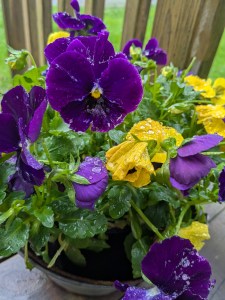
Like pansy petals.
I bring cake and songs and glitter pens for everyone.
I bring questions and ache—
Here, take it—it’s heavy.
Today’s too sad for songs and
Questions rumble over trite answers and
Scattered bits of blue eggs dry in their yolks on the ground and
A storm blows disarray over the whole globe,
Smashing like feral bulls seeing red, pawing after power.
What I asked for didn’t come. What I hoped became impossible.
Celebration and sorrow.
I bring both today.
I wrote a book about living well in a place I hadn’t planned to be. It explores the curious mix of holding both joy and sorrow at the same time. You can order your copy here!
Years ago, I stood in a crocus field in Holland. Our bulb farmer friend showed us the heating pipes that ran under the acres of rows of dirt. These heaters boosted the soil temperature for crocuses to give them a jump start on their competitors.
But before that luxurious spring came winter. Our friend showed us the buildings with huge coolers that forced winter on the bulbs. He explained how essential it is that the crocus corms were kept at a specific cold for a specific length of time. Without this carefully- designed winter, the crocuses wouldn’t produce well later even in their deluxe spring bed heaters.
I often think about that compulsory winter for the wrinkled little bulbs, and I wonder about my seasons and my flourishing.
Right now, it’s winter above the equator and it’s a beautiful one. Every morning I thank God for warmth and light and health and quietness–gifts that many in the world don’t have. For months, I got to watch the black sky turn to periwinkle then I put on boots and many layers of clothes and walked to work in fluffy snow. It was like a storybook. Ok, sometimes now it’s slush, not snow, but still. This winter has treated us exceptionally well.
Some of the best moments were when I walked in falling snow. Or made a snow angel then stayed and watched downy flakes fall and fall on me. It was so quiet relaxing, I understood why one would want to curl up in a snowbank for a nap.
This winter kept on being beautiful. But winter isn’t always white and peaceful, either outside the house or inside the heart. Sometimes more accurate words for winter are
bleak
howling
dark
ghostly
empty
ugly
parched
barren
Winter can be a season in the calendar or of the soul. It is never warm breezes and pink blossoms. I see no beauty in gray, bare stalks and trees. I find no joy in husks of stems and leaves, mud, and thick clouds at high noon. Winter feels like wasted time, pointless, empty, and, worst of all, ugly.
I have found no fast cure, no quick ticket to a warm spring and billows of blossoms. Winter is a season, a rhythm that comes and goes without my permission. I can only control my response to it. So, after many years of resenting winter’s darkness, I’ve come to try to befriend its hostility.
I bought a long down-filled coat and ear muffs and when I wrap my scarf around my neck and face, the cold can hardly get me. I light candles and read and drink tea. Or host friends or bake bread to give away. Or go to bed early. Or play with watercolors or words.
It’s a mindset I learned from Wintering: the Power of Rest and Retreat in Difficult Times by Katherine May. She explained how Scandinavians in their long winters make the most of the season instead of fighting it. Since it’s going to be dark, they insist on cozy lights. Since it’s going to be cold, they wear warm layers and snow boots. That approach has changed my life in northwestern Pennsylvania where winter stays for six months.
In melodramatic moments, I say that we’re in the Arctic Circle and sometimes see penguins. My impatience comes from having lived in Ireland where daffodils bloomed in late January and now I have to wait until at least April. But I also experienced SAD there and those winters were dark and rainy and I wanted to run away to Spain or Italy every winter.
The good thing about seasons is that they don’t stay. And they are part of a life cycle. Winter is not empty time, but a space to go still, like a seed underground. Winter is the creator’s answer to the longing to bloom. Winter quiets the seed, nests it safe, protects it from death while it rests. The husk of the seed does die. Death is part of winter but it is for the purpose of life.
Stillness and quietness works for seeds and people and their fruitfulness.
Have you noticed it? The people you know who are most luminous now have known long, cold, brutal winter in previous seasons. They had no timeline, no calendar to know when spring was coming. They couldn’t see progress or change in that darkness, but underneath all the layers, even in the dark and cold, life hadn’t stopped. The roots hadn’t withered.
I don’t say that glibly. Spring is hard-won. Winter seasons are intensely difficult, demanding, distressing—how many other D words?—dangerous, depressing, debilitating, dark, depleting, deserted.
Being chirpy about winter isn’t helpful. But it helps me to name what is true. And it helps me to know, in a dark season of famine and barrenness, that it won’t always be this way, that spring comes eventually. At some point, I know, water will trickle again instead of freezing.
Let me tell you an unbelievable secret. It’s so astounding, I have to whisper it because it’s so hard to believe. Last week it was zero degrees and as I walked gingerly over ice and snow beside the pear trees, I saw tiny swollen brave buds pushing out of the twiggy branches.
How is it possible? Buds when it’s below freezing?
There is something thrumming down deep out of sight, silent and stubborn: the insistence of life, the throb of light pulsing in the sap and bark and roots. Gnarled twigs hold veins of liquid that circulates in response to the lengthening frigid days.
Light will always be stronger than dark, sending warmth and vitality to the most hidden places. Even in the Artic Circle, the polar night shortens and daylight cautiously emerges. That mechanical Dutch winter those wrinkled, lumpy crocus corms endured became their route to flower.
I’m so curious about what fruits and flowers are ahead of us.
This is an old, out-dated poem, but it doesn’t go away. This is not a statement about politics but tears for the forgotten women and children suffering because of others’ arguments.
April 2, 2022
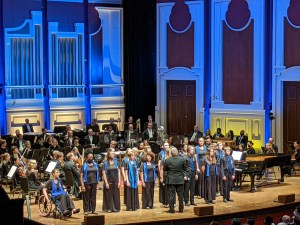
Orchestra musicians and choirs
Donated a free concert in aid of
Ukraine.
Guests waved blue and yellow flags,
Wore blue and yellow clothes
Or gorgeous flowy Ukrainian blouses.
No one clapped the whole evening
Until
Every song and every poem and the grand
Ukrainian national anthem
Faded into silence.
And then
The appropriate applause lasted for a long, loud time.
Surrounded with plush red velvet, dim lighting,
Glittering chandeliers,
We called this solidarity.
We called it respect. And it was.
And the music had been beyond beautiful.
But how does velvet sit in
Harmony with missiles and battered bags,
Fractured families, mass graves?
The irony, the audacity
Sits heavy on my chest.
And
Where were the charity concerts
For starving Afghanis hiding from their government?
I keep asking God to grow my trust in Him. It’s been my recurring prayer this year. Then He sent me a hummingbird.
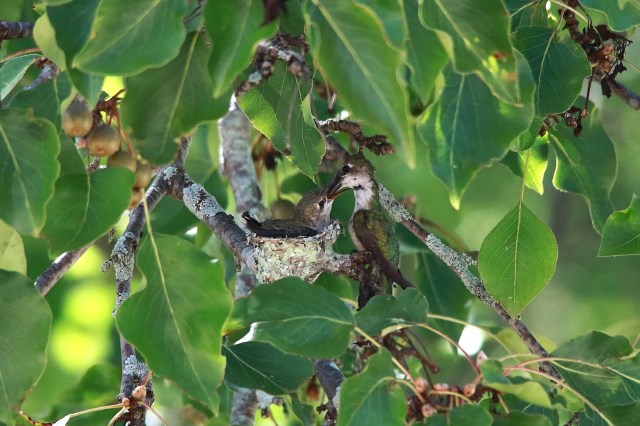
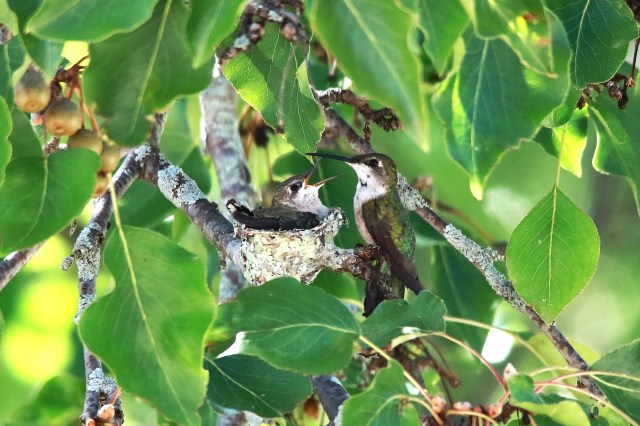
One day in late summer at my second story office, something kept flying in and out of my peripheral vision around the pear tree outside the window. When I stopped to look, I saw it was a hummingbird, and it perched on a branch that pointed toward me about fifteen away.
I called my coworkers to come see, and did anyone have a set of binoculars? The next morning, Sheldon brought his pair and we could see the little bird was clearly building a nest.
I can tell you that I watched a busy little hummingbird make her nest, but then I choke up and my eyes start leaking. I don’t have words to explain how beautiful it was to watch her. She zipped in and out all day, just outside my window.
A neighboring family from church—five little ones and their mom, avid bird lovers—brought their binoculars one day to watch. They told me she would build her nest from moss and spiderwebs.
Sure enough. When Danny*, my co-worker across the hall, got his big camera to capture the action, he caught a shot of a wisp of web on her bill and extra spider webs stockpiled beside the nest.
July 25, 2024
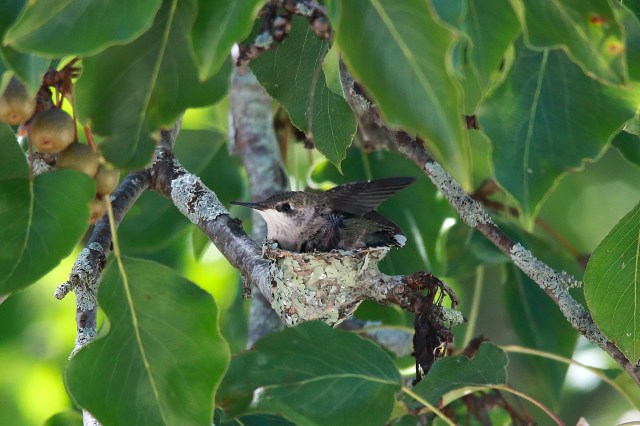
She used her bill to shape and punch and work her nest. She sat in it and scooched around in it to shape its bed. She used lichens from the tree for the outside of the bowl, which was a splendid camouflage. Often when people came to see the nest, it was hard for them to find it because the whites, grays, and greens looked just like the branches surrounding it. Her own green back matched the leaves around her. She was very watchful as she worked, constantly on the look-out.
I watched her build for two weeks. My eyes learned to know exactly where to look, and how to direct others’ eyes to find her. I watched for her partner with his ruby throat, but he never showed up. These are not romantic birds, I understand. Maybe it’s those bills.
Then she sat on the nest for two weeks. The nest was nearly eye level to us, and we wished we could look down into the nest to see the eggs, but we never could. It seemed significant that she usually faced away from my window and toward the tree trunk. I wondered if she felt that direction held her greatest threat, and our brick building with rows of windows felt safe enough to not keep an eye on it.
She was a distraction and many brain breaks and a deep message to me. She was teaching me something about how it looks to rest and trust. I wondered if she knew how small she was and how big the sky is, but she didn’t seem bothered. I couldn’t possibly survive in the wild like her, but I got a front row seat to watching her manage and thrive.
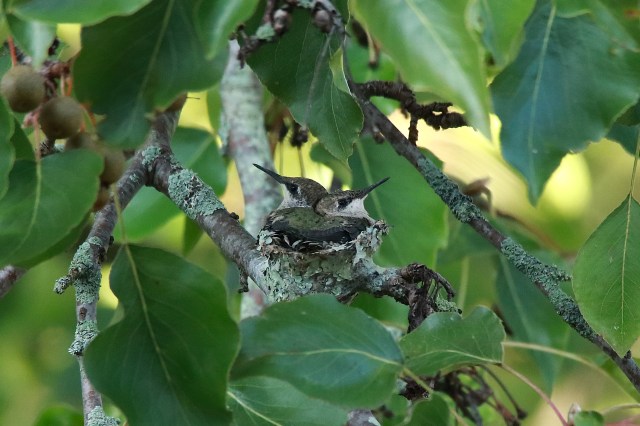
The eggs hatched on August 21 and she started feeding her two babies! It was unbelievable. How was it safe to poke her bill deep into her babies’ mouths? Where was her partner? How could she feed her babies alone?
September 2, 2024
September 3, 2024
Apparently, hummingbirds eat insects in addition to nectar, but still, how is it possible to supply the babies’ growing metabolisms and get them and herself ready to migrate? How can the little mites fly 1,000’s of miles south so soon?
September 3, 2024
Eventually, it looked like the babies were spilling out of the nest. We kept wondering how they practice flying.
September 3, 2024
We never saw the first one leave. Then there was one left. It perched on the edge of the nest and whirred its wings into a blur on and off for a whole day. The next morning, while Danny and I were watching, it hopped onto several branches surrounding the nest, then zoomed away. It took maybe fifteen seconds for it to hop out and decide to fly. We never saw any of them again.
I look out at that tiny, hidden nest every day and I miss that sweet little mama and her babies. I’m not a birder, but she was an immense gift to me this summer. She didn’t understand big words like camouflage or regurgitate or migrate but she knew what to do. In that nest, she rested and trusted something bigger than her.
This summer, it just happened that I noticed her graceful swoops to and from the pear tree. It just happened that I work across the hall from someone who likes wildlife photography and has the equipment for it. It just happened that another neighbor had binoculars that could sit on my window sill for six weeks. It just happened that a plucky little single-parent hummingbird chose a branch that made my office window the best vantage point. It just happened that Danny and I got to watch the last fledgling leave.
Now the leaves in the pear tree are slowly turning red and orange. It’s time for a new season. I understand that hummingbirds won’t come back to their old nest and I’m sad. But this season of watching those birds taught me something deep that I’m still mulling.
I asked for deeper trust and He sent me a hummingbird.
Once at the edge of a crowded Dublin sidewalk, I was waiting for the crosswalk. Just as the pedestrian light turned red, I started to step off the curb, intending to cross quickly before the traffic started. A tall man beside me put out his arm to stop me. His elbow grazed my shoulder. “The man who made time made plenty of it,” he said. I laughed, chastened with his Irish humor and forthright advice.
Turning 50 turned me both pensive and excited about time. We have plenty of it, yes. But time is a weird part of life that we can’t ever get enough of, and yet we’re sad we have it (At least, sometimes. It’s fashionable at some birthdays to be sad about another year.)
I feel an odd mix of exhilaration and bewilderment, and the puzzling compounds when people say they can’t believe I’m 50. “I’d have guessed you about 34 or 36,” they say, and they’re right: that’s how old I feel. But numbers don’t lie, and the math says 1974-2024=50. And what do my friends really mean? That I don’t act my age? How does 50 look? How does 50 live?
My cousin’s 12-year old thought I’m younger than his mom. I can understand him. I don’t have a husband or children, which is how one’s timeline unspools in his world, so to him, I’m just not old enough yet to have a family.
But there’s something in the wider air, beyond his cozy farming community, that doesn’t make sense to me. The math doesn’t work. It’s this:
Everyone is supposed to become the best version of themselves, grow, learn, develop, be all you can be. BUT don’t grow at the expense of becoming old.
Even if we don’t want grandmothers to be dressing like teenagers, we still have this deference for youth and beauty that we’re loathe to lose.
Youth and beauty are wonderful in their time. I live and work around 20-year-olds, and I love their wit and perspectives. But I LOVE being 50 and not 20! I have much to learn and hold many questions, but these 50 years have given me so, so much that I benefit from, give out of, and I would never want to go back to a smaller number.
Some mornings, though, it’s disconcerting to look in the mirror and see more gray hair, or to notice wrinkly skin on my hands. I don’t love that, or the gap in my grin because one year took a tooth. But when I take stock of the richness of my years, I can’t resent the gray and wrinkles. And I have seen repeatedly how a plain face becomes beautiful with a smile, and I don’t think my smile has to sag for a very long time.
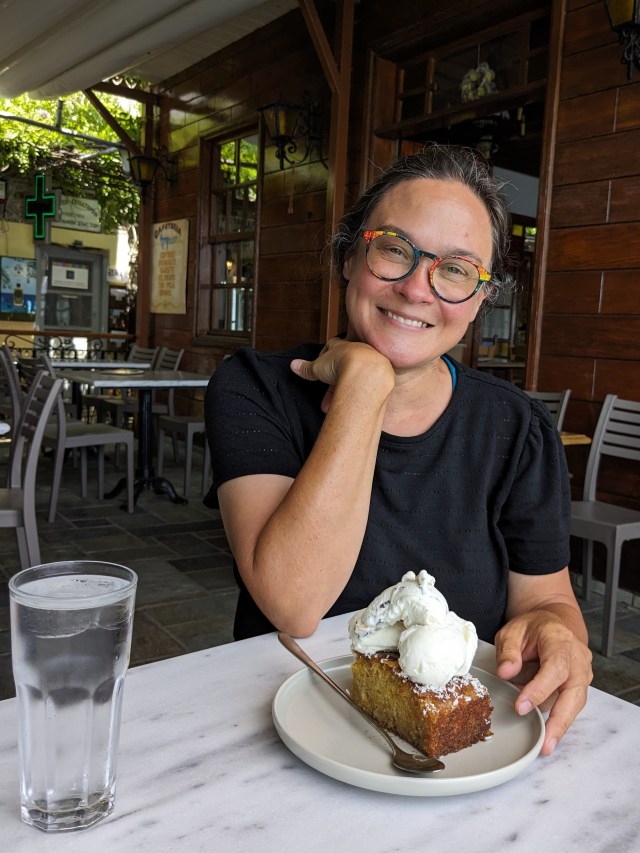
Partly because I think 50 is cool, and partly because I want to push against the worship of youth and beauty, I started celebrating my 50th birthday for the full year before my birthday, and past it. Because why not? I started by going to a wonderful concert in Carnegie Hall and wrote briefly about it here. I bought raspberry batik fabric to make a dress that I love wearing. I went to Greece for three beautiful weeks. I’m going to another concert with another friend in August. There were other planned celebrations, and there might be more. Someone said these were excuses to do something, but I said turning fifty is a REASON, not an excuse to celebrate.
We don’t celebrate enough. I’m sure of it. Our Germanic genes make us too efficient and task-oriented to put effort into taking time to reflect and enjoy the end or beginning of a decade or a summer or a week or an accomplishment. We think we don’t have time, but the man who made time made plenty of it. When I think about how long God has been patient with me, and how many days and years He waits to ripen His purposes, I realize that He isn’t a bit concerned about time or efficiency. Remembering this helps me calm down and breathe deep and wait on whatever He’s up to.
I’ve earned these grey hair and wrinkles. A lot of tears and weights and waiting came before them. I can still be unreasonably chirpy, but I hope I’m a little more measured and thoughtful than I use to be. Fifty years have been very kind and beautiful to me, and I am grateful beyond words.
I wrote this poem last year in anticipation of turning 50:
Nut-brown silk wrapped
Smooth over knuckles,
Gapped grin in line of white,
Silver filaments framing face—
These parts of portraits
Plot a stretch of time,
Paint my story line
Of years, quick and slow,
Rich and deep and variegated, full.
This sagging silk? That dark spot?
They show my days stacked high
Of treasures found in hummocky shamrock fields,
Incandescent faces, glowing coves,
Humming train platforms,
Quiet words and bonfires,
Endless tea and steaming curries and
Tablescapes and holding hands for prayer.
The years and wrinkles converge, collect
To sketch a picture deep beyond
Cosmetics, profile, cursory glance.
Numbers only mark a page.
Wrinkles only touch a face.
My pulse glows calm, claims this age,
And names my story
Very good.








 Once at the edge of a crowded Dublin sidewalk, I was waiting for the crosswalk. Just as the pedestrian light turned red, I started to step off the curb, intending to cross quickly before the traffic started. A tall man beside me put out his arm to stop me. His elbow grazed my shoulder. “The man who made time made plenty of it,” he said. I laughed, chastened with his Irish humor and forthright advice.
 Tis a Gift to Receive