Things I’m Noisy About

“Anita, are you hungry?” My friend asked me in the lunch line. “You’re exclaiming at everything you’re seeing, and I’m just enjoying hearing your delight!”

Well, I was hungry, but the real truth was that I’m always noisy about the things I love, so when there’s wonderful colors and flavors around me, I start crowing and cheering and talking in superlatives. Plus, I haven’t lost the wonder of working in an institution where lunch–colorful, fresh, creative food– is waiting when I walk to the food bar every day. And today’s fish tacos with cilantro lime slaw really and truly was the best lunch all year.

Since bloggers are allowed to rant and rave about whatever they want, and this blogger tries hard not to complain or rant, (but sometimes she fails, judging by the looks of another post that’s simmering) I’m going to be noisy about two things I’m excited about at the moment.

  1. People frequently ask me for book recommendations, and I’m thrilled to give them ideas and push books into their hands, but it always mystifies me because I don’t know why they come to me with their questions about books. There are other people who read far more than I, but I wonder if I get asked about books because I’m just noisier than others about the books I read.

I’m part of a book club, where we read a book a month and the person who chose the book leads the discussion afterwards. (We take a break in the summer, in which our sole group activity is a grilled steak dinner. The men grill, and the women bring salads and desserts. “This is such a perfect evening” we kept saying to each other as we cuddled babies around the fire and drank coffee and looked at the stars. I’m the newest member, and don’t know all the traditions or rhythms yet, but it has been most enjoyable.) Our current read is River Town, two years on the Yangtze by Peter Hessler, who relates his experience as an English lit teacher in China with the Peace Corps.

 It takes me to my own experiences of teaching English as a second language, the child-like identity you have to take on as a foreigner, the way life narrows down to finding the right word to buy supper, the simpler lifestyle that comes with living in a small apartment in town far away from family, the freedom of stepping on a train to explore an even newer place, the love/hate relationship locals have with foreigners, the stereotypes that every nationality presupposes on other nationalities. Peter tells his story with great heart without being sentimental, and I frequently giggle at the stories. The folk lore, the quirks such as the “Happiest Man in All of Fuling as well as the Luckiest,” the teaching bloopers, and can you imagine–pet birds in cages that you bring with you and hang in the rafters when you hang out in the teahouse with your cronies. Can you imagine!

Everyone should experience being foreign at least once. It is terrifying and embarrassing, but wonderfully clarifying and exhilarating and deeply enriching.

19 Travel Quotes to Inspire Your Wanderlust

2. For many years, I dreamed of taking voice lessons. Then for a couple months in Poland, I was at the right place at the right time and exchanged voice lessons for English lessons, which was a singular experience.  I think the Slavic way of singing is different from what I was wanting, plus, my teacher wanted to make me a soprano and insulted me when he said “Most altos are lazy sopranos.” I have no hard feelings. It makes a good joke, and now I think I understand the point he was trying to make. I will always treasure the English lessons where we watched musicians’ speeches and songs. His English was advanced enough to understand the poetry, and I always think of him when I sing “Heal their hearts, heal their souls, their lives can be golden if your love enfolds.”

Last summer, I started going to a voice teacher at the local college. My friends had told me I’ll like her, and they were right. Claire is an incredibly gifted soprano, deeply sensitive to her students. I often wished for 30 minutes to catch up and then 30 to sing, because it was like meeting a friend every week. She hears what isn’t said or sung, and knows what I need to hear or do to improve. In the lessons, I learned that when you hand your soul to a stranger you don’t die, which helped me feel less fear in other settings like public speaking. I learned that driving onto a campus and finding my way into the right building isn’t impossible. I learned that I can sing higher  and sustain lower than I thought I could. I learned that I can bomb a recital, forget everything I knew to do, and still not die. Unfortunately, I’ll never be a credit to Claire, and this week I had my last lesson with her. New responsibilities and other things to learn have crowded out this privilege, but I will always value those lessons. I experienced the law of the echo and the enriching power of a focused discipline.

Of course, the best voices train for years, but I think everyone should take voice lessons for at least one year.

Makoto Fujimura: Silence and Beauty

“When you feel overwhelmed with the enormity of your assignment, give yourself boundaries. Limitations are wonderfully clarifying. So when I started thinking about illustrating the four Gospels, I gave myself a boundary and started with the shortest verse: Jesus wept.”

Charis-Kairos (The Tears of Christ) “Tears of Christ” Makoto Fijimura

This was how Makoto Fijimura began his speech,  and the painting that started the evening. His intent in the painting was to start with a dark background (the backdrop of the voids and traumas of our world) and illumine it with prismatic colors.

The painting fit his speech, “Silence and Beauty,” as Mr. Fijimura unpacked the story of John 11 and 12. I wanted to study the painting for a long time. There is depth, darkness, movement, passion, and light in it. I watched the world-renowned artist shuffle gently back and forth on the stage, talking softly–so softly that I couldn’t catch every word, smiling, peaceful, confident, gentle. He showed us a picture of his simple painting called “Silence,” which he is giving to movie director Scorsese who directed the recent movie with the same name, based on a novel by the same name. “This is painted on mulberry paper, using ink that’s a hundred years old. It’s easy to transport, compared to my other works that are harder to take from place to place. And with their colors, when you take pictures of them, they just disappear. So you just have come see them.” Gentle tone. Shrug. Beaming eyes. Smile.

Fijimura is uncommonly equipped to critique the movie and the novel Silence because of his extensive knowledge of Japanese thought, culture, and art. His speech last night was uncommonly ambitious, moving from a nod to his art, to “Jesus wept,” to Silence and our own unanswered questions, and back to Jesus.

An aside: I was glad of how candidly Fujimura spoke when he showed a picture of the carnage in Nagasaki. He said more Christians died that day than had ever died as martyrs in that country. He didn’t dwell on it, but he put it out there. It is right for Americans to hear and see images of that unconscionable trauma that often gets glazed over.

I haven’t read Silence yet. I’m trying to decide when I’ll have the fortitude to read what I understand to be a harrowing, deep story. But Fijimura was doing more than providing well-informed commentary on Endo, the novelist, and talking to more than those who have read the book.  “Do you know what it’s like to talk to God and to hear nothing in return?”

In John 11, Mary and Martha say the same words to Jesus at different times. They don’t understand His silence, His inaction. Their faith is not an issue. They know He could have kept their brother from dying.

To Martha, the busy CEO of the house, activist, organizer, the one who makes the party happen, Jesus responds with left-brain answers. To her He gives the shining proposition: I AM THE RESURRECTION AND THE LIFE. He speaks her language, meets her where she is.

Mary is the artist, impractical, intuitive, inefficient. She says the same words Martha did, words of questions and bewilderment. For Mary, Jesus has no declarations of truth. He is silent. Instead of declarations and explanations, He weeps. He speaks her language, meets her where she is.

The Gospel is not about fixing things that are broken in a shattered world. The Gospel is about the tears of Jesus and His presence. 

Because He is the answer. His silence is not distance. He is present, and His presence heals what is shattered.

Then in chapter 12, Lazarus is the only one is the story who does nothing. He’s not fighting a culture war to prove that he’s on the right side. He just stays with Jesus, confident,  knowing the reality of the Resurrection. They can’t do anything to him because he’s already died and knows death won’t have the last word. What is there to fear or be defensive about? There is nothing to defend and get worked up about. The resources he draws from have no limit. I think Lazarus’ confidence was akin to Makoto’s gentle invitation for us to come look at his paintings. A shrug, a little grin, nothing to prove or defend.

Mary, the artist, pours on Jesus’ feet the perfume that would have pleased her husband on their wedding night. Artists rebel against the bottom line because they know that their resources are infinite. Mary, extravagant, intuitive, lavish, gave the best she had. Like a true artist, she gave out of abundance, not scarcity, reckless with the bottom line.

How to respond to trauma and betrayal? What if Jesus’ artists would spread His aroma, the Gospel, extravagantly, wastefully, because we know the resources will never end? What if left brains and right brains would meet in the amygdala, the brain’s center, and be Lazarus, and not fight culture, but stay with Jesus?

Mr. Fujimura’s speech moved me deeply. I wept again this morning, remembering Jesus’ response to the women, and I know the message will stay with me always. The speech itself was profound, with ambitious themes covered masterfully in a most understated way. His words were like giant brush strokes that at first appear disconnected but eventually paint a stunning design of emerging light, space, and color.

Matthew - Consider the Lilies “Consider the Lilies” Makoto Fujimura



Anita’s Life Hacks

If you read other life hacks, you know that some are genius, and some fall flat. Well, these are my latest ones, and they work for me.

Kefir with orange concentrate

A couple years ago, I was attracting every bug in town, even with eating garlic sandwiches and Polish pickles at a tremendous rate. Jewel and I had an English student who is a metabolic dietitian (isn’t that a cool title?!) and she said I need probiotics.  So I got attached to kefir, and now I don’t like to do without it for more than a couple days. The healthiest option is to use fresh or frozen fruit to make smoothies with it. Last year when I lived in a dorm, that wasn’t easy to carry off, so I improvised by just adding lemonade mix, and it was lovely.

Now, with summer being over and frozen fruit being at a premium again, I found another solution: orange juice concentrate. I drop a dollop of it into my pint jar, add a bit of sugar, and  oh, it’s so good that I moan every time at the first sip. I associate cold, juicy oranges with this time of year anyhow, and this just fits. Add a smidgen of vanilla and call it an orange julius for breakfast. Yum.

Happy bubbles 

You know how some little people need time to warm up to you, and sometimes you don’t have that kind of time? Or they’re grumpy and won’t be charmed? I found a trick. It’s called bubbles.

It started when I just happened to slip a little tube into my purse after a wedding, and happened to remember it was there when I was trying to befriend a fairy child. The minute I started blowing the bubbles, she started giggling and chasing them and suddenly she liked me after all. Well, she liked the bubbles, but that was ok. Her rollicking laughter was the best thing that happened to me that day, and her gorgeous, chocolate truffle eyes are still with me. I gave her the tube to keep and she couldn’t get done talking about her “happy bubbles.”

So now I have a supply of mini bubble tubes in a closet (JoAnn Fabric’s bridal supply) and keep one in my purse to give to the next child. It’s a sure way to make sweet little friends in an instant. (The photo is at my sister’s wedding reception when my nephew forgot about being grumpy and hungry.)12698453_805008379644694_4219333476885333484_o

The Soloist, a review

I just finished reading The Soloist for the umpteenth time. In a friend’s house on spring break, the book called my name again. I drank iced tea on her balcony and soaked in the beauty of the story and the breeze and sun on my face and smiled and teared up and felt whimpery by turns.

It’s the true story of how Steve Lopez, journalist for the “Los Angeles Times” was looking for a story for his column and came across a homeless man, Nathaniel Ayres, playing his violin with 2 strings under Beethoven’s statue in Pershing Square.

He plays as if he’s a student, oblivious to everyone around him and this is a practice session.

How can I tell you the story without telling the story and spoiling it for you? It’s about music, creative genius, and friendship, and schizophrenia, and homelessness. About two lost men who inadvertently help save each other. Some name dropping here: Ayres and Yo-Yo Ma played in same concert orchestra at Julliard.

In a crazy, surprising way, I found myself identifying with Ayres and his ramblings. The way he would burst out passionately and eloquently about Beethoven and LA and “people who destroy themselves with the drug known as tobacco.” And interspersed were phrases that broke my heart: “I can’t believe how beautiful that sky is—can you believe it?” The only difference between us is that I don’t (usually) say my lines out loud because, well, I don’t like the blank looks I get when my spaghetti brain becomes verbal. I have this fear that my friends get tired of me exclaiming childishly about the beauty that’s stunning me, but Ayers just let it all out. “I cannot believe how gorgeous that concert was tonight. Did you see how perfect Mr. Hong was? It was absolutely flawless. How could he do that? I don’t want the concert to ever end.”

Lopez, a genius in his own right, tells the story with utmost sensitivity. Maybe the story moves me so much because of how fragile I feel even on the best of days. Like Nathaniel Ayres with his colorful, clumsy grocery cart of belongings that he couldn’t possibly let out of his sight even when he went to a concert hall, I have my own issues of letting go and trusting. His story reminds me of how crumbly the edge of mental health is, and how unpredictably the slide down can happen.

One of my favorite parts of the story is a conversation between the journalist and a doctor who’s seen it all at the homeless shelter. I think I like it because it’s an accessible, simple approach to the complex issues they’re discussing:

Let him find his way. Be patient. Be his friend. Relationship is primary. It is possible to cause seemingly biochemical changes through human emotional involvement. You literally have changed his chemistry by being his friend.

Disclaimer: In case you’re sensitive to it, there is rough language in some of the dialogue.

When Breath Becomes Air review

About once or twice a year, I see a book that I have to get. There is no waiting, no deliberating–I need this book now.

When Breath Becomes Air was one of those this week. Never mind that I had a small pile of assigned reading. This was imperative too.

Image result for when breath becomes air cover

I’d watched an interview with him probably about a year ago, and it deeply impacted me, so I was already tuned to hearing about this book. When it came, I couldn’t put it down. I stayed up til the wee hours last night because I couldn’t bring myself to close the book. I rarely let myself do that, so this was particularly indulgent but necessary.

When I finished, my pillow was wet and my throat was tight.

Kalanithi first got his degrees in English literature, because he though literature might hold the vocabulary that gives life meaning. Then he studied biology and the brain because maybe there he could find out what gives humans meaning. After all that searching and studying and excelling in each field, he concluded that God gives meaning to life. Humans find meaning through revelation, not science. He was 36, in his last year of training as a neurosurgeon, when he was diagnosed with lung cancer. The morning he was dressing for his graduation, his body betrayed him completely, and he ended up in ICU for a week. Twenty-two months after his diagnosis, he died.  His daughter was 8 months old.

Kalanithi’s writing is absolutely pristine and totally engaging. It has awakened me so that today color is more vivid, the rain is wetter, and my friends’ eyes are more vibrant and beautiful than they were yesterday. I don’t feel morbid. But I’m thinking in new ways about what is valuable and real. The book was his project in his last year, and in it he explores what it means to be fully alive, nurture life (his daughter), love well (his wife and family) and face death simultaneously, which is where we all are except most of us don’t have a diagnosis and a medical chart.

I loved the medical jargon and needing to pick up a dictionary now and then. The book is the perfect blend of writing and technical terms–art and science. I feel inspired and weepy and resolved.

Resolved to live better than I have.

And to work on that stack of reading.

But first, to play with some chalk pastels.

Tasty Words

coffee-690421_1280

We were a group of friends around a campfire with a silver moon and glorious crisp air around us. It was “literary night” and some of us read wild and wonderful bits and pieces–excerpts and short stories–to the others. I cheered and laughed and ate up all the deliciousness. Among others, there was Dickens and A. A. Milne and then O. Henry.

“Goody, goody, I love O. Henry,” I said under my breath.

“How do you know all those books?” my friend next to me asked.

I shrugged and said I grew up with them. But now that I think about it, except for Milne, that’s not really true. I always read voraciously, but in very protected parameters, without access to a public library. Sometimes I feel like a hoax when I talk about my favorite writers and books because somehow people think I read a lot, but in comparison to other friends, I don’t. I think I give the impression of being well-read because I’m vocal about whatever book and author I’m enthused about, while my friends read much more high-brow content much more quietly and know far more than I.

But I follow some writers I like, here and there on their blogs or talks on YouTube, and then I recognize their names when their books get on best-seller lists.  And I watch some literary reviews in some papers, which alerts me to the up-and-coming new books, and then years later I unearth them in a 2nd-hand shop. Or a friend loans me one like this recently: The Guernsey Literary and Potato Peel Pie Society. I can’t repeat that title very fast, but it was absolutely delightful, and I was none the worse for having waited for it several years after all the book clubs in Ireland were reading it.

And now I’m in an academic setting where most of my assignments center around reading, reading, reading, and for the first time in my life, it’s something I MUST do many hours a day, and while I love it, it’s not easy. I thought it would be like eating chocolate cake. But the Chesterton book right now is such that I can. not. understand any two consecutive sentences. And it’s the book that has a section in which I’ll be responsible to guide a discussion, so I HAVE to get it. The experience is sort of like chewing steak. Tasty, but tough. Nourishing, but work.

This is not going to put me off books. It will probably make me more excited and vocal about words and ideas. And definitely more enthused than ever about wrapping up the day with Milne or O. Henry.

The Hardest Peace, book recommendation


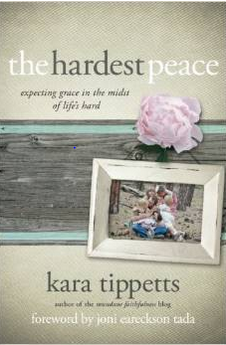
Hardest Peace  I first heard about Kara Tippets when I read a letter she wrote to a young lady who was suffering from cancer and planning a physician-assisted suicide because she didn’t want to fight it and suffer the ravages that were sure to come. Kara has cancer too, and could identify completely with the lady’s pain and fears, and Kara plead for her to look for beauty and hope, because it’s there.

The letter was so beautiful and compelling that I went to Kara’s blog to read more of what she wrote. She was an English major, so it figures that she has a way with words. I loved what she wrote, but I left the blog and didn’t go back to it for awhile because it felt voyeuristic to read about the body blows the cancer was wrecking on her.

But I went back when I realized the wonder of how Kara writes with beauty and grace about their immeasurable pain and sorrow, and it showed me how grace and light is always bigger than whatever darkness is around. I started following her on Facebook because I wanted to bear witness to that light and strength and joy.

Kara is 38, a wife of a church planter, and mother of four children. They never expected their story to look like this–beautiful, but not pretty, as she says.

I was restless this week for a good book, found Kara’s book, The Hardest Peace, on my house-sister’s bookshelf, and finished it today. It undid me in many ways. I cried through most of it. It is poetic and heartbreaking and honest and brave and anointed. Everyone should read it, but you should probably have someone to debrief with.

Kara is home from hospice now, her hair is growing back, but she’s writing less and less. Most mornings, I wake up and wonder if she’s still with us. There is a network of believers laced all over the globe, praying for her, supporting the beautiful family, waiting with them in wings before she enters the throne room. This waiting is sacred, crushing, unbelievably cruel, and beautiful.

My Favorite Therapy

Several years ago, I was home for a weekend, and mom showed me some art. Its official brand name is called Zentangle*, and it was created by Rick and Maria, who give classes to train and inspire people with this kind of art. Some people feel uncomfortable with that name, so they call it ‘pentangle’ or ‘creative doodling.’ Either way, it’s a kind of art she thought I might like.

I DID like it, and I still do. So last night I made this for a friend’s birthday:DSC06381

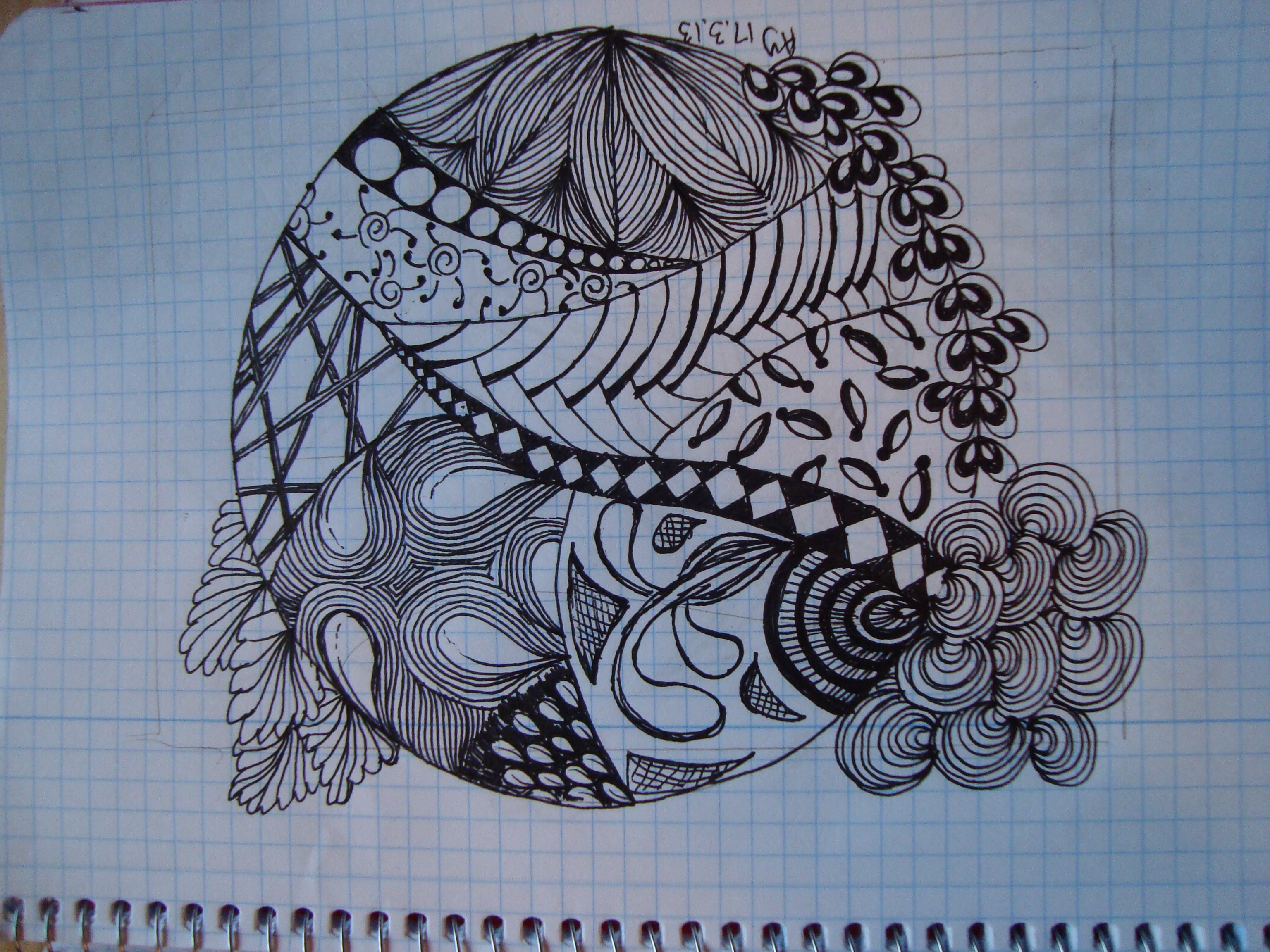
Basically, it’s an elaborate form of doodling. This is from my first practice notebook:

DSC04100  DSC04102

Technically, every pattern has its own name but I don’t know any names. I just find a pattern I like, and do it. You start with a square or circle or any shape, and with a pencil, draw random lines and swirls, and then use a pen to fill in those shapes with designs of your choice. Afterward, erase the pencil lines.

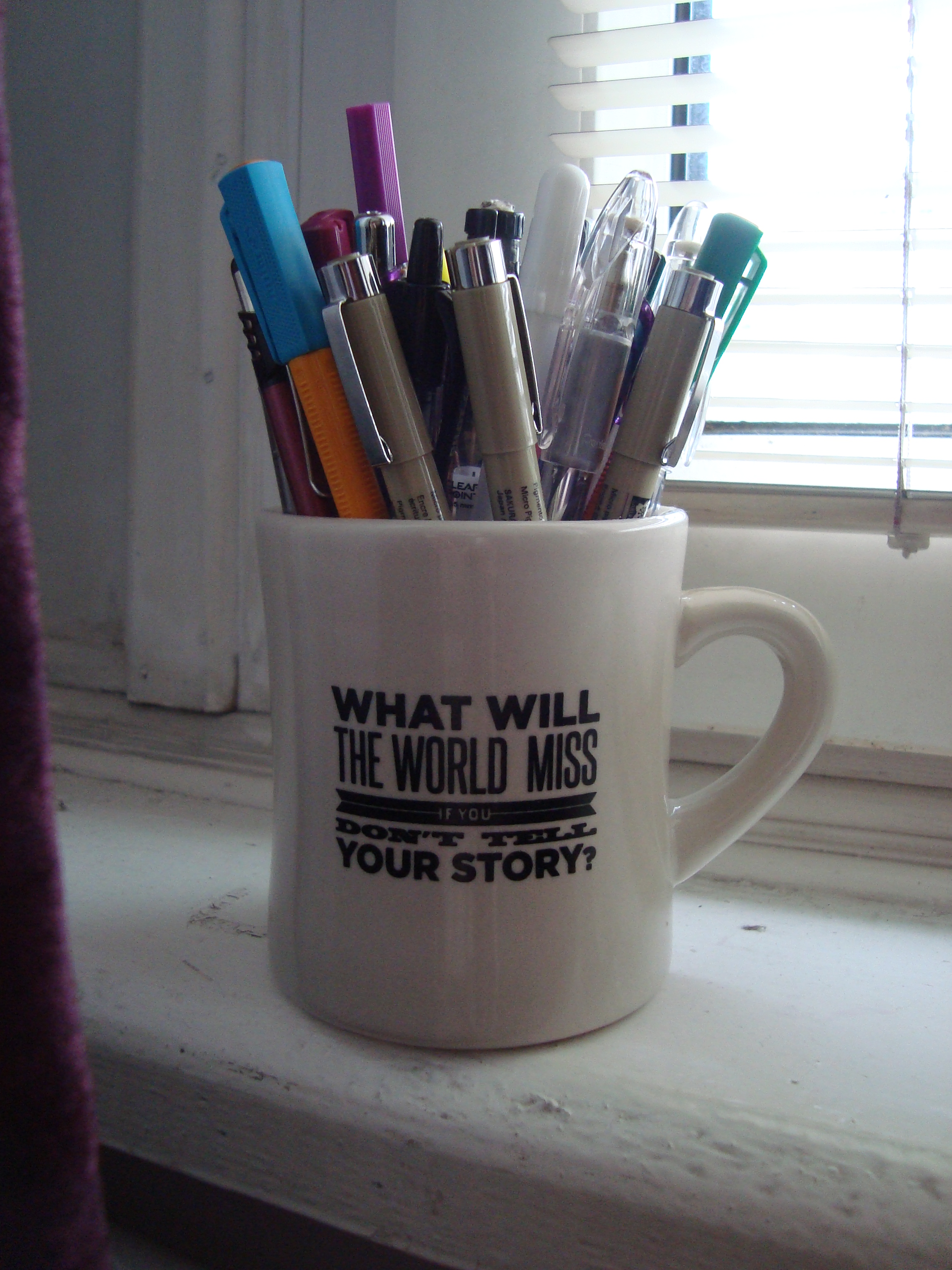
It appeals to me because of its simplicity and I can be an artist without being an artist. All I need is a pen and paper. At home, this is my tool box:

DSC06375

but when I leave the house, all I take is one pen (usually black gel) and one small hardcover unlined notebook where I practice and can slide in a card or two to work on. I’ve stopped doing much work in the notebook except for practicing patterns a little, because I’d rather put that time into something useful.

So I make cards. I LOVE buying cards, but I’ve hardly bought any the past couple years. One thing better than buying (or getting!) cards is making them. One of my favorite things to do in the evening is to sit down with my pens and a blank card, listen to something, and doodle. Pop a little jewel sticker on somewhere, and that’s it.

DSC05219 DSC05259 DSC06383

They’re not witty or gilt-edged or elaborate, but they’re original and full of heart, which is what a card is about, isn’t it? The middle one was a wedding card. The round ones are die-cut cards I bought really cheaply at Michael’s when I was in the US a couple years ago, and now I just cut my own from card stock. I experiment with colors of paper and ink, but always go back to the classic black on white.

I like the rich darkness of a gel Pilot pen,(but it smears if I’m careless) but micron pigma pens are also nice because the different size nibs give you texture and variety. I’d like to learn more about shading, but so far, I’m scared that using a pencil to shade will get too smudgy.

The post-modern mantra that some of the artists use in this is “There are no rules.” But I disagree. My rules have to do with texture and balance. I want the eye to move around the page, so that not everything is immediately apparent. I like starting a piece and not knowing what it’s going to look like in the end.  I like the tactile limitations of pen and paper, and the mindfulness it demands. Disclaimer: This is NOT something to do when listening to a boring lecture or message. I always dislike when my students doodle while I’m talking, so I try to give speakers the attention they deserve, and you should too!

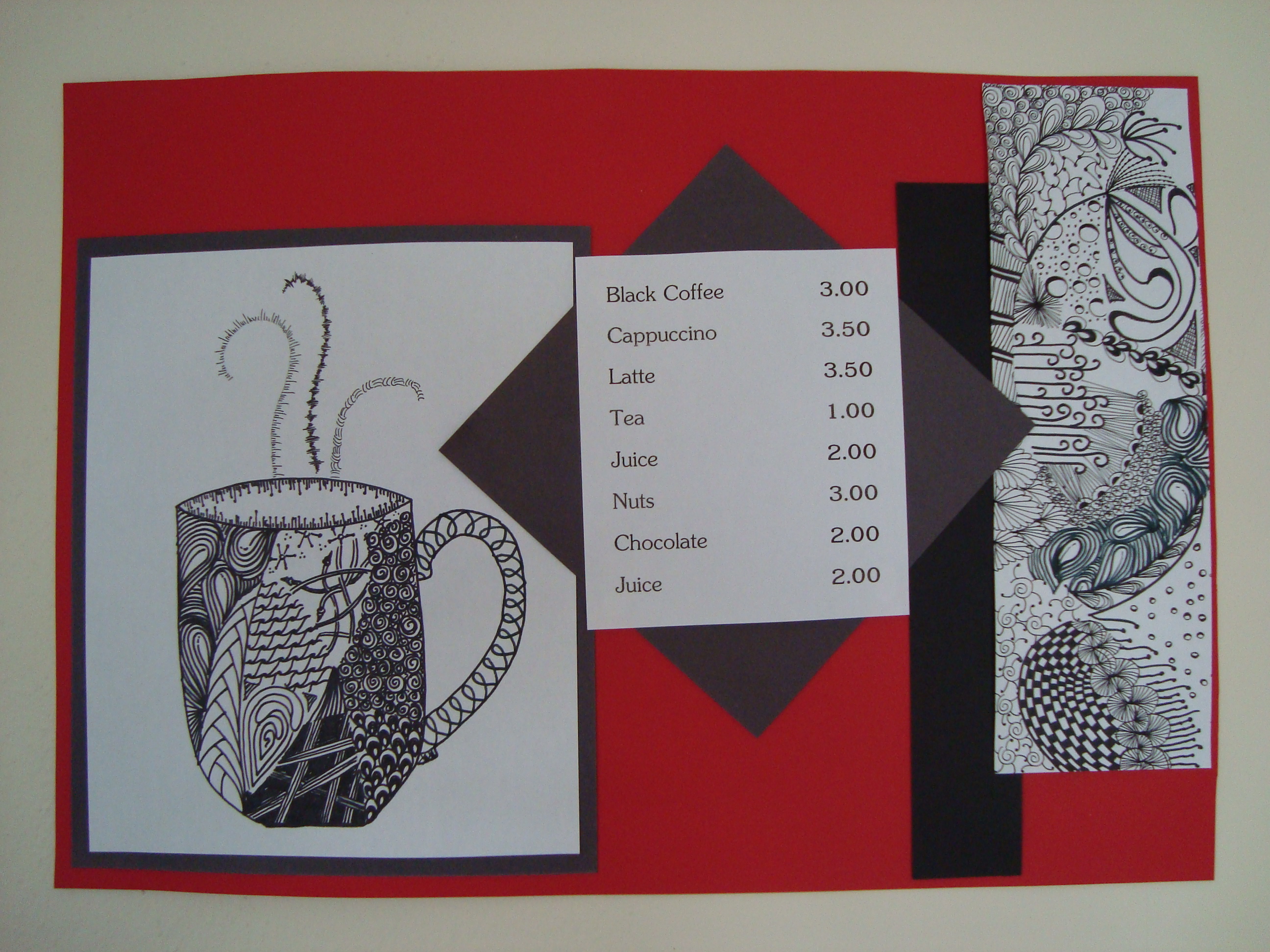
The possibilities with creative doodling are endless. You can use a sharpie to put any design on any piece of ceramic, bake it to set the ink, then paint over all of it with clear nail polish. You can use it in woodburning, quilting, on a chalkboard (isn’t that all the rage right now?), an envelope, or the frost of a window. I used it to decorate a price list at school: DSC04120

You know as well as I do that our world is increasingly narrowing into digital medium. Have you never spread out your fingers on a book page to make it bigger? That’s a dead give-away that means you need to do something creative with your hands. Zentangling is one of my methods of finding alternatives to a digital world. I believe very strongly that we are more whole people if we use our hands to make something that didn’t exist before. You can do this in a myriad ways: plant seeds, make kefir, cut an onion for soup, wash a window. Not only is hand-work practical, but it involves the whole person, and releases tensions that get knotted up if you’re just being sedentary all day.

I found this art in a time when I was in deep depression, and it met a need I didn’t even know I had. Since then, my eyes have been opened to details of light and lines and design. I’ve discovered a new world I never knew before, and it even led me to dabbling in acrylic paint and chalk pastels, something I thought only artists or school children do.

I don’t see myself as an artist, but more as a student discovering beauty. My therapy of choice is creative doodling. I go for a week or so and then my fingers get itchy to do something, and after I make a card, I feel relaxed again. (I think my house-mates are glad when I’m not so twitchy. Do I tangle for their sakes? Not really.) I find most patterns on Pinterest, (you can follow my ‘dangles to tangle’ board) but sometimes I see a pattern in ironwork or a fence or an ad’s graphics and make it my own. My favorite artist is Helen Williams because of her use of lines, light, and shadow. Rick and Maria are real masters, and find inspiration in anything. Their slogan is “Everything is possible one stroke at a time.”

After a few years of experimenting and learning, I’m sort of starting to believe them.

*Disclaimer: please don’t jump on me for the name. It’s just a word. I find no spiritual process in it, no zoning out, no meditation, no aligning my center. It’s just something I do with my hands that makes me happy on many levels. Is that fair enough?

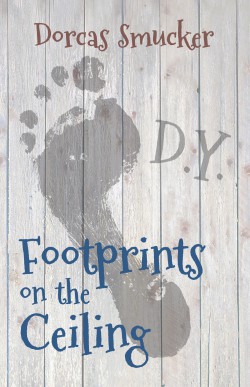
Footprints on the Ceiling, Dorcas Smucker–A Double Giveaway!

The initials on the front cover could be my dad’s initials, but they’re not. You’ll have to read the first chapter to find out the story behind the book title and the initials.ds.fotc.cover

Because I’ve been following Dorcas’ blog for years, I’ve already read all the pieces she has in the book. So I’d read the delightful story of the footprint and initials, but had forgotten about it.

That’s one of the reasons I like this book: I get to revisit the lovely stories I’ve already read, but their details are hazy in my brain.

Footprints on the Ceiling, as all her other four books, are compilations of Dorcas’ monthly newsletter pieces. As I read this book, I repeatedly was amazed at Dorcas’ skill in organizing the stories to make them fit perfectly into this  new setting.  And the sections correspond with the title: kinds of footwear that connect with parts of life: children, change, forebears, travel, reflecting.

What I love about these stories is that they are filled with quirkiness and color. The lines that emerge when you turn the page are  not what you expect, and even if you’ve read the blog posts before, you’re still surprised and amused. For example, the waddling Canada goose in the opening paragraph in “A Knack for the Absurd” had me in giggles until the end of the chapter.

 Though there’s a lovely light-heartedness all through-out, the book isn’t all jokes and silliness. Dorcas thinks deeply and processes well, but she keeps her own advice and (usually) doesn’t take herself too seriously. This is a trait that I find endearing and inspiring.

There are tears in the stories too. I cried at the beauty of a family wedding that celebrated deep joy and healing after shattering loss and grief. Dorcas’ world-view doesn’t get stuck in pain and she lives in the reality that stories do go on, and it won’t always be dark and gloomy, so her words birthed hope in me.

Dorcas loves her family well, with fierce loyalty and service to her husband and children and extended family. She always blogs with great respect and love for her father who lived with them last summer, and in the book writes warmly of her mom’s character and legacy since her death. The stories are honest, but not voyeuristic. They are candid, but not at the expense of someone’s dignity. So we know that these Smuckers are normal people who fight and make up, and make messes and lose things but at the end of the day they don’t stay mad and they keep talking things out. Which is what every healthy relationship is made of, especially the family, God’s ideal social structure.

This is probably the quality that brings readers back to Dorcas’ stories: it’s real life. No fluff, no fancy-schmancy lingo. Forget the idea of blankety-blank Amish novels. Last winter when I was teaching at CBS, the chapter about Bible schools came out, and it was so on-the-money that it made the rounds to all the teachers. We completely identified with the rules, unspoken rules, and laughed knowingly about the signs God sends. Her novel, when it comes, will be made of the same colorful, earthy, human stuff, and I can’t wait!

For now, Dorcas is giving away a signed copy of Footprints on the Ceiling. To enter the giveaway, leave a comment below. I’ll close it next Wednesday, Dec.3,  and you should get it in time for Christmas–a treat for yourself or a friend! This is going to be a double give-away, in that Dorcas will send a copy to the winner in the US. But if you live in Europe, you’ll be eligible for my copy. Isn’t that fun?!

Footprints on the Ceiling is available for $15 per book, postage included.  You can mail a check to Dorcas Smucker, 31148 Substation Drive, Harrisburg, OR 97446.  US addresses only.  To send a copy to Canada or overseas, email Dorcas at dorcassmucker@gmail.comOr find it on Amazon here

We Have Only to Look

the winds of skagit.

Recently I read the book The Glass Castle by Jeannette Walls. It’s the riveting story of her childhood, raised by her artist/hippy/rebel/paranoid parents who were always on the run. She writes with great candor and grace, never bitter about how she got dangerously burned while boiling hotdogs at age 3, or how she was forced to root in the garbage cans for food in high school because she was starving.

(It’s a really rough story in spots, and I don’t recommend it for young readers or to anyone who takes offense at honesty.)

I listened to several interviews with Jeannette, and something she said keeps coming back to me: the worst thing that happens to us is actually the best thing that happens to us.

So she was starving during much of her childhood, but it means that now she appreciates how she can go to a grocery story and buy ANYthing she wants. Their poverty limited them terribly, but it didn’t keep her dad from taking her out on the porch and giving her the planet of her choice for Christmas. He’d said she could have any star she wanted, but when she asked for Venus, he said “It’s Christmas. You can have a planet if you want.” What other child ever got Venus for Christmas?!

It keeps coming back to me–the idea that the things that are ‘bad’ can become something good. I say it carefully here, because I’ve not walked through the deep, devastating losses that many people have. But I want it to be true, that pain doesn’t have the last word, and that the yucky can be changed into good.

In my days and hours and minutes, it looks something like this:

  • When I repeatedly bruise myself in our poorly-designed kitchen, it means we have food to cook and dishes to wash.
  • I don’t like living on the first floor of our apartment building, but just outside my bedroom window yesterday I got to watch an older man carry a wooden cabbage slicer the size of Texas. It was wide enough to take a whole head of cabbage. Only in Poland!
  • A student who drains me is the reminder that I have energy to work and I have a job where I can be creative and be challenged every day, keeping boredom far away.
  • Housemates who have different priorities than I, resulting in potential frustrations, means I don’t live alone. Thus, I’m rarely lonely, and hopefully I won’t become stiff and unbending. (For an excellent read on this phenomenon, please treat yourself here.)
  • Being single when most women my age are mothers of teenagers means I am free to plan trips with my friends at a moment’s notice. Or pile books on the empty half of the bed.
  • Having undergone a harrowing surgery and long recovery gives me sensitivity to others’ physical pain and limitations.

Part of me doesn’t like listing these things, in fear that it feels chirpy. No one who is walking through a dark time wants to hear glib, pat words like “Look–you have dishes to wash which is more than some people have!” Or “Hey, be thankful for your freedom to travel!”

I think the transformation of good coming out of bad is a process of perspective that is hardly possible in the middle of the mess. There is value in being honest and saying “This really stinks, and I hate this.” But to walk out of that and look back on it from a safe distance is redemptive and healing.

Which is what God is all about. The change of perspective is way more than positive thinking and pulling yourself up by your own shoe strings. The picture of peace and joy and glory shining out of negative situations has God’s fingerprints all over it. Because His character is light, and the darkness will never, ever, ever over-power it.

This is what I hang my heart on.

Read The Glass Castle if you want to read a story told by a masterful writer. But more importantly, maybe today you can try to step back from your story and find the streaks of light piercing your clouds.

The beauty might surprise you.

There is glory and beauty in the darkness, could we but see!

And to see, we have only to look. –Fra Giovanni, in 1513