Knowing & Being Known: a book review

Last week I was walking in the snow with a friend and we were talking about the books we’ll read during Christmas break.

“Remind me of the title of the book you said everyone should read,” she said.

“Well, right now I have two books that I’m saying everyone should read,” I said. “Are you thinking of Relational Spirituality  or The Body Teaches the Soul?”

“No—there was one before those.”

I doubled over laughing.

I can’t help that I’m the enthusiast who is sure that of course everyone will love whatever I love. And that means that I make superlative statements sometimes. But yes. I read a lot and because reading time is limited, I work hard to read the best. Which of course means others will want to read them too.  

Then I remembered that before the last two books I really loved and enthused about, there was one a month earlier: Knowing and Being Known by Erin Moniz.

About once a year, I hear about a freshly-published book, and I know I need to read it right away and shouldn’t wait until I can buy it cheaply used, which is usually how I buy books. Last year, it was How To Know a Person by David Brooks. This spring Tyler Staton’s A Familiar Stranger was another one that I knew I couldn’t wait until I could buy a used copy. 

This makes two new books this year. No—there was also A Teachable Spirit by A. J. Swoboda that also everyone should read, but I digress. Another digression: I sometimes also read old books. On the Incarnation is perfect and lovely for this time of year.

Knowing and Being Known answered the sometimes-whispered, but often-silent questions about loneliness and ache for companionship. Erin speaks from the perspective of working with college students who are navigating relationships and find themselves floundering between their ideals and their gritty, disappointing reality.

She found that behavior modification wasn’t changing students’ lives in the ways they were longing for. She could tell them “Stop dating losers.” But while she could give solid advice, it didn’t address the deeper hunger driving the behavior. So she went on a search to explore the theology of intimacy: what is in the good news of Jesus that meets the universal hunger for intimacy? 

Other researchers have identified three essential building blocks for healthy, sustainable relationships: 

  • Self-giving love: reciprocity
  • Attention/curiosity: orientation toward and seeking the other
  • Commitment: choosing each other repeatedly; mutuality

Erin expands on these, and then broadens the points and finds them modeled perfectly in the Trinity. 

“…the revelation of mutuality and freedom in the Trinity challenges individual, entitled autonomy. The Trinity’s mutual love of Father, Son, and Holy Spirit defines for us the balance of interconnected love and freedom. 

That we are hardwired for intimacy harkens back to an origin story of intimacy that yields the eternal goodness, beauty, and abundance that existed before the dawn of time.”

This is the good news of the Gospel: that the magnet of our desire is pulled inexorably toward  the north star of God’s love, the model and perfection of intimacy.

And don’t think we’re talking only about sexual intimacy, although that’s a valid hunger. This north star is much, much wider and deeper than that one level of intimacy, and it is accessible to everyone everywhere. That’s good news!

I love how Erin addresses loneliness. She acknowledges the hard realities of extended singleness but goes on to name a deeper reality: loneliness is part of the human experience. Further, she says, “I do not believe it is loneliness we fear. What we actually fear is the things loneliness reveals….There are other things driving the pain we describe as loneliness.” 

I think she’s 200% right. I live alone and I love it most of the time. I’m not usually lonely, but when it does descend at odd times, I subconsciously get very creative at avoiding the discomfort. But even a healthy, life-giving marriage wouldn’t fix that. My married friends tell me this and I believe them.

It takes a ton of courage to sit with the questions that lie beneath loneliness. But when we find that courage and that silence, we discover what is under that angst and what we really believe about ourselves, our future, God, and those we love. If we can learn to steer our magnets toward our true north, many of our questions and longings will order themselves under that star, like iron filings tracing the path between strong magnets. 

I’m not saying it as well as Erin does, so get yourself a copy and read it and underline it and discuss it with your friends. I’m not getting paid to promote this. I just want others to  discover the richness of a message that has the potential to comfort and coach toward deeper peace and understanding of each other and of God. So go ahead and order a copy for yourself and a friend as a gift to both of you. It could be a great way to start a new year!

My book talks about loneliness too, and has suggestions for when you’re feeling left behind. You can buy it here.


Fairy Rings and Circles

Photo by Mahad Aamir on Unsplash

I’ve been thinking about circles and the ways they provide spaces of beauty, nurture, and life.

Some of my most formative, life-giving, sacred memories happened when I was sitting around a circle. Not in straight rows, not one-on-one, but in a circle. There were camp chairs or blocks of wood, benches, or floor pillows so some people were sitting higher or lower but no one was outside the circle. Both men and women sat in the various circles, people of many ages and life experiences.

A physical object is usually in the center of the circle. We sit around Sunday lunch or a tray of nachos or a crackling fire or a coffee table with a candle and tea. The object in the center isn’t our sole focus, but it gives us a hub to gather around and something to watch if we feel twitchy and unable to meet someone’s eye.

A circle says everyone matters, every voice is valuable–even the voice that would otherwise stay quiet. No one can hide, and it’s safe enough that no one wants to hide. The circle includes, expands, takes in, listens, responds. In these spaces, there’s one conversation happening that everyone contributes to, not splattered clusters of discussions, although those also have value. The words I carry away with me often begin with:

What I hear you saying is….

Have you considered…?

What if…?

You need to know….

I never thought of…in that way.

I heard Jesus say…

I remember circles with gales of rollicking laughter that helped set my world right again. I remember deep questions with long silences. I remember thoughtful observations and poetry read. Food is always a nice feature, and tissues for tears are essential. I remember advice given to me that I could hand to someone else in turn. What’s spoken was usually simple but valuable because it was born out of experience.

To be clear: not all circles are life-changing. Sometimes the conversation is about the lettuce in the garden or the housing market or wall paint. I don’t love small talk, but I’ve learned to try hard to engage even there because it gives me data for conversations with those people in the future. Small talk is a window into what they care about and it establishes trust and safety. (Read The Six Conversations by Heather Holleman for more ideas and guidance about conversations.)

When you’re done with small talk, the real enjoyment and life-giving exchanges happen with good questions.

What have you been processing lately?

What’s big for you next week?

Are you happy?

What are your dreams for the next 10 years?

These are the kinds of questions that enable knowing and being known, a level of intimacy everyone hungers for. These questions went deep fast in the circles I’ve sat in recently. I love that circles are a recurring theme of my story. I blogged about it here before and probably will again.

You can choose a favorite question to keep in your back pocket for the next circle you encounter.

Laurence Koo, board member of Authentic Intimacy, teaches that humans were created for five levels of intimacy:

  1. intellectual (exchanging and pushing around on ideas)
  2. emotional (friendship, banter, camaraderie)
  3. spiritual (sharing what we know and learn and love about God)
  4. physical (hugs, sharing personal bubbles)
  5. sexual (one man and one woman in marriage)

People live whole, full lives without sexual intimacy (thousands have, over the centuries), but people cannot flourish without those first four levels of intimacy. However, when someone has vacancies in any of those first four aspects, they’re more vulnerable to sexual sin.

I’m an unmarried woman at 50 without a date. Multiple formal and informal circles provide those first four levels of intimacy for me, and I dream for everyone to have the same opportunity to flourish and develop.

But here’s the rub. Circles don’t usually show up at your fire ring uninvited. Only fairies and mushrooms do that. To engage in those facets of intimacy, you have to be intentional and risk and give up significant control and autonomy. To be part of a circle might mean you plan, invite, or host to make it happen instead of stay tidy and cozy at home.

You don’t usually just happen onto a circle. You choose to linger when it might be easier to leave an event early. You choose to engage when it would be easier to stay aloof. You choose to ask questions and be awake to who is around you and what they’re saying.

So start small and fun: a shared activity like a walk or work or art project or birthday to celebrate. Find a common interest like poetry or bird watching or thrifting. Start light and breezy, not heavy and ponderous.

Ask God to give you circles to be part of. It was His idea in the first place, that you thrive in community with other voices contributing to your life. He cares about the circles you sit in. I can trace His mysterious, light fingerprints in the way He arranges the circles I’ve been part of. It was clearly His arranging, not mine, but it was on me to be aligned with what He was up to.

Loneliness is an epidemic in the West, and loneliness doesn’t go away when someone gets married. That means everyone needs to find ways to live well in our common experience of being lonely, separate, other.

So let’s learn how to hold the weight of loneliness without crumpling. Let’s find places—circles—to offer companionship, understanding, presence that offers an antidote to crippling, suffocating loneliness.

This doesn’t mean that we should desperately chase after circles so that we’ll never be lonely again. In an ironic turn, I’ve found that when I’m most at peace in solitude, I am most ready to contribute and receive from the bounty of a circle.

Circles are gifts to receive, not rights to demand. But isn’t it good of God to give such lovely gifts?

Walking Beside Each Other

Photo by Rajat Verma on Unsplash

Last week, the lovely Daughters of Promise team asked me for a writer’s interview on Zoom. It was in connection with their Brighter Winter program, which gets participants into lots of books during January and February. I agreed to the interview even though I’d never done anything like it. In the moment, it was mostly enjoyable even though I don’t love being the focus in a virtual conversation. My hosts helped me feel comfortable, and seeing a few friends’ faces made the call enjoyable.

We talked about my book, the process of writing and self-publishing, and my goals for the book. My goal was—and is—for it to be a companionable voice on a lonely path. Then a question came that I wasn’t prepared for: what can the church do for singles to support them and recognize their gifts and contributions to the Kingdom and not make them feel left out?

I stumbled around, offering ideas off the top of my head, but I didn’t feel good about it. So I decided this space (ironically another virtual platform) might be a place to think longer about the question and possible answers. I’m thankful beyond words that in this current season I can put down these ideas from a place of abundance, gratitude, and fullness rather than resentment, scarcity, and envy. I wish all single women’s churches and work places would support them as mine do. I hear many single women’s stories, and this is not their reality.

  • We want to be known and seen as contributing citizens, not oddities, even in our pro-family sub-culture. So please meet our eyes. Notice our appearance. Ask us questions about our latest holiday or visit home or latest book or hopes for the new year.
  • Give us responsibilities in church that fit our lifestyle. Keep in mind that most of us are working 50-60 hour weeks, and we love our work, but we have very little discretionary time. At the end of a long work day, we still have to maintain the car, see the dentist, buy groceries, do laundry, and cook. Did I mention take care of the house or lawn or garden? And all solo? That doesn’t give much time for babysitting, making church bulletins, or hosting–even if those are all things we are able to do and enjoy doing when we find cracks of time in evenings and weekends.
  • We love meal invitations and leftovers. We love hosting too, but it takes a lot of planning ahead because if hosting involves food, we don’t always have food in the fridge.
  • Hug us freely and often. We live in an adult world and often go for days without physical touch.
  • In family-centered activities like meals and picnics, invite us to join your family. We don’t always know where to stand or who to sit beside, and it’s lonely to stand alone in a circle, and we never get used to that.
  • If you don’t know us well but you have a potential boyfriend in mind for us, stay quiet and pray. If you know us well and we’ve confided our dreams to you, set us up with good men. Ask us on a double date or a blind date. We know that marriage won’t solve all our problems so you don’t have to tell us that but we need you to celebrate your beautiful, strong marriages and darling children and we need you to love us where we are and hold hope for us.

I can already hear howls of protest from some singles who feel misrepresented in this list. What I put on the table here is true for some but not all single women. That means it’s on every person to get to know the single lady beside her and love her as a one-of-a-kind individual, not as a piece of demographic information.

Singleness is hard and marriage is hard. That’s what Sam Alberry says, and I believe him. That means that all of us need all of us to accompany each other in this beautiful, broken world, to smooth the path a little bit for each other, to be present and available and tender toward whoever is walking beside us.

God So Loved That He Gave

One of the times I felt most alive was when my friends and I swam in the Dead Sea. The buoyant water let us do gymnastics we could never do before! The clear, turquoise water, briny with salt and minerals, made my skin silky smooth, and soothed the sunburn from the day before.

An Israeli company takes the salts and minerals from the Dead Sea and produces a beautiful line of skin care products, choosing the name Ahava for their brand. A friend I was swimming with in the Dead Sea gave me a tub of lovely Ahava body sorbet that I love using.

Ahava means love. It’s the same word God used in Leviticus: You shall ahava the Lord your God, and your neighbor, and the foreigner among you.

Why did God command a condition of the heart instead of action with the hands or feet? Or is ahava only an emotion, an intangible word?

The root word of ahavah means “to give.” To ahava the Lord and our neighbor is an act of intentional giving, serving, focusing on the other. Love is far more than a warm feeling deep inside. It is action and generosity, sacrifice and service.

In this week of masses of pink and white fuzzy animals, red-foil balloons, and heart-shaped chocolates, it is normal to focus on what we might or might not get, and what makes us feel warm and loved. Romantic love is beautiful and life-changing, and carries enormous power to heal and restore. Valentine’s Day is often the most noticeable, accessible (and consumerist) form of romantic love, but ahava is far bigger than a day on the calendar.

God modelled ahava for us when He loved us so much that He spared nothing and gave His only Son. God’s call for us to ahava is a call to the shape of a life, the deeds and habits of a heart that gives and serves the neighbor and the family member and the stranger. Ahava is not expecting to receive nice things or to stay comfortable.

However, in a beautiful paradox and a curious exchange, when we ahava God and others, we receive stupendously in return.

In this week of pink and white and red all around you, how will you receive and give ahava?

I wrote a book one time about living well and living loved—even without romance. You can order your copy here!

Hope Opens Every Door

Photo by Jan Tinneberg on Unsplash

This is the time of year when all the Christian writers come out of the woodwork to offer their Advent devotionals. Every year, I get tired of all the serious, sober one-liners we should reflect on for the whole season. They’re all wise and thoughtful, but it gets to be too much to take in.

So if you can’t absorb one more pithy statement or rumination about how a Christian can approach Christmas, please scroll on, with no hard feelings.

These days, I keep thinking about hope and its agony, how warming hope’s promise is, but how devastating its wait is. I used to think Emily Dickinson’s lines were so sweet:

“Hope” is the thing with feathers –
That perches in the soul –
And sings the tune without the words –
And never stops – at all –
And sweetest – in the Gale – is heard –
And sore must be the storm –
That could abash the little Bird
That kept so many warm –
I’ve heard it in the chillest land –
And on the strangest Sea –
Yet – never – in Extremity,
It asked a crumb – of me.

But I know better now. I don’t know a hope that doesn’t ask for even a crumb. That sounds like limp-noodle passivity, shut-down apathy, which is not a healthy way to live.

I find that vibrant, throbbing hope asks for a lot, lot, LOT of surrender, trust, agony–words I prefer to forget about.

I’d love a conversation with Miss Dickinson and ask what she meant by saying that hope doesn’t ask a crumb of me. She’s a brilliant writer, and she must have had some good reason for the line. I like these of hers better:

Not knowing when the Dawn will come,
I open every Door.

I think it’s hope that motivates a person to “open every Door.” And to be clear: I’m not talking about hoping it rains tomorrow, or hoping your cold will go away soon, or wanting to get pregnant and holding your newborn ten months later. I don’t mean to dismiss that kind of hopefulness, but let’s be honest: praying the same agonized prayer for years or decades is another kind of hope.

The kind of hope that opens every door is a hope that’s been waiting a long, long time–years and years and years with no sign of anything ever changing. This hope longs for dawn, aches for light and relief from murkiness and questions and waiting. This hope is a tenacious push, a desire that never goes away, eyes that long for the night to end.

In the Christmas story, hope is what the Jews held close to their hearts every time a woman was pregnant, because they were so desperate for Messiah, a rescuer. They were living under an oppressive regime, and they believed the prophets’ words that had never yet come true, not even after thousands of years. They still hoped for Jesse’s rod to bloom into justice. They hoped for the Prince of Peace to reign on David’s throne. They didn’t know what shape their hope would take, but the ones who were attuned to their hearts’ desire opened every door, looking for their Dawn.

Did you ever notice how often the familiar prophecies use will?

The LORD will indeed give what is good, our land will yield its harvest.

The desert and the parched land will be glad, the wilderness will rejoice and blossom.

They will enter Zion with singing; everlasting joy will crown their heads. Gladness and joy will overtake them, and sorrow and sighing will flee away.

Today, far removed from Jewish women’s hopeful waiting, we carry our own stories of night and longing–at least all those attuned to their inner pulse. Single women hope for true love and meaningful work and a place to belong. But we don’t have a monopoly on longing and hope. Hope for dawn, for change, for the night to end, is the common thread that connects all people who carry hope for years.

But here’s the kicker: hope is slippery.

Hope is shaped by and linked to desire.

And desire is closely akin to demand, which is where hope turns ugly.

We know how those demanding faces look. We’ve heard the bossy, impatient voices in our living rooms or in front of us at Starbucks. Next time, let’s listen with compassion to that brassy, harsh woman. Maybe her hope went awry. Maybe her hope was sweet at first, but that was ten years ago, then her hope spiraled into demand, and the woman’s crustiness has nothing to do with the poor barista and everything to do with heartache.

When the Jews didn’t get their promised Messiah for thousands of years, their hope wept and moaned, “How long, O Lord?” What I love about this is that God never told them to stop groaning and asking.

Lament is a form of hope because it looks outside itself for the dawn. Lament acknowledges the deep holes of the soul; lament names what is dark. And with tenacious, stunning courage, lament lifts its eyes beyond the closed door to the eastern horizon.

Hope requires immense courage and staggering risk, holding throbbing possibility that sometimes makes me feel I’ll bleed out. With all due respect to Emily Dickinson, hope asks me for far, far more than crumbs.

The Psalms model for me hope’s posture: name what is unbearably dark and unfair, weep and howl over it, and open my door to God who brings the dawn.

The purest form of hope is worship. Hope doesn’t kick open the door nor slam it shut and go silent. Hope turns the knob, risks the click of the latch and mourns the devastating darkness and speaks to the Man of Sorrows who’s acquainted with grief. Lament is worship because it trusts the only one who can do anything about the dark, and it declares Him endlessly loving and mighty and wonderful.

Hope is not a chirpy Pollyanna. Hope is nurtured in silence and secrecy, but its softness and expectancy leak out in winsome, delightful ways of living. In contrast, crushed hope-turned-bitter festers in invisible places of the personhood, but reveals itself in caustic words and ugly negativity. The old saying is true: what’s in the heart comes out.

Luke records that Zechariah, finally able to speak after his son John was born, crafted a prophetic poem of worship. His people’s long wait was nearly over, and he worshiped:

…the tender mercy of our God, by which the rising sun will come to us from heaven.

Zechariah had opened every door, didn’t stop hoping for Dawn, and named what He loved about God: His tender mercy.

Maybe hope involves more than the thing hoped for, more than the dawn waited for. Maybe the best part about hope is that it’s the place we experience, sweetly and piercingly, God’s tender mercy even in–especially in–the dark.

I wrote a book one time about living well in a place I hadn’t planned to be. It also talks about how to dream, which is akin to hope. You can order your copy here!

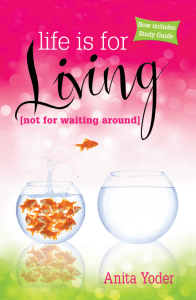
Life is for Living

I was always going to write a book, but this one wasn’t in the plans. I thought I was going to write about an American Mennonite’s experience of living in Ireland, but I don’t think that one’s going to ever make it, which is very ok.

I remember hearing about a girl who was planning her wedding but her sisters (older and younger than her) could hardly be civil to her, consumed with their losses and desire to be brides. I felt sad for them, knowing some of their pain, but I felt strongly that they weren’t on Earth to be bitter about what they didn’t have.

What IS our greatest purpose? What ARE we here for?

If it’s to be happy brides and wives, some of us have failed our purpose.

If it’s to love and worship God, that option is open to anyone, anyone.

That was my driving motivation in writing the book: what were we created for, and how can we enter into it now, without a romance story? I wrote out of my experience and my hope. I wrote about what I knew and dreamed of. Looking back now, I think it was kinda audacious of me to start writing a book at age 30, and parts of it seem chirpier than I am now, but the premise hasn’t changed.

We were created for a vast, endless, creative love, and there’s no limit to entering into it and letting it transform our lives.

I wrote for singles ages 20-30 because that’s what I knew and had experienced. But often moms and pastors’ wives come up to me to say how the book meets them. I’m deeply honored that they read it, and am learning not to be surprised that it connects with them because we are, all of us, living in Plan B. None of is now where we thought ten years ago we’d be, are we? Unless you’re sitting at the same place you were, eating PopTarts™ slathered with marshmallow creme.

It seems that living well means figuring out how to thrive in Plan B. I’m still learning, steadily by jerks.

Singles don’t have a monopoly on disappointment, ambiguous grief, or unrequited love. We don’t suffer more than others, but we do live with a specific loss that deserves some attention sometimes.

You’ve probably heard a talkative mother say she was never going to marry, but here she is, with a house and family because some man came out of nowhere and swept her off her feet. She’s grinning as she says it, and people chuckle. She’s allowed to joke about her Plan B.

But a single lady isn’t allowed to say she was never going to be single at 26 or 46, but here she is, all dressed up with no date. Her Plan B is real, but not one people chuckle about.

We’re ALL in Plan B and for some it’s socially acceptable to talk/groan/chuckle about it, and for others of us, it’s not something we bring up at a fellowship dinner table.

I hope my book provides a safe, understanding place to name the Plan Bs readers find themselves in, and that it gives them ways to look at themselves, the future, and God–our generous, wise, gentle, lavish Creator. The book is a practical, realistic invitation to the love and worship we were all created for. My premise is that we thrive when we enter into that love and worship.

Gearing up for Cyber Monday, you can buy a digital copy of the book on  Amazon or hard copy here at Christian Learning Resources.  Under the banner of my blogsite’s home page, click on the book title and find the drop-down list of each chapter and you can read the first page of each. After you read it, I’d love to hear what you think!

Always A Bridesmaid and Never a Bride

12698453_805008379644694_4219333476885333484_o (1)

Last week, my good friend Shari posted a guest post I’d written for her blog. I wrote 500 words about something I don’t hear a lot of conversation about. I wasn’t planning to post it on my blog, but here we are, in a more-or-less quarantine, on-line more than normal, with more free time than normal. I don’t usually ask for interaction from readers, but there again, we’re breathing different air right now.

So let’s talk.

“My church doesn’t know what to do with me.”

I’ve heard this line from singles many times. Maybe it’s the default setting in a sub-culture that greatly values marriage and family, but it always makes me sad. However, I’m deeply grateful for a church that gives me a place and lets us singles feel welcome, equal, and human.

Some things they do to give us a place:

  1. The ladies look for ways for us to be together—ladies’ evenings when the men have brother’s meeting, women’s retreats, extra ladies’ nights when we relax and laugh and tell stories.
  2. The men meet my eyes and shake my hand after church. They regularly publicly honor and praise single and married women’s contributions to the families, school, and church.
  3. Families invite me for meals and tuck leftover food into my bag as I leave because they know I don’t have all day to cook.
  4. They treat me like an individual with a life: they remember my birthday and ask about my family. They care about my dreams.
  5. The men generously give advice and assistance in their area of expertise: purchasing and maintaining a car, phone, house, or garden, which can include pest control, yard work, or a mechanic’s number.
  6. They send us reports of member’s meetings.
  7. Church treats us like people who have something valuable to contribute, and so we’re on the hostess list and the church cleaning list and the list of people for jobs on reorganization night. And no, I don’t like the job they gave me but it means they believe in me.
  8. They compliment my clothes. They remember I was gone last week and ask about the trip. They remember to ask about things we’ve talked about before.
  9. They don’t ask us singles to serve the Valentine’s banquet.
  10. They invite me to join their family in the fellowship dinner line.

Some time ago, in another place, I was helping to host an event and several men acted as if I wasn’t there. Were they wanting to prove their loyalty to their wives? Was I intimidating or dangerous? I got a taste of my friends’ lines: “They don’t know what to do with me,” and I felt newly thankful for the conversations, camaraderie, and support the men in our church give to me and other single women.

A key part of this is that healthy relationships are two-way streets. I aim to give more than I take. I need to contribute, not just consume. I must plug in, make effort, invest, because the good life is not about me and my comfort. I often don’t feel like going to cell group or bringing food for an event or doing my assigned job, but who does? And who will have the richest life—those who stay home and curl into a ball when they feel like it, or those who push themselves to do hard things and love their people?

It goes both ways, but if you know a single in your church, think about how you could love her well and let her feel like she matters and belongs.

Now back to you:

What would you add to this list of 10? Which ones do you feel aren’t important?

What keeps you from engaging with someone with a different marital status than you?

What do we single women do that makes us seem threatening or dangerous to men?

To be clear: extended singleness isn’t the worst thing that could happen to a person. It’s not a crisis situation, and there are much, much worse, harder scenarios to live in.

But singleness IS a disenfranchised grief. There are no sympathy or thinking-of-you cards that address it, and singleness doesn’t keep getting better every year like a good marriage apparently does. So it’s a lonely place for most of us, and one where good role models are scarce, and it’s hard to talk well about it without sounding bitter or desperate.

So.

Let’s hear each other, ask questions, and walk toward wholeness and mutual understanding. This isn’t a platform for bitterness or accusation. We all need each other and we’re all far more alike than we are different.

We all want to matter, to make a difference.

We all want to know we’re beautiful and loveable and not obnoxious.

We all are hungry for more connection and less isolation.

What would you add to the lists of commonalities and ways to integrate?

Life is for Living, Regardless

Recently, my friend Abby told me that she read my book when she was 10 or 11 and I laughed and laughed. She was definitely not the demographic I had in mind for an audience when I started writing it back in 2004.

Still, she said the book started her thinking about living fully and she decided then not to be shriveled and shrunken. The way she lives now, more than ten years later, demonstrates how well she internalized the book’s message. A big chunk of her heart is still in Greece with refugees after she worked there for five months. Now she invests her time in helping in special needs classrooms in public schools.  She’s dating a wonderful young man, and I cheer for their vision for life, and I know that they will become even more attractive, effective, vibrant people as they live well and don’t wait around.

When I wrote the book, I heard that the average marketable life of a book is 1-3 years. However, I expected it to stay in print for a long time because I thought that every year, another group of young women will discover they’re single and want guidance in it because there’s not a lot of great help out there, at least not in the pro-family conservative Anabaptist culture.

It seems that young women discover themselves to be single at different ages, depending on their context and the expectations of people around them. I was pushing 30 when I looked around me and realized that most of my friends were married and I wasn’t. I hear from girls who feel very single at 18 and I want to say, “Honey child, you’re not single, you’re just growing up yet!” But in their context, grown ups marry at 19, so of course they feel left behind, forgotten, not-belonging.

It’s almost 12 years since the book came out, and what has surprised me most is how many moms and preacher’s wives tell me that it connects with them.  The book isn’t a how-to book for singles, but an exploration of what it looks like to pursue living well in the middle of Plan B.

Turns out everyone is living in a story they didn’t plan, and we all need to know that there are ways to do well with adjusting expectations and learning how to flourish.

book cover

You can order the book at Christian Learning Resource. Order from the website (it’s not out of stock even if it says so) call (814) 789- 4769, or email clr@fbep.org.

Alternatively, it’s an ebook, available here, for only $4. If you or a friend speaks Spanish, you can download it for free here!

I don’t know how long I’ll keep the book in print. For now, it’s puttering along, leading a life of its own, and now and then a nice story comes tripping back to tell me what it did. It’s a very happy stage to be in, because I care about God’s people living good stories, and if my book can help with that, I’m delighted.


The Seduction of Sehnsuht, Part II

yohann-lc-1052234-unsplash

It seems that sometimes God stops us in our tracks and fills us with the deafening thunder of loneliness. Real-time, raw, gritty loneliness.

You don’t have anyone your age at church to talk with. You emailed your mentor but she’s too busy to reply. You feel trapped and stressed with conditions at work and have no one safe to talk it through with you.

Many times, loneliness is God’s invitation. It’s when He stills you enough so that you can hear Him saying “Press hard into Me. Can you tell Me about it? I call the stars out by name and I know your feelings of isolation and I’m big enough to take what you’re feeling.”

The wonder of this invitation is that we can never ask too much of Him. We can never confide in Him too much, or ask for His presence too often. We don’t even have to articulate the Sehnsuht in our soul, but only breathe “Jesus, Jesus, Jesus,” and He understands what’s underneath the breaths.

Loneliness drives us all to different places—self-soothing to forget the ache, a stranger’s arms or fantasy for comfort, hard work or delirious pleasure to distract, stoicism or denial to appear strong and not-needy.

But as long as we stay strong and distracted and numb, we will never experience the fullness and depth and width of God’s comfort and companionship, which is the truest, deepest intimacy He created for us.

And Jesus knows something about loneliness, so His words aren’t just theory. He gets it when you tell Him you’re lonely. He had no strong co-worker with whom to debrief His frustrations with people. He never knew the comfort of coming home to a woman’s warmth. For all we know, His times of solitude included hours of wordless breaths of “Father, Father, Father.”

Loneliness, the deep, dark cavern, instructs us. It tells us—when we listen—that we’re not as alone as it feels. Loneliness sharpens our sensitivity to others who hurt and smart even more acutely than we. This is a most healing, positive discovery because it lifts our eyes off ourselves and urges us to look up and out.

I had lunch one day with three women. All live in different states, all of them are married to leaders who are gifted visionaries. These women partner with their husbands to serve and pour out their lives on behalf of the Kingdom. They are intelligent and talented and full of life, and over our extended lunch, we laughed and cried and asked questions and heard each other’s stories of the past year.

What eventually came dripping out of all our eyes, in different moments and stories, was how each lady feels profoundly lonely. I was the youngest of the four, single, living in an isolated mission, and loneliness understandably goes with that package. But them? These witty, positive personalities, with attentive husbands and beautiful children?

Yes, them.

No place or person on earth will protect anyone from isolation, misunderstanding, loneliness. The stubborn existential loneliness is a clingy cat that’s constantly underfoot and we keep kicking into it even when we think it’s gone.

While we can let loneliness work for us and follow the nudgings toward the eternal and infinite, we can also choose to stay in a dangerous no-man’s land. In that terrain, the enemy’s taunts feel completely plausible.

“You’re here because no one likes you. They don’t like you because you’re too intense, shy, emotional, boring, threatening. Look at you—who would actually enjoy you? Time you get yourself into shape like everyone else.”

When you hear these lies, your best option is to RUN. Run, gasping only for Jesus, Jesus, Jesus. He will repel the dark lies with His light and the words you need to hear.

Do you know someone who’s listening to those toxic lies? Take their hand and run with them. Run with confidence to the comfort and light of Truth. The truth is that He is never far away, and He’s always waiting to respond to your call for help. This truth frees you and lights a flame in the darkness that could suffocate you.

While everyone grapples with existential loneliness, often singles carry a pronounced, practical loneliness. It’s important to recognize this and be honest about how heavy it feels to make major decisions alone and absorb inter-personal pressures alone and go to sleep alone every night. Alone was not how we were designed to live and it makes life hard.

But many, many others are even more profoundly lonely. I think of abandoned wives, and mothers with chronically ill or handicapped family members, or women who married unwisely. I think of widows and women with unbelieving husbands and I should probably stop listing categories now because there’s many others I’m missing. Palpable loneliness can tend to overwhelm people and skew their perspective of life and God. Could it be that you can be comfort to them? That you can carry or speak or paint or bake a token of God’s presence for them?

Your loneliness can help someone else’s loneliness? Who knew! God’s economics are wonderful and nothing is ever wasted.

We carry His presence, you know. In a stroke of wild vulnerability, He put His Spirit in us to ignore or treasure at will. The Spirit is the Comforter, the One who comes along-side. He is safety and light and truth, and He tents in us. We take Him with us into our world—the world full of lies and arrows and the tears of Sehnsuht.

The Sunday school answer is still the only enduring answer. Could it be that you, carrying the treasure of Himself, are part of the answer to someone who’s crying “Jesus, Jesus, Jesus?”

The Seduction of Sehnsuht

yohann-lc-1052234-unsplash

“I understand your loneliness,” he told me.

I was in a meeting to discuss an issue at school. It morphed into a conversation where three people were telling me how their spouses help give them perspective and advice about their issues and idiosyncrasies. I said I have no one like they do to lean on and ask for insights when I’m puzzled, so I feel very alone.

When he said he understands my loneliness, I wanted to shake my head and wail, “But you just told me your wife helps you with your blind spots, and you know I’m single—how can you understand?”

But I stayed quiet and did my best to pour grace into his words.

My gentle friend went on to say that even their healthy marriage carries an emptiness in its core. The cave inside doesn’t mean something’s wrong with the relationship. It’s just the way things are.

Later, it came to me: I’d been talking about my practical, tangible loneliness, and he was talking about existential loneliness, so I had felt like we weren’t understanding each other.

Existential loneliness, I’ve learned, is the ache of emptiness that caverns inside every human. It’s the thirst after every pleasure and the whimper at every dream come true.

There’s an old German word, Sehnsuht, that explains it best to me. Everyone feels it, but it seems only the bravest, most honest writers, artists, and composers try to express it. They explain it as the inconsolable longing for a place you haven’t seen but know as home. You could call it nostalgia, or homesickness, except that it’s the reverse of that, a hungering for a place we haven’t been to yet. The emotion is so profound and intense that sometimes we’re aware of the ache, but don’t even know what we’re aching for.

Sehnsuht is the tendency to demand presence and availability from someone who can never ever be big and wonderful and sensitive enough to fill the holes in your soul. It’s the drive to go further and longer and higher into uncharted horizons because maybe just out there is the place that will fully soothe your soul. It’s what keeps you talking and discussing and pushing for concepts that solve all your dilemmas perfectly.

The Sunday school answer to this insatiable thirst is that Jesus satisfies it. Happily, it’s true, but it can be hard sometimes to know or experience how it’s true.

God, in His inscrutable design, created us with this cavernous loneliness without creating something that fills the cavern. Only He, the Infinite, can fill to overflowing, satisfy, and soothe the Sehnsuht He gave us.

God also thought up countless creative, beautiful ways for us to live whole, full, rich lives. We are awake to textures, colors, sounds, flavors, memories, dreams that constantly entwine with incredible, gifted, winsome, deep, whimsical people around us.

But Sehnsuht still haunts us.

I read an interview of a playwright who said, “All the best stories have to do with loneliness.” We connect best with what what’s been our experience, and everyone has experienced loneliness, so the stories that include that theme are the ones that become enduring. Sehnsuht crept out of the theater stage and connected with this playwright’s audiences because it connects with every human.

You’ve seen the same hunger demonstrated in your friends in their life choices, in the characters in your favorite novels, and the lyrics of your go-to music. Many people can’t put Sehnsuht into words, but Bono was brave enough to call it for what it is when he sang “I still haven’t found what I’m looking for.”

The search drives alive, sensitive people to breathtaking thrills. I can’t scorn the lady who endlessly pursues expensive exercise regimens and takes any man who gives her attention. Or the man who loses himself in games and adrenaline. Their search is part of being human, alive, and honest about their thirst. But they short-circuit the search when they settle for something less than Infinity.

This post concludes tomorrow.