Yesterday was the last day of Winter Term, and as part of the wrap-up chapel I was one of four instructors who was asked to say something to the group. I wanted to give a reflection and benediction, and I suspect I went over my time allowance. Ugh, so sorry. Here are yesterday’s ideas in a slightly expanded form.
I love Winter Term! This marks the end of my eleventh Winter Term either as student or staff, and I still love it every year. I love many aspects of it. I love the snow and walking in it, the students–always the students, because if they weren’t here, I’d go home.
One favorite part of Winter Term is all the questions that hang thick in the air. In the dining room, in classes, in my office, in small groups and one-on-one, I heard lots of questions–questions like, “Does it ever stop snowing here?”
And I say, “Nope, not until May!”
Then there were other questions with no good answers.
“Does this sweater go with this outfit?”
“How does Mr. Brubaker expect us to do this whole assignment today?”
And there were deeper questions that I heard no answers for.
“How can my culture be a bridge to another culture?”
“What is God doing about so much injustice in the world?”
“How am I supposed to reckon with the sin and brokenness that’s in me and around me?”
And I love it. Questions are stimulating and exciting, and this is a school so we want to think things through.
I have held big questions this term too–questions with no answers. I have spent a long time these weeks desperately looking for answers, and I’ve done so all my life. It makes sense that my brain wants to make sense of the information that’s coming at it.
(Half in jest here, but mostly seriously, I find some of my questions answered in choral music–played loud enough to swim in, or very, very softly. Human voices and shimmering harmonies can help to answer whatever is distressing me–that, plus a walk.)*
But maybe questions are for something more than just answers. I haven’t walked with God as long as some people here, like Mr. Coblentz. But I’m learning some things. It seems that God is less interested in handing me the answers I’m desperate for, and He’s more interested in giving me Himself.
I say this carefully because I don’t want to dismiss valid questions, and I don’t want to be trite:
At the end of the question, in the question mark, we can meet God.
Underneath the desperation for solutions lies our deepest yearning: Jesus. And He meets us there. He continues to meet us. He doesn’t get tired of finding us in the question mark. His face is very, very kind, and He says He loves justice too.
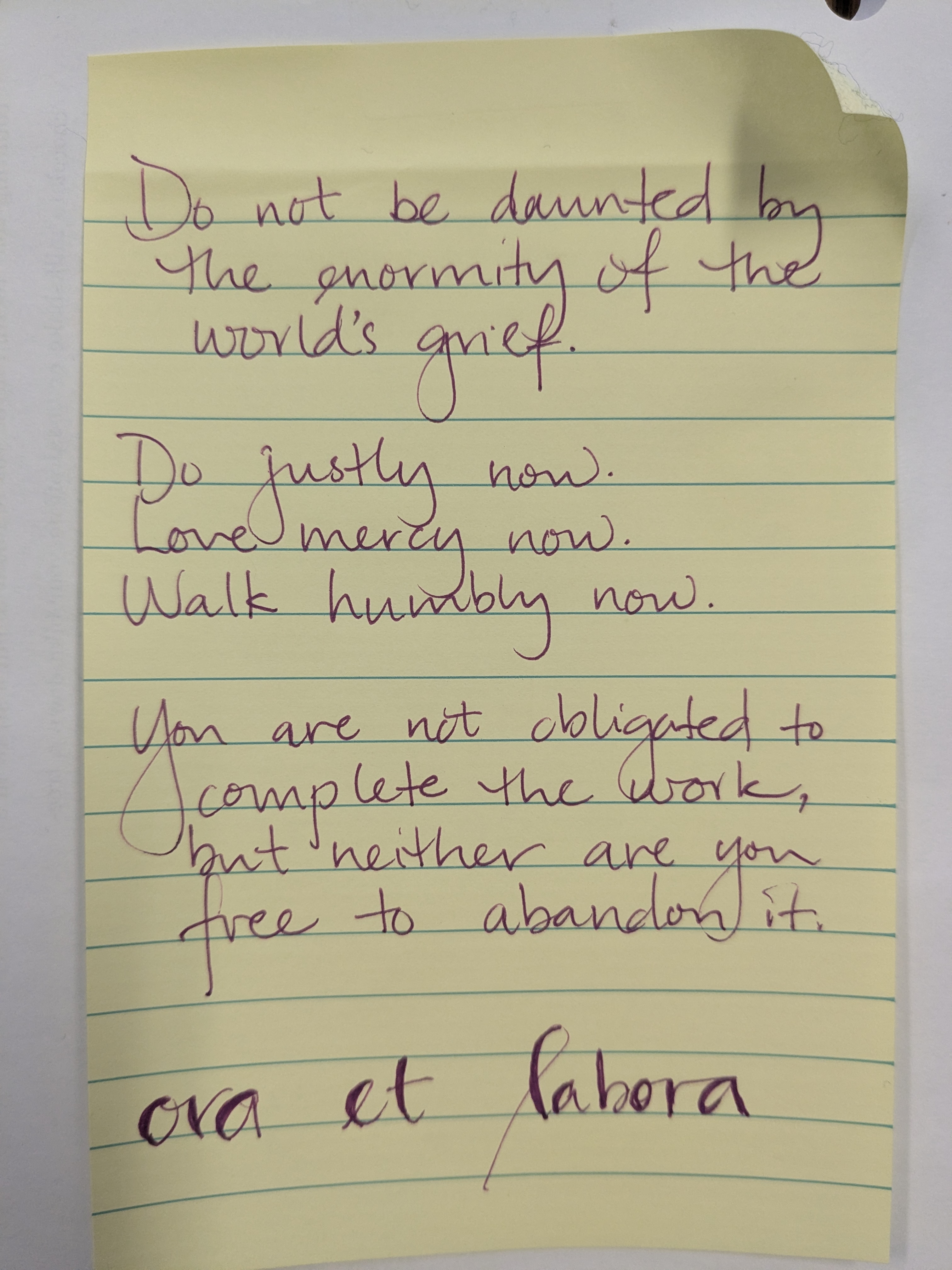
There’s a quote from the Talmud that I write on a sticky note and keep on my computer. It fades, then I copy it every few months to replace it because I need to keep it in front of me. I share it with you as a way to walk into questions with no answers.
Do not be daunted by the enormity of the world’s grief.
Do justly now. Love mercy now. Walk humbly now.
You are not obligated to complete the work, but neither are you free to abandon it.
*Here’s my Spotify and YouTube choral playlists because I’m kind of a junkie that way. And don’t come at me if some of the music doesn’t suit you!
How does God host us? How does God’s woman host? I think about this often and I don’t have all the answers, but I’m sure that part of hospitality involves our own person and how we bring ourselves to the space we’re in. We can be should be hospitable outside our homes and welcome others into our presence in casual, brief interactions, such as with the shelf stocker in the grocery store or the hostess who seats us at a restaurant. People always deserve our respect and love, and presence and conversation is a gift we bring to our world and that’s why I refuse to use an automatic checkout unless someone’s waiting for me. This story of hospitality on a sidewalk happened to me over a year ago and its beauty will always stay with me.
The pair caught my eye as I sat at the table with my friend Melody outside my favorite coffee shop in Pittsburgh. The lady was largely pregnant, in a soft teal green sweater dress stretched over her stomach. Her husband’s hand reached protectively to support her back as she stepped up on the curb then into the cafe. Minutes later, I noticed them leave, coffee cups in hand, walking as if every step was a gift.
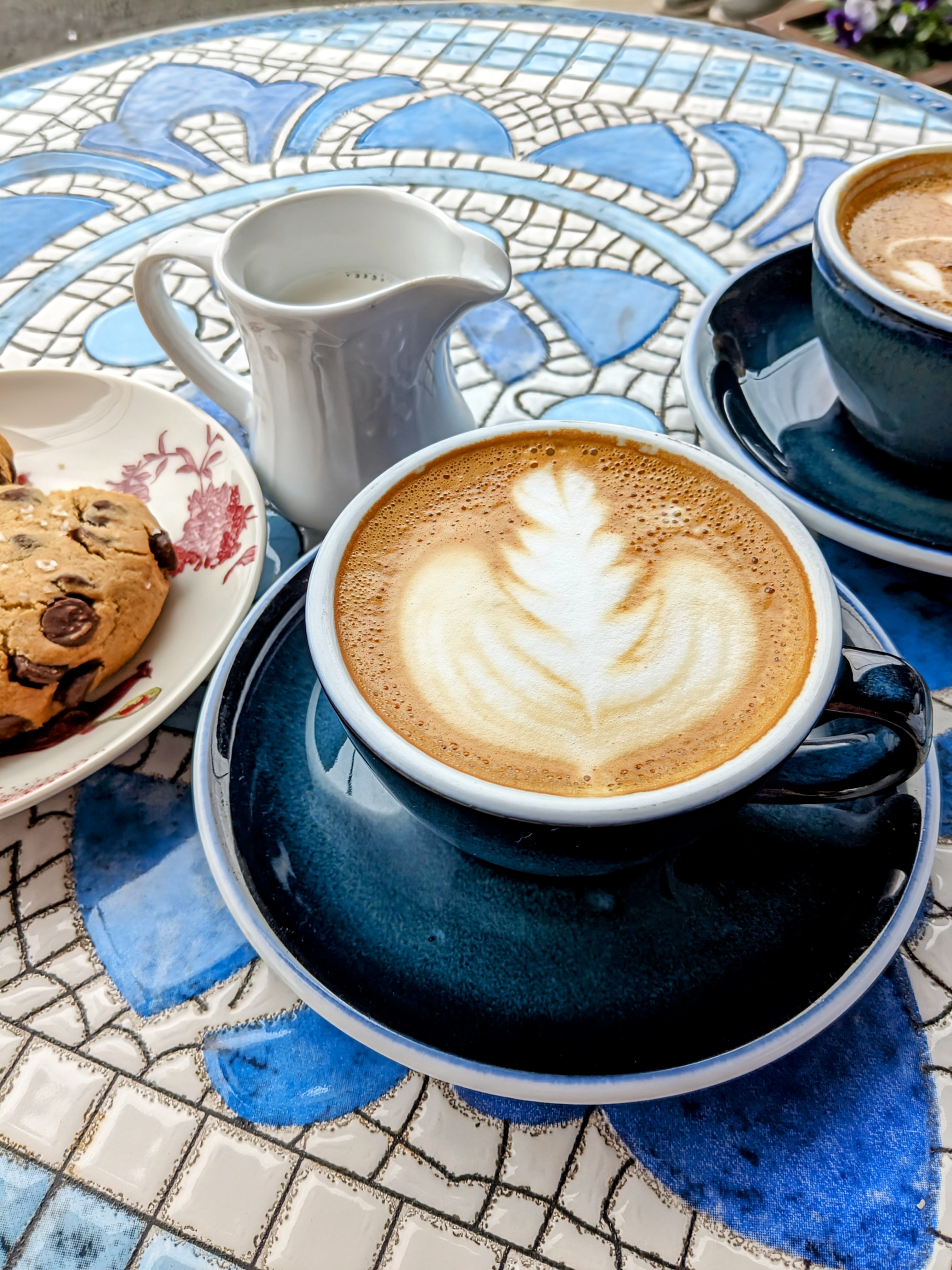
Melody and I finished our gorgeous, rich cortados in gorgeous, bright blue pottery, ambled through a funky, fun doughnut shop (Peace, Love, and Little Donuts!), then around the corner. Ahead of us walked the young couple I’d noticed earlier.
We quickly caught up with them because they were taking their time. I turned my head because I heard Melody say something but she wasn’t talking to me. She’d asked the lady when her baby’s due.
The man and woman stopped as if glad for the break from walking. Their friendly, open faces clearly wanted to exchange more than polite pleasantries. “I’m due on Sunday, Mother’s Day, so we’re just walking to pass the time. Do you ladies have any advice for a first-time mom in labor?”
I’m always surprised when strangers expect me to have a family, but I said nothing and Melody answered as if she was waiting to be asked, her eyes warm: “Well, Jesus endured the cross for the joy that was set before Him. Childbirth is like the cross and its pain, but we endure it for the joy that’s coming.”
The young mother nodded and her husband said, “You’re right. The Gospels talk often about the Christian experience being like childbirth.” He quoted several lines and his wife nodded.
They clearly wanted to talk more, so we introduced ourselves and said where we’re from. They were Catholics from a neighboring town, and they farmed with horses. The four of us stepped to the side so we wouldn’t block the sidewalk. We could’ve talked a long time; they were so engaging and thoughtful, but they needed to keep moving. We wished each other God’s blessings and walked away.
Later, I was curious, so I asked Melody why she referred to Jesus so quickly, before she knew they were believers and would give credence to what she said. “I saw such openness and gentleness in the man’s face, and I felt free in my spirit to quote from Hebrews.”
We wonder where they are now, this couple and their child, and we treasure that conversation on the sidewalk. Poet Danusha Lameris calls these brief moments of exchange “dwelling places of the holy” and “fleeting temples” because for just a few moments on a spring day, we recognized the presence of God on a dirty, common sidewalk. This is what hospitality and welcome can look like as we live with open hands and open faces.
For whatever reason, I don’t love liturgical experiences. I can be ok with liturgy in some contexts, but I usually find it too confining, too structured for my heart to feel at home in.
There. I said an uncool thing.
Even so, I love following the church calendar. Especially I love following the seasons of Advent and Lent. Western Christianity tends toward appearing glossy, smooth, smiley, and satisfied, and it tends to not account for or acknowledge the crazy hard, bewildering, unfair parts of life. It sings “trust and obey, for there’s no other way to be happy in Jesus” but I often wonder–what does ‘happy in Jesus’ even mean?
And if you sing more of that song, you come to “Not a shadow can rise, not a cloud in the skies, but His smile quickly drives it away” and you think, “Well… it’s not always been that quickly for me.” However, sloppy theology in songs is another subject for a braver day.
Advent and Lent give 28-40 long days to sit with the unaskable questions we hold. Advent and Lent let us name our hopes and fears, our anxieties and obsessions, and our longings in a dark season that is aching for the light of Christmas and Easter. These generous weeks in the church calendar give us space to lament–an essential part of the human experience–at least for the human who wants to be whole and healthy.
Lament is not a pity party or a sob story that wallows in misery. Lament is a gutsy wail that says not all is as it should be and I don’t like it and this stinks. People who deserve babies can’t conceive and people who deserve to die keep on living and people who deserve to live suddenly die and none of it’s fair or right or beautiful.
Maybe you thought being happy in Jesus means never saying any of this out loud and especially not to God. But if you can’t name your questions and put words to what feels grossly unfair, what does ‘healthy relationship’ even mean?
The difference between lament and self-pity is that lament turns toward Jesus and self-pity turns inward and spirals down. Lament goes somewhere with its sorrow and it wrestles and groans, sometimes for a very long time. It does not insist on always being polished and presentable and it does not follow a timeline.
But lament is a season, even though it doesn’t listen to any kind of time limit. Christmas and Easter come at the end of that season, and they remind us that it won’t always be winter, barren, dark.
Lament howls around for however long it needs to but because it turns toward Jesus, it finds comfort and soothing–eventually. This is a deep knowing, a solid confidence, a quivering consolation in the person who knows so much about grief that He’s called the “Man of Sorrows.” You can hold that reality close forever, and you have my permission to never sing “happy in Jesus” again.
If we’re honest with ourselves, we’re not always happy, and we are all waiting. We are waiting for many joys that Jesus also longs for. Just because He’s God doesn’t mean He gets what He’s waiting for either.
When Lucy met Mr. Tumnus in Narnia, he told her that it’s always winter and never Christmas. I think about that these days on my walks in the icy cold and I hear a stream trickling under the snow. The sound tells me that Aslan is on the move and Christmas–joy and feasting and merriment–is coming, and I don’t only mean smoked salmon at breakfast and turtle cheesecake for second breakfast.
This last night of Advent, I wish for you bright, shining tomorrows and the dripping of ice even in your lamenting, even in your waiting.
Last week I was walking in the snow with a friend and we were talking about the books we’ll read during Christmas break.
“Remind me of the title of the book you said everyone should read,” she said.
“Well, right now I have two books that I’m saying everyone should read,” I said. “Are you thinking of Relational Spirituality or The Body Teaches the Soul?”
“No—there was one before those.”
I doubled over laughing.
I can’t help that I’m the enthusiast who is sure that of course everyone will love whatever I love. And that means that I make superlative statements sometimes. But yes. I read a lot and because reading time is limited, I work hard to read the best. Which of course means others will want to read them too.
Then I remembered that before the last two books I really loved and enthused about, there was one a month earlier: Knowing and Being Known by Erin Moniz.
About once a year, I hear about a freshly-published book, and I know I need to read it right away and shouldn’t wait until I can buy it cheaply used, which is usually how I buy books. Last year, it was How To Know a Person by David Brooks. This spring Tyler Staton’s A Familiar Stranger was another one that I knew I couldn’t wait until I could buy a used copy.
This makes two new books this year. No—there was also A Teachable Spirit by A. J. Swoboda that also everyone should read, but I digress. Another digression: I sometimes also read old books. On the Incarnation is perfect and lovely for this time of year.
Knowing and Being Known answered the sometimes-whispered, but often-silent questions about loneliness and ache for companionship. Erin speaks from the perspective of working with college students who are navigating relationships and find themselves floundering between their ideals and their gritty, disappointing reality.
She found that behavior modification wasn’t changing students’ lives in the ways they were longing for. She could tell them “Stop dating losers.” But while she could give solid advice, it didn’t address the deeper hunger driving the behavior. So she went on a search to explore the theology of intimacy: what is in the good news of Jesus that meets the universal hunger for intimacy?
Other researchers have identified three essential building blocks for healthy, sustainable relationships:
Self-giving love: reciprocity
Attention/curiosity: orientation toward and seeking the other
Commitment: choosing each other repeatedly; mutuality
Erin expands on these, and then broadens the points and finds them modeled perfectly in the Trinity.
“…the revelation of mutuality and freedom in the Trinity challenges individual, entitled autonomy. The Trinity’s mutual love of Father, Son, and Holy Spirit defines for us the balance of interconnected love and freedom.
That we are hardwired for intimacy harkens back to an origin story of intimacy that yields the eternal goodness, beauty, and abundance that existed before the dawn of time.”
This is the good news of the Gospel: that the magnet of our desire is pulled inexorably toward the north star of God’s love, the model and perfection of intimacy.
And don’t just think we’re talking only about sexual intimacy, although that’s a valid hunger. This north star is much, much wider and deeper than that one level of intimacy, and it is accessible to everyone everywhere. That’s good news!
I love how Erin addresses loneliness. She acknowledges the hard realities of extended singleness but goes on to name a deeper reality: loneliness is part of the human experience. Further, she says, “I do not believe it is loneliness we fear. What we actually fear is the things loneliness reveals….There are other things driving the pain we describe as loneliness.”
I think she’s 200% right. I live alone and I love it most of the time. I’m not usually lonely, but when it does descend at odd times, I subconsciously get very creative at avoiding the discomfort. But even a healthy, life-giving marriage wouldn’t fix that. My married friends tell me this and I believe them.
It takes a ton of courage to sit with the questions that lie beneath loneliness. But when we find that courage and that silence, we discover what is under that angst and what we really believe about ourselves, our future, God, and those we love. If we can learn to steer our magnets toward our true north, many of our questions and longings will order themselves under that star, like iron filings tracing the path between strong magnets.
I’m not saying it as well as Erin does, so get yourself a copy and read it and underline it and discuss it with your friends. I’m not getting paid to promote this. I just want others to discover the richness of a message that has the potential to comfort and coach toward deeper peace and understanding of each other and of God. So go ahead and order a copy for yourself and a friend as a gift to both of you. It could be a great way to start a new year!
My book talks about loneliness too, and has suggestions for when you’re feeling left behind. You can buy it here.
I wrote this poem some time ago, but it works now too, except for the line about summer! I took this snowy picture two days ago and the snow is still falling and it’s beautiful beyond words.
I could write a poem about stopping by the woods on a snowy evening, but Someone much wiser and more profound than I has already written a poem beginning with that line and After I read that I feel that I can never write so sparse and rich so why should I try, But I have words in me that Frost never did, so that gives me permission to try to push out Words, pat them into line, riffle through, discard or choose the precise ones to show, not tell, The mood and texture of the vignette I have in mind And even though it’s not about horse or downy flake (I drive a car, it’s high summer, and I don’t Collect Currier & Ives prints) my soul holds Pictures of thin spaces, moments, sparkles, glistenings, that would be fun to take out of storage, unfold, Hold up to the light, adjust, unwrinkle, because, even though out of sight, they shape me, and maybe They could nudge someone and set the compass for a friend’s reference point of what is Good and beautiful and true since stable compasses are scarce these days and we need them Even though we don’t say it, however insightful we are and however experienced because we are all Mostly shuffling our way toward home, knowing we’re not there yet and it might be Awhile—probably miles to go before we sleep—but we’ll get there someday and meanwhile we hold Each other’s hands to find the path and share the light we see because beauty must be shared, not Hoarded, which has to be why Frost gave us his snapshot of his woods and horse.
My book talks about another kind of walk. It’s a voice to remind you that you’re never actually alone, wherever you’re walking. You can buy it here!
Last week, this post gave the first part of this article on “home.” It introduced the idea that God cares that home creates comfort and safety. One day in chapel this week, we read Psalm 27 and my brain starting pinging when I saw all these words about God’s home: house, temple, dwelling, tabernacle. This concept must be important to God. I wonder how that should inform how we live, how we see the church and individuals?
Rublev’s “Trinity”
Creating welcome for the stranger
In addition to creating comfort and safety, God designed the home to create welcome for the stranger.
The picture of Revelation’s wedding feast shows us a place of welcome, generosity, and abundance. As we reflect God’s character of housekeeping, we can offer His warmth and welcome by embodying hospitality in our physical places. This can reach beyond walls, doors, and a roof.
In Free to be Single, her excellent book now out of print, Elva MacAlister points out that even when I walk across a college campus and fall in step beside a friend, I can welcome them into my space, my personal bubble, and show them hospitality as we walk together. Our personhood, the space we take up on a sidewalk or a car or a park bench, can be a place where we embody welcome, care, and interest in this person at this place and at this time.
God’s spaces reflect His selflessness, His intention toward people, and His deep care for us. We are most like God when we focus on others instead of our default selfishness. This is the biggest part of being hospitable.
Creating our spaces in pressure to compete with the latest influencer or neighbor will drain us instead of help us thrive. On the other hand, creating home as a place to welcome the stranger, which is really anyone, frees us to express our individuality in ways that help our people feel at ease, loved, and refreshed. One homemaker will prioritize plants and toys while another puts her energy into minimalism or coffee, but each can be responding to God’s direction to create order and welcome the stranger.
Home looks different for all of us, depending on our ages, seasons of life, and native abilities. But Christians can always reflect God’s homemaking skills in ways that make order out of chaos and offer life and beauty to people.
Trinity is an old painting by the Russian artist Rublev that moves me deeply. Showing us a peek into God’s character, the medieval painting depicts themes of fellowship, unity, order, and hospitality. Three angels sit around a table at Mamre, while Abram, childless and out of sight, prepares a feast for them. The angels represent the Trinity, a unit of perfect love, fellowship, and safety. They graciously accept Abram’s eager hospitality. Abram, is, after all, reflecting God’s generosity and care, demonstrating what He knows about God’s character.
As homemakers made in God’s beautiful image, we extend, arrange, offer safety, and create homes because we first receive it from God’s heart. Rublev’s Trinity shows how home, fellowship, and hospitality comes full circle: we receive and offer in response, we give out of what God gives us, and we can never out-give God!
Is home a person, feeling, or place?
When I look at the glad fellowship of the Trinity and see how Jesus showed us the Father’s face in a particular time and place in history and geography, my love deepens for the Father, Son, and Holy Spirit, and I discover my true home. In the Trinity’s circle of beauty and truth, home is a person, a feeling, and a place. Because I’m in a body and not only a soul, I learn from God that place, stuff, food, furniture, things I touch, all matters because it matters to Him.
In the trailer we rent, our shared space isn’t trendy or influencer-worthy, but my housemate and I try hard to blend our differing color preferences, use indirect lighting, white walls, original art, and plenty of blankets within reach to make a comfortable space for ourselves and our guests. I like to put tea and scones on the battered coffee table so that people don’t have to move far for it, and they can prop up their feet wherever they’re comfortable. Friends often step from the porch to the living room and sigh “Oh, this looks so warm and cozy” which is exactly what we want them to feel!
Does home matter to God?
God cares deeply about home as a place of safety and welcome.
In a world that’s constantly degenerating into entropy and disorder, God’s people have a high responsibility to bring beauty, order, and welcome wherever we can. Women (and some men!) are especially good at this, regardless of their personalities or Enneagram numbers.
Of all the careers you’ve dreamed of, imagine reflecting God’s character of being a home-maker!
I wrote a book about living well in a place I hadn’t planned to be. Turns out that’s where a lot of us find ourselves. You too? Order your copy here!
Over two years ago, the lovely team at Daughters of Promise asked me to write a thoughtful, theological article on home. It was to explore this question: “Why does home matter in the bigger context of God’s story?” It was a new idea to me, but I quickly got excited as I began to study and ask questions about home. Since then, it has become something I think about often and take notes about and dream of expanding this article to something significantly more substantial. For example, what is special or significant about women in their ability to reflect God’s character as homemaker? And how does mundane, unseen work become meaningful when we think of ourselves as co-creators with God who is in the business of making all things new–pushing back entropy? So many rich questions to untangle! But that will be the work of another several years. For now, here’s the original (slightly polished) article, coming in two parts.
Is home a person, feeling, or place?
As a third-culture kid who feels at home in multiple states and countries, I have wrestled with this conflicted question for years.
If I don’t have a home, does it matter?
Is something important missing from my personhood?
Does God care about home since my homes have been so interchangeable?
I walk in a refugee camp in Greece and saw tents and blankets for houses. Under news headlines, I see photos of tent cities sprout up in Syria after another earthquake. I have suffered nothing like these beautiful people have, but I know the search for home. I’ve wondered if it should matter so much to me, and if home even matters to God because there are a great deal of other big questions that need His attention.
But when I observe people, listen to their stories, read literature, study the Bible, and cringe when people ask me where I’m from, it’s clear: home matters.
The immense disruption, disorientation, and restlessness over the loss of home shows me that home is important, does matter, isn’t a question to hush and try to forget.
Home can be a person or a feeling. But seeing God’s heart in the Biblical stories of Genesis to Revelation, it seems clear that God cares enormously about home as a place.
People and feelings do matter to God, because He says much about how to love Him and our neighbors. But He also holds place as very important, which gives us a way to think about our homes as places that matter to God.
In spiritual matters of the heart, we tend to live in our heads and work hard to think kind and gentle thoughts and nurture loving and patient attitudes. But in physicality, in places, our thoughts become embodied and visible.
For this and many other reasons that I’m still exploring, matter matters.
Bodies matter.
Places matter.
Home matters because God cares about physicality, clay, dust, tangible pieces of His creation. The incarnation of Jesus proves that, in case we doubt whether God values physicality. Jesus’ body, His dusty life as He touched people and got hungry and tired, elevates for us the gritty reality of matter, stuff, tangible pieces of living.
Once when I was reading John 14, I actually gasped when I read verse 23: “We will come to him and make Our home with him.” Jesus is talking about Himself and His Father, and He’s saying they are homemakers!
What kind of home do they make? How do they work together? What does their home look? They’re making their home in me? What does that even mean?
God’s homemaking in me is a spiritual reality with profound significance that ripples into physical reality even when I’m not conscious of it. Further, when I know something about His character and get to know Him as a homemaking person, I can grow in reflecting that part of His character.
Like elegant bookends, the special, prepared places in Genesis and Revelation show us what God thinks about home. And in between those places, we see many ways and times where God valued home as a physical place. He asked Mary to give a home to His Son Jesus, and placed that home first in her womb, then in Nazareth, specific places at specific times. God ends the Biblical timeline with a picture of our eternal home, a place too wondrous to describe, but we know it includes a wedding feast (I think there will be lots of cake!), cultural diversity, a river, and a fruitful tree. All these scenes happen in specific places, not just in our heads.
As I study the Bible and get to know God’s heart, I see His homemaking reveals many things about His character and here are just two:
He creates order and safety
He welcomes the stranger
This concept gives me goosebumps because these characteristics are beautiful and actionable for all of us!
Creating order and safety
God’s design of home holds an atmosphere of safety, rest, and belonging, seen both in Eden and our eternal home. God crafted them as places for fulfillment and fellowship where humans and nature can flourish and expand to their fullest capacity.
Home is a nest that protects fledglings from storms and predators. Home is a fuzzy blanket that wraps children in warmth and keeps out the world’s cold, hard edges. Home is the inviting smell of gingerbread baking. Its physicality engages all our senses and grounds us in this place, right now. Its daily, weekly, annual rhythms shape our neural pathways and linger in our subconscious.
In the absence of safety (wars, famine, abuse, neglect) humans tend to become less-than-ideal versions of who they were intended to be. The loss of home as a place is one reason refugees and natural disaster victims turn to violence and become people they would otherwise not be. In addition to suffering from emotional and spiritual damage, their material losses devastate their lives profoundly because physicality matters. No one just lives in their head.
But in safety and belonging in physical spaces, we flourish because that’s how God designed us. It’s the kind of homemaker He is.
From ages 35 to 41, I lived in five places. In each place, I arranged furniture, organized a kitchen with a housemate, and found a rhythm of keeping order that worked for that season of life. Then I walked away from it, left the stuff behind me (except for a mug or two), and started over in the next place. By the fifth place and the third country in six years, I wanted to think that home and belonging didn’t matter because it was too hard to reckon with all the loss and change I was living in.
But I’ve come to see that those transitions were so shaping and impactful to me precisely because home is so important. I couldn’t brush off the loss of home as if it didn’t matter.
The longing for home and belonging is an ache as deep as time. The loss of home is probably one reason Cain cried when he realized would never belong anywhere and would live in a place that means “wanderer.” We were made for home as a place that provides context for the connections in relationships that make us better people. Even literature knows this. Think about your favorite stories and books and how they center around the search for home and belonging.
The Odessey
Anne of Green Gables
Hannah Coulter
Gilead
News of the World
To be clear: home is not the most defining thing about us, but it IS basic to the need of our flourishing. This need doesn’t require us to live in one place all our lives. But creating home as a safe place to thrive means we can order our present spaces in ways that are restful and calming wherever we are.
When God gave humans dominion over creation, He was letting us be homemakers, designers of places. He was setting us free to innovate, create, and bring order out of the chaos that cascaded out of the fall. He could have regimented every part of keeping the first home, but He didn’t want Adam and Eve to be robots. Every healthy person carries some capacity to create, experiment, and maintain (“dress and keep”) home. As we carry out that work, we become better people ourselves and provide a comfortable, organized environment for others to flourish.
Up next Friday: Home Matters Part II, Creating Welcome for the Stranger
I wrote a book about living well in a place I hadn’t planned to be. Turns out that’s where a lot of us find ourselves. You too? Order your copy here!
When I read Ultra-Processed People, (which every American should read, by the way) I was dismayed to find out that exercise doesn’t automatically burn up the calories I consume. For example, when I eat a Snickers bar then compute how long I need to walk to burn those calories, my walk will benefit me, but not by erasing those yummy junk calories. The math doesn’t math that way, which is deeply disappointing to me and also proves that numbers hate me.
Ultra-Processed People shook me for other reasons too, which I won’t go into here except to say that after you read it, you will often ask yourself as you eat, “Was this food made with love to nourish me or made by a company that wants to make money off me?”
Back to NOT walking off the calories from a Snickers bar: the author says walking has many benefits even if it doesn’t consume the calories I wish it would. Even though I’m mad at numbers, I absolutely agree that walking benefits me in many ways.
When I think back to very dark seasons of distress, I remember that the times I was most calm and at peace were when I walked down the road to the sea or when I went swimming in a cove. Back then, I thought it was the sea that calmed me. But now, connecting the dots in retrospect, I know it was the physical movement of walking or swimming that ultimately regulated me, and my body knew what it needed more than I did. This is the road with the sea at my back:
Years later, when I was new to northwestern Pennsylvania, I was telling a friend how hard it is to survive the long dark winter. (In dramatic moments, I know we have nine months of winter in the year.) She suggested I take 15-20 minutes to walk right after lunch when the sun is at its highest. It was the advice I needed, and it has served me enormously. Most days, I’d invite my co-worker friend across the hall to go with me. Sometimes, when I knew she was having a stressful day, I used stronger language and insisted she walk with me. We’d walk in all weather except rain.
When we were scrambling to begin working from home during COVID, the first thing I put in my schedule was two walks a day: one with my co-worker and one alone. Two daily walks was the best decision I made in that season.
For years, lower back pain bothered me. Sometimes it was better, then worse. One chiropractor said firmly, “You could walk this off.” I was glad to know, and walking regularly is probably why my back doesn’t give me trouble now.
In another difficult, overwhelming season, my doctor (and I) didn’t want to put me on anti-depressants, but she suggested daily walks. I told her I already walk, and she cheered. “And look up as you walk—45 degrees slanted up toward the sky. There’s a reason the good book says to lift your eyes to the hills!” and she swept her arm up from the horizon. I try to remember her advice when I walk. Looking up exposes my eyes to more light and Vitamin D. But I suspect Psalm 121 intended even more than those physical benefits.
I’m the pal who drags her people out for a walk after a meal even in the middle of winter. You don’t feel like going, it’s true, but after approximately five steps, you already feel better. You take longer, deeper breaths, you notice birdsong and the sky even if it’s gray, and when you get back you never wish you’d have stayed inside. Never. For real.
Walking rests my brain. Some of my best ideas come on a walk. It’s probably something about the cross-pattern or rhythmic movement or not needing to concentrate or increased oxygen or change of scenery.
My current walking place is nothing like where I walked in Ireland, and this is sad. But it’s green and has wildflowers in every season and wild apples and white aspens. Sometimes I do a color walk, which gives me new eyes to see the ordinary.
Silence is a practice I stack with walking. In the morning, if I’ve been listening to a podcast or audio book as I fix my bed and pack my bag, I turn off the audio at my door. I step out the door in silence, walk through the morning in silence, walk the scenic route to my office in silence, stop to see the sun and sky and trees in silence. In the evening, I might listen to or send voice messages as I walk, but not more. I need silence to give a chance for some of the open tabs in my brain to close. I need silence for thinking space and for rest. Deep work calls for deep rest, Aundi Colber says, and silence is restful. If it’s not, it’s probably time to sit with it and ask it why.
Because I benefit from the social, emotional, physical, and spiritual results of daily walks, I think everyone else should walk too. If it’s too warm to walk at noon, walk at golden hour when the sun is less direct. Or walk in starlight, which is its own magic and calm and wonder. And if you can’t walk, do stretches. If you can’t stretch, do deep breathing. Or sing. The breathing, rhythm, and focus on something outside yourself will benefit you in surprising ways.
If it doesn’t, come talk to me! You know we’ll go on a walk to figure it out.
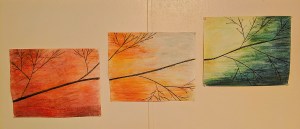
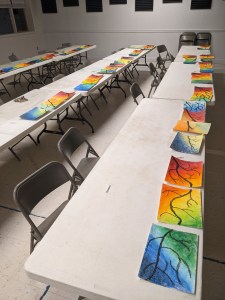
They are mementos of a happy hour of immersive color. I’d pinned the inspiration painting on my “To Paint” Pinterest board and one Sunday afternoon I knew it was time. It was time to play, sketch, blend a branch across three panels.
The backs of old calendar pages gave the size I needed, plus the paper had enough texture to take on my chalk pastels. The technical term is that the paper had tooth but who knows what that means?
The colors morphed, shimmered, stretched across their lines to join each other and the layers became new colors. When I finished, the art looked exactly as I’d hoped–even better–but then, it’s hard to go wrong with chalk pastels, fingers, and a simple black silhouette. I attached the pieces to the ugly orange wall in our sitting room and we loved the tryptic. My finger nailbeds carried the blended colors for days and I didn’t care.
Months later, I packed my Polish life into three suitcases and the colors stayed on the wall because I didn’t think I needed them.
But I missed those colors. So after one year, I asked my housemate to bring them over with her. She carefully wrapped them around a paper towel tube and hand-delivered them to me. The paper was brittle and started to crack when I unrolled them but I was careful. It was so right to see the colors on my wall again!
Now I have them in my studio. They remind me to keep playing, experimenting, trying new compositions and palettes and media. They’re ten years old now. The colors and shades have smudged around the edges but I don’t look too closely. I used them once in art class for 5th and 6th graders who also went home with colors under their fingernails.
Maybe that’s the highest use of art–to be a presence that invites play, reflects color and shape, and offers a sense of home. From the old country to the new and now familiar, we have crossed miles and seen many seasons but some things never change.
This poem came out of a prompt in the writers’ circle I’m part of, led by Rachel Devenish Ford.
I bring whimsy and laughter and hugs—
Here, have one!
Today’s too beautiful for dour, dry words and
We are delighting in spring’s light shining in eyes and
Music sparkling from fingers,
Colors spilling from dresses that drape and swoosh
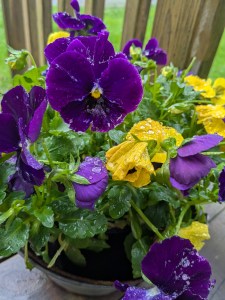
Like pansy petals.
I bring cake and songs and glitter pens for everyone.
I bring questions and ache—
Here, take it—it’s heavy.
Today’s too sad for songs and
Questions rumble over trite answers and
Scattered bits of blue eggs dry in their yolks on the ground and
A storm blows disarray over the whole globe,
Smashing like feral bulls seeing red, pawing after power.
What I asked for didn’t come. What I hoped became impossible.
Celebration and sorrow.
I bring both today.
I wrote a book about living well in a place I hadn’t planned to be. It explores the curious mix of holding both joy and sorrow at the same time. You can order your copy here!


 Tis a Gift to Receive